📖Topic Explanations

🌐 Overview
Hello students! Welcome to Dimensional Analysis and Applications! Prepare to unlock a simple yet incredibly powerful tool that will sharpen your understanding of every physical concept you encounter and become your secret weapon for problem-solving.

Imagine being able to spot an error in a complex physics equation just by looking at the units, or even predict the approximate form of a physical law without knowing all the intricate details! Sounds like magic? It's not! It's the elegance and brilliance of dimensional analysis, a fundamental concept that empowers you to reason about the physical world with remarkable clarity.

At its core, Dimensional Analysis is about understanding the fundamental nature of physical quantities. Every measurement we make – be it length, mass, time, or derived quantities like force, energy, or power – has a specific 'dimension'. This topic teaches us how to systematically analyze these dimensions to gain profound insights into physical laws and relationships, ensuring consistency across the vast landscape of physics.

This isn't just an abstract concept; it's a practical superhero in your physics journey. For your Board Exams, mastering dimensional analysis forms the bedrock for understanding units, checking the validity of formulas, and performing unit conversions effortlessly. For JEE Main and other competitive exams, it's a consistent source of relatively easy and high-scoring questions. It empowers you to quickly verify options in multiple-choice questions, eliminate incorrect formulas, and even approximate relationships between physical quantities when you might not recall the exact derivation.

In this section, we will embark on a fascinating journey to explore:

  • What are dimensions and units, and how they differ?

  • How to systematically determine the dimensions of various fundamental and derived physical quantities.

  • The cornerstone of this topic: the powerful Principle of Homogeneity of Dimensions, which states that only quantities with the same dimensions can be added, subtracted, or equated.

  • Practical applications, including how to:

    • Check the dimensional correctness of a physical equation – a rapid fire check for your solutions!

    • Efficiently convert units from one system to another (e.g., CGS to SI) with precision.

    • Even derive approximate relationships between physical quantities, given the factors they depend upon, making complex derivations seem approachable.


It's like having a universal 'sanity check' for all your physics calculations and a smart shortcut for formula recall. No more guessing if your formula for kinetic energy is 1/2 mv or 1/2 mv² – dimensional analysis will tell you instantly which one is dimensionally consistent!

So, get ready to master this elegant, indispensable, and incredibly useful tool. Let's explore the world where units speak volumes and dimensions unravel mysteries, giving you a deeper appreciation for the structured beauty of physics!
📚 Fundamentals
Hello future physicists! Welcome to a foundational topic that's incredibly powerful and surprisingly elegant: Dimensional Analysis and its Applications. Think of this as your secret weapon to check formulas, derive relationships, and even convert units, all by just looking at the 'makeup' of physical quantities.

We're going to start from scratch, build our understanding step-by-step, and see how this seemingly simple concept becomes an indispensable tool for both your board exams and competitive exams like JEE.

---

### What are Dimensions in Physics? (Not what you think!)

When we talk about "dimensions" in physics, we're not talking about length, width, and height in the geometric sense. Instead, we're referring to the fundamental nature of a physical quantity, irrespective of the system of units used to measure it.

Every physical quantity, whether fundamental or derived, can be expressed in terms of combinations of the seven fundamental (or base) quantities. Do you remember them?

1. Mass [M]
2. Length [L]
3. Time [T]
4. Electric Current [A]
5. Thermodynamic Temperature [K]
6. Amount of Substance [mol]
7. Luminous Intensity [cd]

The square brackets `[ ]` around these symbols (e.g., `[M]`, `[L]`, `[T]`) signify that we are talking about the dimensions of the quantity. Most of the time, especially in mechanics, we'll primarily deal with Mass, Length, and Time.

For example, whether you measure length in meters, feet, or inches, it's still fundamentally a 'length'. Its dimension is `[L]`. Similarly, mass is `[M]`, and time is `[T]`.

---

### Deriving Dimensional Formulas for Derived Quantities

A dimensional formula is an expression that shows how and which of the fundamental quantities are involved in a derived quantity. Let's see how we can find them for some common quantities.

The trick is to always remember the defining formula of the quantity.


  1. Area:


    We know, Area = Length × Breadth.


    Since both length and breadth are fundamentally 'lengths', their dimensions are [L].


    So, Dimensions of Area = [L] × [L] = [L2].


    Often, we express dimensions in terms of M, L, T, even if M and T are not present. So, Area can be written as [M0L2T0].


  2. Volume:


    Volume = Length × Breadth × Height.


    Dimensions of Volume = [L] × [L] × [L] = [L3] or [M0L3T0].


  3. Speed/Velocity:


    Speed = Distance / Time.


    Dimensions of Speed = [L] / [T] = [LT-1] or [M0LT-1].


    Analogy: Think about how you calculate speed - meters per second. Meters is a unit of length, seconds is a unit of time. So, Length/Time.


  4. Acceleration:


    Acceleration = Change in Velocity / Time.


    Dimensions of Acceleration = [LT-1] / [T] = [LT-2] or [M0LT-2].


  5. Force:


    From Newton's Second Law, Force (F) = Mass (m) × Acceleration (a).


    Dimensions of Force = [M] × [LT-2] = [MLT-2].


    This is a very important one! Memorize it, or be able to derive it quickly.


  6. Work/Energy:


    Work (W) = Force (F) × Displacement (s).


    Dimensions of Work = [MLT-2] × [L] = [ML2T-2].


    Remember, all forms of energy (kinetic, potential, heat, etc.) have the same dimensions as Work. This is a common trap in JEE - checking if you know quantities with same dimensions.


  7. Power:


    Power (P) = Work (W) / Time (t).


    Dimensions of Power = [ML2T-2] / [T] = [ML2T-3].


  8. Pressure:


    Pressure (P) = Force (F) / Area (A).


    Dimensions of Pressure = [MLT-2] / [L2] = [ML-1T-2].


JEE Tip: Mastering dimensional formulas is crucial. Practice deriving them for various quantities. You might encounter quantities from different branches of physics (electricity, magnetism, optics) – always go back to their defining equations!

---

### What is Dimensional Analysis?

Dimensional analysis is a powerful tool based on the idea that physical equations must be consistent in terms of their dimensions. It's like a quality control check for equations!

The core principle behind dimensional analysis is the Principle of Homogeneity of Dimensions.

#### Principle of Homogeneity of Dimensions

This principle states that:
"An equation is dimensionally correct only if the dimensions of the terms on both sides of the equation are the same. Furthermore, only physical quantities having the same dimensions can be added or subtracted."

* You can add apples to apples, oranges to oranges, but not apples to oranges.
* Similarly, you can add a length to a length (e.g., `5m + 2m = 7m`), but you cannot add a length to a time (`5m + 2s` doesn't make sense physically).
* If you have an equation like `A + B = C`, then the dimensions of A, B, and C must all be identical.

---

### Applications of Dimensional Analysis

Let's explore the powerful applications of this principle.

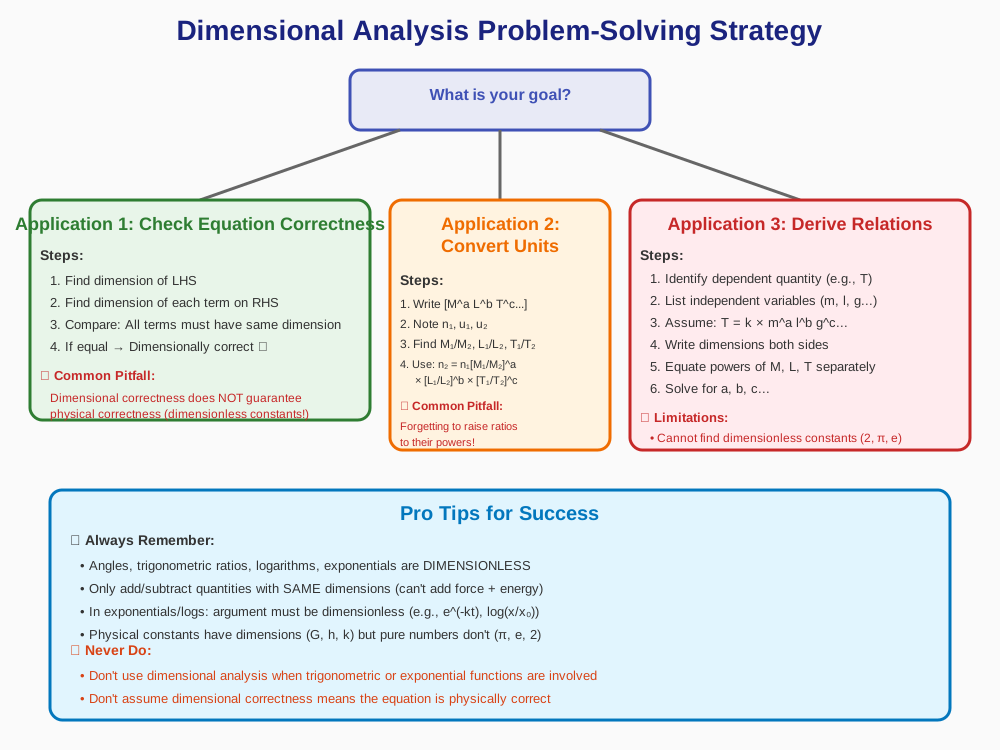
#### 1. Checking the Dimensional Consistency (Correctness) of an Equation

This is the most straightforward application. If an equation claims to represent a physical phenomenon, it *must* be dimensionally correct.

Example 1: Check the equation of motion: `v = u + at`

Here, `v` = final velocity, `u` = initial velocity, `a` = acceleration, `t` = time.

* Dimensions of LHS (v): `[LT-1]` (Velocity)
* Dimensions of RHS (u): `[LT-1]` (Velocity)
* Dimensions of RHS (at):
* Dimensions of `a` = `[LT-2]`
* Dimensions of `t` = `[T]`
* Dimensions of `at` = `[LT-2] × [T]` = `[LT-1]`

Since the dimensions of `v`, `u`, and `at` are all `[LT-1]`, the equation `v = u + at` is dimensionally consistent.

Example 2: Check the equation `E = mc2` (Einstein's Mass-Energy Equivalence)

Here, `E` = Energy, `m` = mass, `c` = speed of light.

* Dimensions of LHS (E): `[ML2T-2]` (Energy, same as Work)
* Dimensions of RHS (mc2):
* Dimensions of `m` = `[M]`
* Dimensions of `c` = `[LT-1]` (Speed)
* Dimensions of `c2` = `([LT-1])2` = `[L2T-2]`
* Dimensions of `mc2` = `[M] × [L2T-2]` = `[ML2T-2]`

Since the dimensions of LHS and RHS are identical, the equation `E = mc2` is dimensionally consistent.

Important Caution (for CBSE & JEE):
A dimensionally consistent equation is not necessarily physically correct. For instance, `s = ut + (1/3)at2` is dimensionally correct (try it!), but physically, the constant should be `1/2`.
However, a dimensionally inconsistent equation is definitely physically incorrect. This means if the dimensions don't match, you know the formula is wrong!

#### 2. Deriving Relations between Physical Quantities

This is where dimensional analysis truly shines as a derivation tool, especially in situations where you know what factors a quantity depends on, but not the exact formula.

Method:
1. Assume the physical quantity depends on other quantities raised to some powers.
2. Write down the dimensional formula for each quantity.
3. Equate the dimensions on both sides of the assumed relation.
4. Solve the resulting system of linear equations for the unknown powers.
5. Introduce a dimensionless constant (which dimensional analysis cannot determine).

Example: Derive the formula for the time period (T) of a simple pendulum.

Let's assume the time period `T` depends on:
* Mass of the bob (`m`)
* Length of the pendulum (`l`)
* Acceleration due to gravity (`g`)

So, we can write: `T ∝ ma lb gc`
Or, `T = K ma lb gc`, where `K` is a dimensionless constant.

Now, let's write down the dimensions for each term:
* Dimensions of `T` = `[T]`
* Dimensions of `m` = `[M]`
* Dimensions of `l` = `[L]`
* Dimensions of `g` = `[LT-2]` (acceleration)

Substitute these into our assumed equation:
`[M0L0T1] = [M]a [L]b [LT-2]c`
`[M0L0T1] = [Ma] [Lb] [LcT-2c]`
`[M0L0T1] = [Ma L(b+c) T-2c]`

Now, equate the powers of M, L, and T on both sides:
* For M: `a = 0`
* For L: `b + c = 0`
* For T: `-2c = 1`

Solving these equations:
1. `a = 0`
2. From `-2c = 1`, we get `c = -1/2`
3. From `b + c = 0`, we get `b = -c = -(-1/2) = 1/2`

So, the powers are `a=0`, `b=1/2`, `c=-1/2`.
Substitute these back into our assumed relation:
`T = K m0 l1/2 g-1/2`
`T = K (l1/2 / g1/2)`
`T = K √(l/g)`

From experiments, the value of `K` for a simple pendulum is `2π`.
So, the final formula is `T = 2π√(l/g)`.
This matches the actual formula for a simple pendulum's time period!

Limitation (for JEE Advanced):
This method cannot determine the value of the dimensionless constant `K`. Also, it fails if the quantity depends on more than three fundamental quantities (like M, L, T), because we only have three equations to solve for the powers. Furthermore, it cannot derive equations involving trigonometric, exponential, or logarithmic functions (e.g., `sin(θ)`, `e^(kt)`), as these functions are dimensionless.

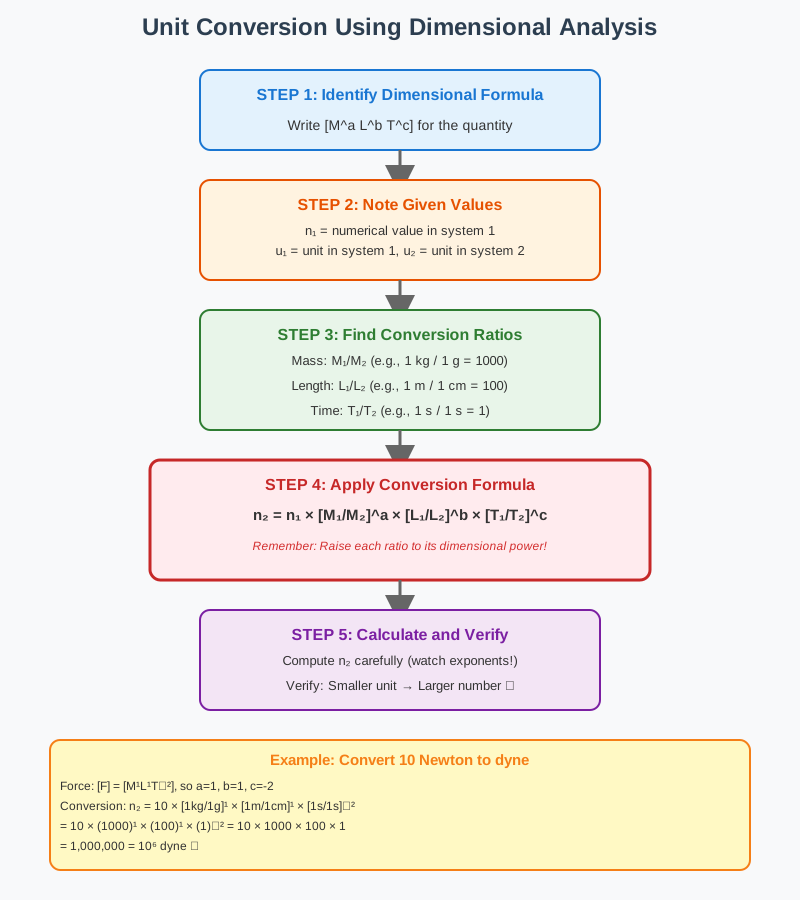
#### 3. Converting Units from One System to Another

Dimensional analysis provides a systematic way to convert a physical quantity from one system of units to another.

The principle here is that the magnitude of a physical quantity remains the same, irrespective of the system of units used.
If `n1` is the numerical value and `[U1]` is the unit in one system, and `n2` and `[U2]` are the corresponding values in another system, then:
`n1[U1] = n2[U2]`

Let the dimensions of the quantity be `[MaLbTc]`.
Then, `[U1] = [M1a L1b T1c]` and `[U2] = [M2a L2b T2c]`.

So, `n1 [M1a L1b T1c] = n2 [M2a L2b T2c]`
This gives us:
`n2 = n1 [ (M1/M2)a (L1/L2)b (T1/T2)c ]`

Example: Convert 1 Joule (SI unit of Energy) into ergs (CGS unit of Energy).

* Step 1: Write the dimensional formula for Energy.
Dimensions of Energy = `[ML2T-2]`
So, `a=1`, `b=2`, `c=-2`.

* Step 2: Identify the two systems of units.
* System 1 (SI): `M1 = 1 kg`, `L1 = 1 m`, `T1 = 1 s`. Numerical value `n1 = 1`.
* System 2 (CGS): `M2 = 1 g`, `L2 = 1 cm`, `T2 = 1 s`. Numerical value `n2` is what we need to find.

* Step 3: Apply the conversion formula.
`n2 = n1 [ (M1/M2)a (L1/L2)b (T1/T2)c ]`
`n2 = 1 × [ (1 kg / 1 g)1 (1 m / 1 cm)2 (1 s / 1 s)-2 ]`

* Step 4: Convert units within the brackets to be consistent.
`1 kg = 1000 g`
`1 m = 100 cm`
`n2 = 1 × [ (1000 g / 1 g)1 (100 cm / 1 cm)2 (1 s / 1 s)-2 ]`
`n2 = 1 × [ (1000)1 (100)2 (1)-2 ]`
`n2 = 1 × [ 103 × (102)2 × 1 ]`
`n2 = 1 × [ 103 × 104 ]`
`n2 = 107`

Therefore, `1 Joule = 107 ergs`.

---

### Key Takeaways and Limitations of Dimensional Analysis (JEE Focus)

* Dimensional homogeneity is paramount: Every term added or subtracted in an equation must have the same dimensions.
* Dimensional correctness is necessary, but not sufficient: An equation must be dimensionally correct to be physically correct, but dimensional correctness alone doesn't guarantee physical correctness (e.g., constants might be wrong).
* Cannot determine dimensionless constants: Like the `2π` in the pendulum formula.
* Cannot handle certain functions: Equations involving trigonometric, exponential, or logarithmic functions cannot be directly derived or fully checked, as these functions themselves are dimensionless and their arguments must also be dimensionless.
* Limitations on the number of dependent variables: If a physical quantity depends on more than three fundamental quantities, this method can become complex or fail (since we typically use M, L, T as our primary base dimensions, giving only three independent equations for the powers).
* Cannot distinguish quantities with same dimensions: For example, Work, Energy, and Torque all have dimensions `[ML2T-2]`. Dimensional analysis cannot tell them apart.

Dimensional analysis is a fantastic first step in understanding and verifying physical relationships. It gives you a powerful sanity check and a method to infer formulas. Master it, and you'll have a strong conceptual foundation for much of physics!
🔬 Deep Dive
Alright, aspiring physicists and future engineers! Welcome to a crucial deep dive into a powerful tool in physics: Dimensional Analysis. This technique is like a secret weapon that allows us to check our equations, derive relationships, and even convert units, all by just looking at the fundamental building blocks of physical quantities – their dimensions. Get ready to build a strong conceptual foundation that will serve you well in both your CBSE exams and the challenging JEE.

---

### Understanding Dimensions: The ABCs of Physics Quantities

Before we dive into dimensional analysis, let's first understand what 'dimensions' truly mean in physics.

Every physical quantity, whether it's length, time, mass, or something more complex like energy or force, can be expressed in terms of certain fundamental or base quantities. In the SI system, we primarily use seven such base quantities:

1. Mass (M)
2. Length (L)
3. Time (T)
4. Electric Current (A)
5. Temperature (K)
6. Amount of Substance (mol)
7. Luminous Intensity (cd)

When we talk about the dimension of a physical quantity, we are referring to the *powers to which these fundamental quantities must be raised* to represent that quantity. It's like writing a formula using only the base quantities.


Key Distinction: Don't confuse dimensions with units!


  • Dimensions tell you the fundamental nature of a quantity (e.g., Length is [L]).

  • Units are specific standards for measuring that quantity (e.g., meter, foot, centimeter are units of Length).


For example:
* The dimension of Length is simply [L].
* The dimension of Mass is [M].
* The dimension of Time is [T].

Now, let's consider a derived quantity like Speed. Speed is defined as distance divided by time.
* Distance has dimension [L].
* Time has dimension [T].
* So, the dimension of Speed = [L]/[T] = [LT⁻¹].

This expression, [LT⁻¹], is called the dimensional formula of speed. A dimensional equation is then an equation that relates a physical quantity to its dimensional formula. For example, `[Speed] = [LT⁻¹]`.


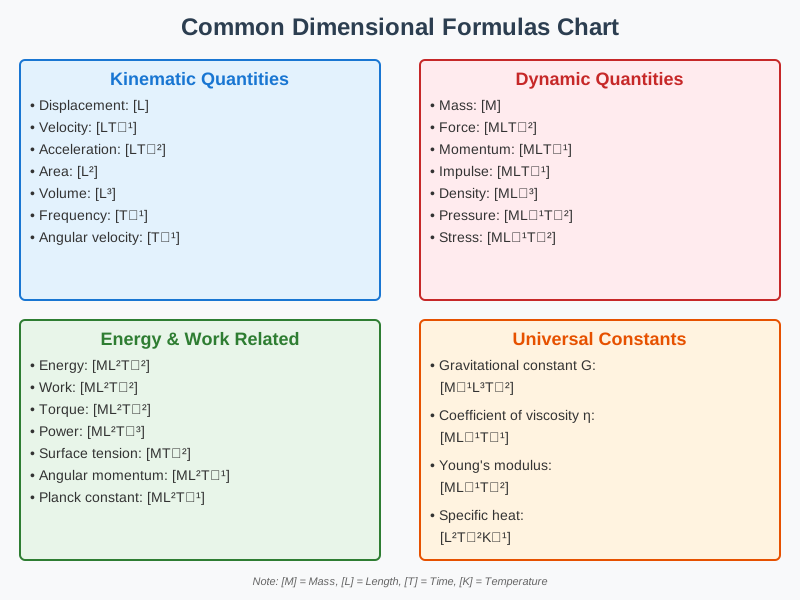
Physical Quantity Formula Dimensional Formula
Area Length × Breadth [L²]
Volume Length × Breadth × Height [L³]
Density Mass / Volume [ML⁻³]
Acceleration Change in Velocity / Time [LT⁻²]
Force Mass × Acceleration [MLT⁻²]
Work / Energy Force × Distance [ML²T⁻²]
Power Work / Time [ML²T⁻³]
Pressure / Stress Force / Area [ML⁻¹T⁻²]
Momentum Mass × Velocity [MLT⁻¹]
Impulse Force × Time [MLT⁻¹]
Frequency 1 / Time Period [T⁻¹]


---

### The Principle of Homogeneity of Dimensions

This is the cornerstone of dimensional analysis. It states:


Principle of Homogeneity: An equation is dimensionally correct if the dimensions of the terms on both sides of the equation are the same. Furthermore, only physical quantities having the same dimensions can be added to or subtracted from each other.


Think of it this way: You can add 5 kilograms of apples to 3 kilograms of oranges, resulting in 8 kilograms of fruit. Here, 'kilograms' (mass) is the common dimension. But you cannot add 5 kilograms of apples to 3 meters of cloth; the result makes no physical sense. Similarly, if an equation says $A = B + C$, then the dimensions of A, B, and C must all be identical.

This principle is incredibly powerful because it gives us a direct way to check the validity of equations or derive relationships.

---

### Applications of Dimensional Analysis

Let's explore the practical applications of this principle.

#### Application 1: Checking the Dimensional Correctness of an Equation

This is the most straightforward application. If an equation is physically correct, it *must* be dimensionally correct. If it's not dimensionally correct, it's definitely wrong!

Method:
1. Write down the dimensional formula for each term in the equation.
2. For terms added or subtracted, ensure they have identical dimensions.
3. Check if the dimensions of the Left Hand Side (LHS) match the dimensions of the Right Hand Side (RHS).

Example 1: Check the dimensional correctness of the equation of motion: $v = u + at$

* LHS: $v$ (final velocity)
* Dimension of velocity: [LT⁻¹]

* RHS: $u$ (initial velocity) + $at$ (acceleration × time)
* Dimension of $u$: [LT⁻¹]
* Dimension of $a$: [LT⁻²]
* Dimension of $t$: [T]
* Dimension of $at$: [LT⁻²] × [T] = [LT⁻¹]

Since the dimensions of $u$ ([LT⁻¹]) and $at$ ([LT⁻¹]) are the same, they can be added.
The dimension of the entire RHS is also [LT⁻¹].

* Conclusion: LHS dimensions ([LT⁻¹]) = RHS dimensions ([LT⁻¹]).
Therefore, the equation $v = u + at$ is dimensionally correct.

Example 2: Check the dimensional correctness of kinetic energy formula: $E_k = frac{1}{2}mv^2$

* LHS: $E_k$ (kinetic energy)
* Dimension of energy (Work = Force × Distance = [MLT⁻²] × [L]): [ML²T⁻²]

* RHS: $frac{1}{2}mv^2$
* The numerical factor $frac{1}{2}$ is dimensionless.
* Dimension of $m$: [M]
* Dimension of $v$: [LT⁻¹]
* Dimension of $v^2$: ([LT⁻¹])² = [L²T⁻²]
* Dimension of $mv^2$: [M] × [L²T⁻²] = [ML²T⁻²]

* Conclusion: LHS dimensions ([ML²T⁻²]) = RHS dimensions ([ML²T⁻²]).
Therefore, the equation $E_k = frac{1}{2}mv^2$ is dimensionally correct.


JEE Focus Alert!


  • Being dimensionally correct does NOT guarantee physical correctness. For instance, $E_k = mv^2$ is also dimensionally correct, but the constant $frac{1}{2}$ is missing, making it physically wrong. Dimensional analysis cannot determine numerical constants.

  • Be careful with terms that involve different dimensions. If you see $A = B + C$ where dimensions of B and C are different, the equation is immediately wrong!


#### Application 2: Deriving Relations between Physical Quantities

This is one of the most exciting applications! If we know the physical quantities on which a certain phenomenon depends, dimensional analysis can help us derive the relationship between them, up to a dimensionless constant.

Method:
1. Identify the physical quantity whose formula you want to derive (let's call it P).
2. List all the physical quantities on which P is supposed to depend (say, Q, R, S).
3. Assume the dependence is in a product form: $P = k cdot Q^a cdot R^b cdot S^c$, where 'k' is a dimensionless constant and a, b, c are the powers we need to find.
4. Write down the dimensional formulas for P, Q, R, S.
5. Equate the dimensions on both sides of the assumed equation.
6. Compare the powers of M, L, T (and other base quantities) on both sides to form a system of linear equations.
7. Solve the equations to find the values of a, b, c.
8. Substitute these values back into the assumed equation.

Example 1: Derive the formula for the time period (T) of a simple pendulum.
Assume the time period (T) depends on:
* Mass of the bob ($m$)
* Length of the pendulum ($l$)
* Acceleration due to gravity ($g$)

1. Assumed relation: $T = k cdot m^a cdot l^b cdot g^c$ (where k is a dimensionless constant)

2. Dimensional formulas:
* [T] = [T¹] (LHS)
* [m] = [M¹]
* [l] = [L¹]
* [g] = [LT⁻²] (acceleration)

3. Equating dimensions:
[T¹] = [M]^a [L]^b [LT⁻²]^c
[M⁰L⁰T¹] = [M^a L^b L^c T⁻²c]
[M⁰L⁰T¹] = [M^a L^(b+c) T^(-2c)]

4. Comparing powers of M, L, T on both sides:
* For M: $a = 0$
* For L: $b + c = 0$
* For T: $-2c = 1 implies c = -frac{1}{2}$

5. Solving for a, b, c:
* $a = 0$
* $c = -frac{1}{2}$
* $b + (-frac{1}{2}) = 0 implies b = frac{1}{2}$

6. Substitute back into the assumed relation:
$T = k cdot m^0 cdot l^{1/2} cdot g^{-1/2}$
$T = k cdot sqrt{l} cdot frac{1}{sqrt{g}}$
$T = k sqrt{frac{l}{g}}$

From experiments (or advanced physics), we know $k = 2pi$. So, $T = 2pi sqrt{frac{l}{g}}$.
Dimensional analysis gives us the correct functional dependence but not the numerical constant.

Example 2: The velocity (v) of transverse waves in a string depends on the tension (F) in the string and its mass per unit length ($mu$). Derive the expression for v.

1. Assumed relation: $v = k cdot F^a cdot mu^b$

2. Dimensional formulas:
* [v] = [LT⁻¹]
* [F] = [MLT⁻²] (Tension is a type of force)
* [$mu$] = [ML⁻¹] (Mass per unit length)

3. Equating dimensions:
[LT⁻¹] = [MLT⁻²]^a [ML⁻¹]^b
[M⁰L¹T⁻¹] = [M^a L^a T⁻²a] [M^b L⁻^b]
[M⁰L¹T⁻¹] = [M^(a+b) L^(a-b) T^(-2a)]

4. Comparing powers:
* For M: $a + b = 0 implies b = -a$
* For L: $a - b = 1$
* For T: $-2a = -1 implies a = frac{1}{2}$

5. Solving for a, b:
* $a = frac{1}{2}$
* $b = -a = -frac{1}{2}$

6. Substitute back:
$v = k cdot F^{1/2} cdot mu^{-1/2}$
$v = k sqrt{frac{F}{mu}}$

(Experimentally, for transverse waves on a string, $k=1$).


CBSE Focus: These derivation types are very common in board exams. Practice them thoroughly to score well.


JEE Focus: Sometimes, problems might involve more than 3 variables, or quantities whose dimensions are not immediately obvious. Always break down complex quantities to M, L, T, A, K.


#### Application 3: Converting Units from One System to Another

Dimensional analysis provides a systematic way to convert the numerical value of a physical quantity from one system of units to another.

The core idea is that the actual magnitude of a physical quantity remains the same, regardless of the system of units used.
So, if $n_1$ is the numerical value in unit system 1 ($U_1$) and $n_2$ is the numerical value in unit system 2 ($U_2$), then:
$n_1 U_1 = n_2 U_2$

If the dimensional formula of a quantity is [M$^a$ L$^b$ T$^c$], then:
$U_1 = [M_1^a L_1^b T_1^c]$ and $U_2 = [M_2^a L_2^b T_2^c]$

So, $n_1 [M_1^a L_1^b T_1^c] = n_2 [M_2^a L_2^b T_2^c]$
This gives:
$n_2 = n_1 left( frac{M_1}{M_2}
ight)^a left( frac{L_1}{L_2}
ight)^b left( frac{T_1}{T_2}
ight)^c$

Example 1: Convert 1 Joule (J) into ergs.

* Joule is the SI unit of Work/Energy. Erg is the CGS unit of Work/Energy.
* Dimensional formula of Work/Energy: [ML²T⁻²] (so, a=1, b=2, c=-2)
* Given: $n_1 = 1$ Joule. We need to find $n_2$ in ergs.

* System 1 (SI):
* $M_1 = 1 ext{ kg}$
* $L_1 = 1 ext{ m}$
* $T_1 = 1 ext{ s}$

* System 2 (CGS):
* $M_2 = 1 ext{ g}$
* $L_2 = 1 ext{ cm}$
* $T_2 = 1 ext{ s}$

Now, substitute into the formula:
$n_2 = n_1 left( frac{M_1}{M_2}
ight)^a left( frac{L_1}{L_2}
ight)^b left( frac{T_1}{T_2}
ight)^c$
$n_2 = 1 left( frac{1 ext{ kg}}{1 ext{ g}}
ight)^1 left( frac{1 ext{ m}}{1 ext{ cm}}
ight)^2 left( frac{1 ext{ s}}{1 ext{ s}}
ight)^{-2}$

Convert units to a common base (e.g., grams and cm):
$n_2 = 1 left( frac{1000 ext{ g}}{1 ext{ g}}
ight)^1 left( frac{100 ext{ cm}}{1 ext{ cm}}
ight)^2 left( 1
ight)^{-2}$
$n_2 = 1 left( 1000
ight) left( 100^2
ight) left( 1
ight)$
$n_2 = 1000 imes 10000 = 10^3 imes 10^4 = 10^7$

So, $1 ext{ Joule} = 10^7 ext{ ergs}$.

Example 2: Convert 1 Newton (N) into dynes.

* Newton is the SI unit of Force. Dyne is the CGS unit of Force.
* Dimensional formula of Force: [MLT⁻²] (so, a=1, b=1, c=-2)
* Given: $n_1 = 1 ext{ N}$. We need to find $n_2$ in dynes.

* System 1 (SI): $M_1 = 1 ext{ kg}$, $L_1 = 1 ext{ m}$, $T_1 = 1 ext{ s}$
* System 2 (CGS): $M_2 = 1 ext{ g}$, $L_2 = 1 ext{ cm}$, $T_2 = 1 ext{ s}$

$n_2 = n_1 left( frac{M_1}{M_2}
ight)^1 left( frac{L_1}{L_2}
ight)^1 left( frac{T_1}{T_2}
ight)^{-2}$
$n_2 = 1 left( frac{1 ext{ kg}}{1 ext{ g}}
ight)^1 left( frac{1 ext{ m}}{1 ext{ cm}}
ight)^1 left( frac{1 ext{ s}}{1 ext{ s}}
ight)^{-2}$
$n_2 = 1 left( frac{1000 ext{ g}}{1 ext{ g}}
ight) left( frac{100 ext{ cm}}{1 ext{ cm}}
ight) left( 1
ight)$
$n_2 = 1000 imes 100 = 10^5$

So, $1 ext{ Newton} = 10^5 ext{ dynes}$.

---

### Limitations of Dimensional Analysis

While powerful, dimensional analysis has its limitations:

1. Cannot determine dimensionless constants: It cannot give us the value of dimensionless constants like $k$, $pi$, $2pi$, $1/2$, etc. (e.g., in $T = 2pisqrt{l/g}$ or $E_k = 1/2 mv^2$).
2. Cannot deal with trigonometric, logarithmic, or exponential functions: These functions are themselves dimensionless, and their arguments must also be dimensionless. For example, in $y = A sin(omega t)$, the term $omega t$ must be dimensionless, which dimensional analysis can verify, but it can't derive the sine function itself.
3. Cannot derive relations involving addition or subtraction of quantities with different powers of dimensions: If a quantity depends on multiple factors that are added or subtracted (e.g., $x = ut + frac{1}{2}at^2$), dimensional analysis can only check its correctness term by term, but cannot *derive* the sum form. It generally works best for multiplicative relationships.
4. Limited number of variables: If a physical quantity depends on more than three or four fundamental quantities (depending on the number of fundamental dimensions used, typically M, L, T), we might get more unknowns (powers a, b, c, d...) than equations, making it impossible to solve uniquely.
5. Cannot distinguish between physical quantities having the same dimensions: For example, work, energy, and torque all have the dimension [ML²T⁻²]. Dimensional analysis cannot tell you if a derived quantity is work or torque.

---

### Conclusion

Dimensional analysis is an invaluable tool for any physics student. It helps you quickly verify equations, understand the fundamental relationships between quantities, and perform unit conversions with confidence. While it has its limitations, mastering this technique will significantly enhance your problem-solving skills and intuition in physics, setting a strong foundation for both your board exams and competitive exams like JEE. Keep practicing, and you'll find it becoming second nature!
🎯 Shortcuts

Welcome to the 'Mnemonics' section for Dimensional Analysis! In competitive exams like JEE Main, time is critical. Remembering key dimensional formulas and principles through mnemonics and shortcuts can significantly boost your speed and accuracy. While understanding the derivation is paramount, these memory aids help you recall quickly during exams.


Why Mnemonics for Dimensional Analysis?


  • Speed: Quickly recall dimensional formulas for common physical quantities.

  • Accuracy: Reduce calculation errors when checking dimensional consistency or deriving relations.

  • Efficiency: Frees up mental processing for more complex problem-solving.


Key Principles & Their Mnemonics


1. Principle of Homogeneity


This is the cornerstone of dimensional analysis. It states that only quantities of the same physical dimension can be added, subtracted, or equated.


  • Mnemonic: "LHS = RHS Dimensions Always Match!"

    • Remember, if an equation involves addition or subtraction, every term on both sides MUST have the exact same dimensions. If they don't, the equation is dimensionally incorrect.

    • JEE Tip: Use this to quickly eliminate options in multiple-choice questions if their dimensions don't match.


2. Fundamental (Base) Dimensions


Understanding the seven base dimensions is crucial. Most derived quantities are expressed in terms of Mass (M), Length (L), and Time (T).


  • Mnemonic for M, L, T: "My Little Time"

    • M: Mass (kilogram, [M])

    • L: Length (meter, [L])

    • T: Time (second, [T])


  • For the full seven base quantities (JEE Level):

    • Mass (M)

    • Length (L)

    • Time (T)

    • Electric Current (A)

    • Thermodynamic Temperature (K)

    • Amount of Substance (mol)

    • Luminous Intensity (cd)


Mnemonics for Commonly Confused Dimensions


Physical Quantity Dimensional Formula Mnemonic/Shortcut
Work, Energy, Torque [ML²T⁻²] "Work and Torque are Twins!" (They share the exact same dimensions).
Energy is Work done, so also the same.
Frequency, Angular Frequency, Angular Velocity [T⁻¹] "Anything 'per unit time' is just T⁻¹."
(e.g., cycles/second, radians/second)
Power [ML²T⁻³] "Power is Work done PER UNIT Time (W/T)."
(Work [ML²T⁻²] / Time [T] = [ML²T⁻³])
Gravitational Constant (G) [M⁻¹L³T⁻²] "G has -1 for M, +3 for L, and -2 for T."
(Recall F = Gm₁m₂/r² -> G = Fr²/m₁m₂ to derive if forgotten.)
Pressure, Stress, Energy Density [ML⁻¹T⁻²] "Pressure and Stress are partners; Energy Density joins the party." (All are Force/Area or Energy/Volume).


General Shortcut for Deriving Dimensions


If you forget the dimensions of a quantity, always remember a fundamental formula involving it. Then, substitute the dimensions of known quantities to derive the unknown one.


  • Example: Dimensions of Impulse (I)?

    • Recall: Impulse = Force × Time (I = FΔt)

    • Dimensions of Force (F) = [MLT⁻²]

    • Dimensions of Time (Δt) = [T]

    • So, Impulse (I) = [MLT⁻²] × [T] = [MLT⁻¹]

    • Quick Check: Impulse is also change in momentum (Δp). Momentum (p = mv) = [M][LT⁻¹] = [MLT⁻¹]. They match!


By integrating these simple mnemonics and derivation strategies into your study routine, you'll find dimensional analysis becoming a much more straightforward and less time-consuming topic in your JEE and CBSE preparations. Practice regularly to make these shortcuts second nature!

💡 Quick Tips

🚀 Quick Tips: Dimensional Analysis & Applications


Dimensional analysis is a powerful tool to check the consistency of equations, derive relationships, and convert units. Mastering it is crucial for both JEE Main and CBSE Board Exams. Here are some quick tips to ace this topic:


💡 Core Principles & Application Tips


  • Principle of Homogeneity: This is the most fundamental rule. An equation is dimensionally correct only if the dimensions of all the terms on both sides of the equation, and of all terms added or subtracted from each other, are the same.

    • JEE Focus: Use this extensively to eliminate incorrect options in MCQs. If an option violates homogeneity, it's immediately wrong.

    • CBSE Focus: Essential for checking the correctness of derived formulas.


  • Dimensionless Quantities: Angles, trigonometric ratios (sin, cos, tan), logarithmic functions, and exponential functions are dimensionless.

    • The argument of these functions (e.g., θ in sin(θ), the exponent in e-kt) must always be dimensionless. This is a common point for tricky questions.

    • Pure numbers (e.g., 1/2, π) are also dimensionless.


  • Units Conversion: Dimensional analysis is excellent for converting units from one system to another (e.g., from SI to CGS). Remember that the physical quantity's dimension remains unchanged, only the numerical value and unit change.


  • Deriving Relationships: You can often derive a relationship between physical quantities by assuming the dependence in the form of a product of powers (e.g., F = k ma vb rc). Equate the powers of M, L, T on both sides.

    • Limitation: Dimensional analysis cannot determine the value of dimensionless constants (like 1/2, 2π) and cannot handle equations involving addition or subtraction of terms unless the terms have the same dimensions.


🎯 Exam-Specific Strategy


  • Memorize Key Dimensions: Don't try to derive every dimension during the exam. Memorize dimensions of common quantities like Force (MLT-2), Energy (ML2T-2), Power (ML2T-3), Pressure (ML-1T-2), Gravitational Constant (M-1L3T-2), Plank's Constant (ML2T-1).


  • Check Options First (JEE): In multiple-choice questions, quickly check the dimensional consistency of each option. Often, 1-2 options can be eliminated immediately, saving time.


  • Constants Matter: Remember that physical constants (like G, h, c) have specific dimensions and must be included in your analysis.


  • Common Trap: Don't confuse dimensions with units. Dimensions are the fundamental properties (M, L, T, A, K, mol, cd), while units are the specific measures (kg, m, s, A, K, mol, cd).


Mastering dimensional analysis gives you an edge in both theoretical understanding and problem-solving efficiency. Practice regularly with varied problems to solidify your skills!


🧠 Intuitive Understanding


Welcome to the intuitive understanding of Dimensional Analysis! This section aims to build your 'gut feeling' about why and how this powerful tool works, rather than just memorizing rules.


The Core Idea: 'Apples and Apples'


At its heart, dimensional analysis is based on a very simple, common-sense principle: you can only add or subtract quantities that have the same physical nature. You can't add 5 kilograms to 2 meters and get a meaningful result. Similarly, in any valid physical equation, every term added or subtracted must have the same dimensions. This is known as the Principle of Homogeneity.


  • If an equation states A = B + C, then the dimensions of A, B, and C must all be identical: [A] = [B] = [C].


  • This principle extends to all valid physical formulas. If you derive an equation for velocity, every term in that equation must ultimately simplify to dimensions of [Length]/[Time].


Why it's Intuitively Powerful


Dimensional analysis offers several immediate, practical benefits that feel almost like a 'cheat code' in physics:


  • Quick Error Detection (Sanity Check): If your final derived formula for energy has the dimensions of velocity, you instantly know there's a mistake. It's a fundamental filter for correctness. This is crucial for both CBSE and JEE.


  • Predicting Relationships (JEE Focus): When you're unsure about how physical quantities relate, dimensional analysis can often suggest the form of the relationship. It helps you hypothesize the dependency of one quantity on others without needing to solve complex equations.


  • Unit Conversion Aid: Understanding dimensions simplifies unit conversions, as you're essentially converting one set of base units to another while preserving the overall dimension of the quantity.


How it Works: Dimensions as Algebraic Variables


Think of dimensions (Mass [M], Length [L], Time [T], etc.) as algebraic variables. You can multiply them, divide them, and raise them to powers.


  • Multiplication: Dimensions multiply. For example, Area = Length × Width, so [Area] = [L] × [L] = [L]2.


  • Division: Dimensions divide. For example, Speed = Distance / Time, so [Speed] = [L] / [T] = [LT-1].


  • Dimensionless Quantities: Angles (ratio of arc length to radius), refractive index (ratio of speeds), and arguments of trigonometric, logarithmic, or exponential functions are always dimensionless. This is a very strong intuitive check: the argument inside sin(), cos(), tan(), log(), or e^(...) must always reduce to M0L0T0.


Intuitive Example: Period of a Simple Pendulum


Imagine you want to find how the time period (T) of a simple pendulum depends on its mass (m), length (l), and acceleration due to gravity (g). Intuitively, you might guess:


  • Mass (m)? Experience tells us that for a simple pendulum, mass usually doesn't affect the period significantly (neglecting air resistance).


  • Length (l)? A longer pendulum swings slower, so T should increase with L.


  • Gravity (g)? Stronger gravity should make it swing faster (smaller period), so T should decrease with g.


Let's use dimensions to confirm this intuition and find the exact power relationships:


We assume T ∝ ma lb gc.


Writing dimensions:
[T] = [M]a [L]b ([LT-2])c
[M0L0T1] = [M]a [L](b+c) [T](-2c)


Comparing powers on both sides:


  • For [M]: a = 0

  • For [L]: b + c = 0

  • For [T]: 1 = -2c ⇒ c = -1/2


Substituting c = -1/2 into b + c = 0 gives b = 1/2.


So, T ∝ m0 l1/2 g-1/2 ⇒ T ∝ √(l/g).


This confirms our intuition: the period does not depend on mass, increases with the square root of length, and decreases with the square root of gravity. This method is incredibly powerful for JEE Main problems where proportionality is often sufficient.


By grasping these core ideas, dimensional analysis becomes less about rigid rules and more about an intuitive understanding of physical consistency.

🌍 Real World Applications

Real-World Applications of Dimensional Analysis


Dimensional analysis, though often introduced as a theoretical concept, is a powerful tool with significant practical applications across various scientific and engineering disciplines. Understanding its real-world utility helps solidify its importance beyond just exam problems.


Here are some key applications:


  • Verifying the Correctness of Physical Equations:

    One of the most fundamental applications is to check whether a derived or proposed physical equation is dimensionally consistent. If an equation is incorrect, it will often fail the dimensional consistency test. While dimensional consistency doesn't guarantee correctness (as dimensionless constants are not determined), dimensional inconsistency *always* implies an incorrect equation.


    • JEE & CBSE Relevance: This is a highly tested concept. Students frequently use it to check their answers or to identify incorrect options in multiple-choice questions.


  • Deriving Relations Between Physical Quantities:

    If you know the physical quantities on which a particular phenomenon depends, dimensional analysis can help establish a relationship between them. For example, by assuming the time period of a simple pendulum depends on its length (L), mass (M), and acceleration due to gravity (g), dimensional analysis can lead to the form (T propto sqrt{L/g}).


    • JEE Relevance: This is crucial for problems where a relationship needs to be derived without knowing the exact physical laws beforehand, often seen in advanced problems.


  • Changing Units from One System to Another:

    Dimensional analysis provides a systematic way to convert a physical quantity's value from one system of units (e.g., SI) to another (e.g., CGS or Imperial). By ensuring the dimensions remain consistent, you can derive the conversion factor.


    Example: Converting a force of 1 Newton to dynes. Since ([F] = [MLT^{-2}]), and 1 N = 1 kg m/s², converting kg to g and m to cm systematically gives 1 N = (10^5) dynes.


  • Modeling and Scaling (Principle of Similitude):

    In engineering, especially in fluid dynamics and aerospace, dimensional analysis is used to design models for experiments (e.g., wind tunnels, ship models). It helps in scaling up results obtained from small-scale models to predict the behavior of full-scale prototypes by identifying relevant dimensionless parameters (like Reynolds number).


Example: Checking an Equation's Correctness


Consider the formula for the time period of a simple pendulum: (T = 2pisqrt{frac{L}{g}}).


Quantity Dimension
Time Period (T) ([T])
Length (L) ([L])
Acceleration due to gravity (g) ([LT^{-2}])
(e.g., m/s²)

Let's check the dimensions of the Right Hand Side (RHS) of the equation:


Dimensions of (sqrt{frac{L}{g}}) = (sqrt{frac{[L]}{[LT^{-2}]}}) = (sqrt{[T^2]}) = ([T])


Since (2pi) is a dimensionless constant, the dimension of the RHS is ([T]), which matches the dimension of the LHS (Time Period, (T)). Thus, the equation is dimensionally consistent.


Understanding these applications will not only help you solve problems more effectively but also appreciate the fundamental principles governing physical phenomena. Keep practicing these techniques for both JEE and board exams!

🔄 Common Analogies

Understanding abstract physics concepts can often be made simpler and more intuitive through the use of analogies. For Dimensional Analysis, these comparisons help solidify its core principles and applications.


1. The "Grammar Check" for Physics Equations


  • Analogy: Imagine fundamental dimensions (Mass [M], Length [L], Time [T]) as the basic letters of a physics alphabet. Physical quantities (like velocity, force, energy) are "words" formed by combining these letters (e.g., Velocity = L T⁻¹, Force = M L T⁻²). A physical equation is like a "sentence" constructed from these words.


  • Explanation: Dimensional analysis acts as a rigorous "grammar check" for any physics equation. Just as a sentence like "The cat ran and blue" is grammatically incorrect, an equation like "Force = mass + velocity" is dimensionally incorrect.


  • Principle Highlighted: This analogy perfectly illustrates the Principle of Homogeneity of Dimensions. It states that only quantities with the same dimensions can be added, subtracted, or equated. Both sides of an equation, and every term added or subtracted, must have identical dimensions.


  • JEE/CBSE Relevance: This is a fundamental concept for verifying the correctness of formulas provided in questions or derived by you. If dimensions don't match, the formula is definitely wrong.


2. Building with "Lego Bricks" for Physical Quantities


  • Analogy: Think of the fundamental dimensions (M, L, T, and sometimes A for current, K for temperature, etc.) as foundational Lego bricks of different shapes and sizes.


  • Explanation: Any derived physical quantity (e.g., speed, acceleration, energy, power) can be constructed by uniquely combining these fundamental "Lego bricks" with specific exponents. For instance, velocity is made from one 'Length' brick and one 'Time' brick, combined as L/T (or L T⁻¹). Energy is built as M L² T⁻².


  • Principle Highlighted: This analogy helps visualize how complex quantities are ultimately composed of simpler, fundamental dimensions. Dimensional analysis systematically breaks down any quantity into its constituent fundamental dimensions.


3. Identifying an "Unknown Signature" for Formula Derivation


  • Analogy: Imagine you are an expert forensic analyst and you have an unknown signature. You know it was signed by a specific person, but you don't know the exact style or flow. You look for characteristic features like loops, slants, and pressure points.


  • Explanation: When you need to derive a relationship between a physical quantity and the factors it depends on (e.g., the time period of a pendulum depending on mass, length, and gravity), dimensional analysis acts like this "signature analysis." You assume the quantity is a product of these factors raised to some powers (e.g., T = k * m^a * l^b * g^c). By matching the dimensions on both sides, you can determine the unknown powers (a, b, c).


  • JEE Relevance: This application is highly relevant for JEE problems where you might be asked to find the dependence of one quantity on others without knowing the exact formula, but only the influencing factors. Dimensional analysis helps find the proportional relationship, though constant values (like 2π in pendulum formula) cannot be determined dimensionally.


These analogies aim to make the abstract rules of dimensional analysis more concrete, aiding both understanding and practical application in problem-solving.

📋 Prerequisites

Prerequisites for Dimensional Analysis and Applications


Before diving into Dimensional Analysis and its powerful applications, a solid grasp of certain fundamental concepts is essential. These prerequisites form the bedrock upon which your understanding of units, dimensions, and their implications in Physics will be built.


  • Understanding of Physical Quantities:

    • You must clearly distinguish between Fundamental (Base) Quantities (e.g., Mass, Length, Time, Electric Current, Temperature, Luminous Intensity, Amount of Substance) and Derived Quantities (e.g., Velocity, Force, Energy, Pressure).

    • Knowing how derived quantities are expressed in terms of fundamental quantities is crucial. For instance, velocity is length per unit time (L/T), and force is mass times acceleration (M L/T²).

    • JEE Callout: JEE often tests your ability to quickly identify and express the dimensional formulas of a wide range of derived quantities.


  • Knowledge of SI Units:

    • Familiarity with the seven base SI units (meter, kilogram, second, ampere, kelvin, mole, candela) is non-negotiable.

    • You should also know the common SI units for derived quantities, such as Newton (for Force), Joule (for Energy/Work), Watt (for Power), Pascal (for Pressure), Hertz (for Frequency), etc.

    • Understanding the relationship between different units for the same quantity (e.g., cm, m, km for length) and the ability to perform basic unit conversions.


  • Basic Algebraic Manipulation:

    • Proficiency in algebraic operations, especially dealing with exponents and powers, is vital. Dimensional analysis heavily relies on multiplying and dividing dimensional formulas, which involves adding and subtracting exponents.

    • Ability to rearrange equations, solve for unknown variables, and equate expressions. For example, if you have [L] = [M]a[L]b[T]c, you need to equate powers of M, L, and T on both sides.

    • CBSE Callout: While CBSE also requires these skills, JEE problems might involve more complex equations or a larger number of variables to solve for simultaneously.


  • Concept of Proportionality and Constants:

    • A basic understanding of direct and inverse proportionality between physical quantities (e.g., Force is directly proportional to mass and acceleration).

    • Awareness that many physical laws involve proportionality constants, some of which are dimensionless (e.g., 'k' in F=kx) and others that have dimensions (e.g., Universal Gravitational Constant 'G' in F = GMm/r²). Dimensional analysis helps in determining the dimensions of these constants.


Mastering these foundational elements will ensure that you approach Dimensional Analysis with confidence, enabling you to effectively check the consistency of equations, derive relationships between physical quantities, and perform unit conversions with ease.


⚠️ Common Exam Traps

⚠ Common Exam Traps in Dimensional Analysis ⚠


Dimensional analysis is a powerful tool, but examiners often set traps that exploit common misconceptions. Be vigilant to avoid these pitfalls:


  • Trap 1: Ignoring Dimensionless Constants


    • Explanation: Dimensional analysis can only check the consistency of physical quantities, not the exact numerical value of dimensionless constants. For example, both E = mc² and E = 1/2 mc² are dimensionally correct for energy. Similarly, the time period of a simple pendulum is T = 2π√(L/g); dimensional analysis only suggests T ∝ √(L/g), it cannot determine the .

    • JEE Relevance: Questions frequently provide options that are all dimensionally correct but differ in their dimensionless constants. You must recall the actual physical formula to choose correctly.


  • Trap 2: Misapplication of Principle of Homogeneity (Every Term Must Match)


    • Explanation: The principle states that for an equation to be dimensionally correct, every term added or subtracted must have the same dimensions. Students often only check if the LHS dimensions match the RHS dimensions as a whole, overlooking individual terms. For example, in x = ut + 1/2 at², each term (x, ut, 1/2 at²) must individually have the dimension of length.

    • Exam Trap: An equation might have one incorrect term among several correct ones. If you don't check each term, you might mistakenly deem the entire equation correct.


  • Trap 3: Dimensions of Arguments of Trigonometric/Logarithmic/Exponential Functions


    • Explanation: The argument (what's inside) of trigonometric functions (sinθ, cosθ, tanθ), logarithmic functions (log x), and exponential functions (e^x) must always be dimensionless. For example, in y = A sin(kx - ωt), both kx and ωt must be dimensionless.

    • JEE Relevance: This is a very common trap used to find the dimensions of unknown variables. If ωt is dimensionless, then [ω] = [1/T] = [T⁻¹]. Similarly for kx, [k] = [1/L] = [L⁻¹].


  • Trap 4: Dimensional Correctness is Necessary, Not Sufficient, for Physical Correctness


    • Explanation: While a physically correct equation must always be dimensionally correct, the reverse is not always true. An equation can be dimensionally correct but still physically incorrect (e.g., Kinetic Energy = 7/3 mv² is dimensionally correct but physically wrong).

    • Board vs. JEE: Board exams might simply ask to check dimensional correctness. JEE, however, might give multiple dimensionally correct options and expect you to know the physically correct formula.


Mastering dimensional analysis is about understanding its principles and its limitations. Practice diligently to identify and avoid these common exam traps!


Key Takeaways

📌 Key Takeaways: Dimensional Analysis and Applications


Dimensional analysis is a powerful tool in physics, offering a systematic way to understand the relationships between physical quantities based on their fundamental dimensions. Mastering its principles and applications is essential for both conceptual clarity and problem-solving in competitive exams.


📍 Core Principles to Remember


  • Dimensions of Physical Quantities: Every physical quantity can be expressed in terms of fundamental dimensions (Mass [M], Length [L], Time [T], Electric Current [A], Temperature [K], Amount of Substance [mol], Luminous Intensity [cd]). Derived units have dimensions that are combinations of these fundamental ones (e.g., Velocity = [L][T]-1, Force = [M][L][T]-2).


  • Principle of Homogeneity of Dimensions: This is the cornerstone of dimensional analysis. It states that:

    • Only physical quantities having the same dimensions can be added or subtracted.

    • The dimensions of each term on both sides of a physical equation must be identical.


    Warning: This principle is *necessary* but not *sufficient* for an equation to be correct. An equation can be dimensionally correct but physically wrong.


💪 Primary Applications (JEE Focus)


  1. Checking Dimensional Consistency of Equations:

    • Apply the principle of homogeneity to verify if the dimensions of all terms on the LHS match those on the RHS.

    • This is an excellent first check for any formula or derivation.

    • JEE Tip: Often, options in MCQs can be eliminated using dimensional analysis.


  2. Deriving Relations Between Physical Quantities:

    • If a physical quantity depends on other quantities, assume a power law relationship (e.g., Q ∝ Aa Bb Cc).

    • Equate the dimensions on both sides to find the powers (a, b, c).

    • Limitation: This method cannot determine dimensionless constants (like 1/2, 2π, π), nor can it derive relations involving sums or differences of terms.


  3. Conversion of Units from One System to Another:

    • The numerical value of a physical quantity changes with the system of units, but the actual magnitude remains constant. If Q = n1[U1] = n2[U2], then n2 = n1 ([U1]/[U2]).

    • Express the units in terms of fundamental dimensions (M, L, T) for both systems and calculate the conversion factor.


📚 Limitations of Dimensional Analysis (Crucial for JEE Advanced)


  • Cannot determine dimensionless constants (e.g., 1/2, π).

  • Cannot derive equations involving trigonometric, exponential, or logarithmic functions directly (as these functions are dimensionless, their arguments must also be dimensionless).

  • Cannot distinguish between physical quantities having the same dimensions (e.g., torque and energy both have [M][L]2[T]-2).

  • Fails if a quantity depends on more than three fundamental dimensions in mechanics problems (M, L, T).

  • Cannot derive equations involving addition or subtraction of terms.


📓 CBSE vs. JEE Main Perspective


Aspect CBSE Board Exams JEE Main
Focus Conceptual understanding, definition, listing applications and limitations. Direct questions on checking equations or simple derivations. Application-oriented. Problems involving derivation of complex relations, conversion between non-standard units, and identifying incorrect options based on dimensions.
Question Type Direct questions (e.g., "State principle of homogeneity", "Derive the formula for time period of a simple pendulum"). MCQs testing all applications and limitations, often disguised in complex scenarios.

💪 Keep these points handy for quick revision. A solid grasp of dimensional analysis can save a lot of time and prevent errors in competitive exams!


🧩 Problem Solving Approach

Problem Solving Approach for Dimensional Analysis


Dimensional analysis is a fundamental technique in Physics, particularly useful for checking the consistency of equations, deriving relations between physical quantities, and performing unit conversions. A systematic approach ensures accuracy and efficiency in solving problems related to this topic.

Systematic Steps for Problem Solving


  1. Identify All Quantities:

    • List all the physical quantities involved in the problem statement. This includes both the knowns and the unknown quantity you need to find or derive.

    • For example, if deriving a formula for time period, identify quantities like mass, length, acceleration due to gravity, etc.


  2. Determine Dimensional Formulas:

    • Write down the dimensional formula for each identified quantity in terms of fundamental dimensions (M for Mass, L for Length, T for Time, A for Current, K for Temperature, mol for Amount of Substance, cd for Luminous Intensity).

    • Tip: Ensure you have memorized the basic dimensional formulas for common quantities like force, energy, power, velocity, acceleration.


  3. Formulate the Relation (for Derivation Problems):

    • If you need to derive a formula for a quantity (say, 'X') that depends on other quantities (A, B, C), assume a proportionality: X ∝ Aa Bb Cc.

    • Convert this into an equation: X = k Aa Bb Cc, where 'k' is a dimensionless constant.


  4. Equate Dimensions:

    • Substitute the dimensional formulas for all quantities into your equation.

    • Equate the dimensions on the Left-Hand Side (LHS) with the dimensions on the Right-Hand Side (RHS). For an equation to be dimensionally consistent, the powers of each fundamental dimension (M, L, T, etc.) must be equal on both sides.


  5. Solve for Unknown Powers:

    • By comparing the powers of M, L, T (and other fundamental dimensions) on both sides of the dimensional equation, you will obtain a system of linear algebraic equations.

    • Solve these simultaneous equations to find the values of the unknown exponents (a, b, c, etc.).


  6. Substitute and Finalize:

    • Substitute the calculated powers back into your assumed relation (X = k Aa Bb Cc).

    • For checking consistency, if the dimensions on both sides match, the equation is dimensionally correct.


JEE Main vs. CBSE Board Approach


Aspect CBSE Boards JEE Main
Focus Checking dimensional consistency, simple formula derivations, unit conversions. More complex derivations, identifying limitations, application in multiple-choice questions (e.g., finding incorrect options based on dimensions).
Complexity Direct application of rules, straightforward calculations. May involve understanding subtle aspects like dimensionless quantities or when dimensional analysis fails.


Example: Derivation of Time Period of a Simple Pendulum


Let's derive the expression for the time period (T) of a simple pendulum, assuming it depends on mass (m), length (l), and acceleration due to gravity (g).


  • Quantities & Dimensions:

    • Time Period [T] = [T]

    • Mass [m] = [M]

    • Length [l] = [L]

    • Acceleration due to gravity [g] = [LT-2]


  • Formulate Relation:
    T = k ma lb gc

  • Equate Dimensions:
    [T] = [M]a [L]b [LT-2]c
    [M0L0T1] = [Ma Lb+c T-2c]

  • Solve for Powers:

    • Comparing powers of M: a = 0

    • Comparing powers of L: b + c = 0 => b = -c

    • Comparing powers of T: -2c = 1 => c = -1/2

    • From b = -c, we get b = -(-1/2) = 1/2


  • Final Expression:
    Substituting a=0, b=1/2, c=-1/2 into the relation:
    T = k m0 l1/2 g-1/2
    T = k√(l/g)
    (Note: Dimensional analysis cannot determine the value of the dimensionless constant 'k', which is 2π in this case.)


Important Considerations & Tips


  • Limitations: Dimensional analysis cannot derive formulas involving trigonometric, exponential, or logarithmic functions. It also cannot determine dimensionless constants or formulas with sums/differences of terms (unless all terms have the same dimensions).

  • Dimensional Homogeneity: An equation is dimensionally homogeneous if the dimensions of all the terms on both sides of the equation are identical. All correct physical equations must be dimensionally homogeneous.

  • Care with Powers: Be extremely careful while equating powers of fundamental dimensions, especially when negative or fractional powers are involved.

  • Unit Conversions: Remember that dimensional analysis is also crucial for converting a physical quantity from one system of units to another (e.g., converting Joules to ergs).

📝 CBSE Focus Areas

Welcome, future physicists! For your CBSE Board Exams, a clear understanding of Dimensional Analysis is a guaranteed way to secure marks. While foundational for JEE, CBSE questions often focus on direct application of its core principles. Let's delve into the specific areas to master.


CBSE Focus Areas: Dimensional Analysis and Applications


1. The Principle of Homogeneity of Dimensions


This is the bedrock of dimensional analysis and a frequent topic in CBSE exams. You must understand and be able to state it clearly.


  • Statement: An equation is dimensionally correct if and only if the dimensions of all the terms on both sides of the equation are the same.


  • Practical Implication: You can only add or subtract physical quantities having the same dimensions. For example, you cannot add mass to length.


2. Key Applications for CBSE Board Exams


CBSE questions typically revolve around these two primary applications:


  1. Checking the Dimensional Consistency of an Equation:

    • This is a very common type of question. You will be given a formula and asked to check if it is dimensionally correct.


    • Method:


      1. Write down the dimensions of each physical quantity involved.

      2. Determine the dimensions of the Left Hand Side (LHS) of the equation.

      3. Determine the dimensions of each individual term on the Right Hand Side (RHS) of the equation.

      4. Compare. If the dimensions of LHS match the dimensions of every term on RHS, the equation is dimensionally consistent.


    • Important Note: A dimensionally correct equation may not necessarily be physically correct (e.g., it cannot tell you about dimensionless constants like 1/2 or π).


    Example: Check the dimensional consistency of the equation of motion: $v = u + at$


    Term Physical Quantity Dimension
    $v$ (LHS) Final Velocity $[L^1 T^{-1}]$
    $u$ (RHS Term 1) Initial Velocity $[L^1 T^{-1}]$
    $at$ (RHS Term 2) Acceleration $ imes$ Time $[L^1 T^{-2}] imes [T^1] = [L^1 T^{-1}]$

    Since the dimensions of LHS ($[L^1 T^{-1}]$) match the dimensions of each term on RHS ($[L^1 T^{-1}]$ and $[L^1 T^{-1}]$), the equation is dimensionally consistent.


  2. Deriving Relationships Between Physical Quantities:

    • Another frequently asked question. You'll be told that a physical quantity depends on a few other quantities, and you need to derive a possible relationship.


    • Method:


      1. Assume the quantity depends on the other quantities raised to some powers (e.g., $X propto A^a B^b C^c$).

      2. Replace the proportionality with an equality and a dimensionless constant ($X = K A^a B^b C^c$).

      3. Write down the dimensions of all quantities.

      4. Equate the powers of M, L, and T on both sides of the equation.

      5. Solve the resulting simultaneous equations to find the values of $a, b, c$.


3. Limitations of Dimensional Analysis


These are important for theoretical questions and understanding the scope of the method:


  • It cannot determine dimensionless constants (like 1/2, $pi$, etc.).

  • It cannot be used to derive relations involving trigonometric, exponential, or logarithmic functions.

  • If a physical quantity depends on more than three fundamental quantities (M, L, T), it can be challenging or impossible to derive the relation.

  • It doesn't tell us if a quantity is a scalar or vector.


CBSE Board Exam Tip: Always show your steps clearly when solving dimensional analysis problems. Write down the dimensions of each term explicitly. Even if your final answer has a minor error, clear steps can fetch you partial marks. Practice the standard derivations like the time period of a simple pendulum or the frequency of vibration of a stretched string.


Mastering these aspects will build a strong foundation and ensure you ace questions on Dimensional Analysis in your CBSE exams!

🎓 JEE Focus Areas

🔍 JEE Focus Areas: Dimensional Analysis and Applications


Dimensional analysis is a fundamental tool in Physics, highly scoring, and frequently tested in JEE Main. It's crucial for quickly checking the validity of equations and understanding physical relationships. Mastering this topic can provide easy marks.


Key Applications for JEE Main:


  1. Checking Dimensional Consistency (Principle of Homogeneity):


    • Concept: For an equation to be physically correct, the dimensions of all terms on both sides of the equation, and terms added/subtracted, must be identical.

    • JEE Strategy: This is invaluable for eliminating incorrect options in MCQs. If an option's dimensions don't match, it's definitively wrong. Remember, dimensional consistency is a necessary condition, but not sufficient, for an equation to be correct (i.e., dimensionally correct equations might still have incorrect numerical constants).

    • Example Type: "Check if the equation $v^2 = u^2 + 2as$ is dimensionally consistent." (Often more complex equations in JEE, involving new or unknown constants).


  2. Deriving Relationships Between Physical Quantities:


    • Concept: If a physical quantity depends on other quantities, its formula can be derived by assuming a product form (e.g., $X = k cdot A^a B^b C^c$) and equating dimensions.

    • JEE Strategy: This is a direct application type question. You need to identify the fundamental quantities involved and set up the dimensional equations carefully. Most JEE problems involve 3-4 variables, which are solvable using the 3 fundamental dimensions (M, L, T).

    • Limitation (Important for JEE): This method cannot determine dimensionless constants (like $1/2, pi, 2pi$), nor can it derive equations involving trigonometric, logarithmic, or exponential functions, or additions/subtractions of terms that can't be combined into a single dimensional term.


  3. Converting Units from One System to Another:


    • Concept: A physical quantity remains the same regardless of the unit system. If $n_1 u_1 = n_2 u_2$, then $n_2 = n_1 (u_1/u_2)$. Knowing the dimensions allows you to define $u_1$ and $u_2$ in terms of base units.

    • JEE Strategy: Questions often involve converting values between SI, CGS, or even custom-defined unit systems. You must know the dimensions of the quantity being converted. For instance, converting 1 Joule to ergs involves dimensions of work/energy: $[M^1 L^2 T^{-2}]$.


Key Points & Common Traps for JEE:


  • Dimensions of Constants: Be familiar with the dimensions of universal constants like Planck's constant ($h$), Gravitational constant ($G$), permittivity of free space ($epsilon_0$), permeability of free space ($mu_0$), Boltzmann constant ($k_B$), Gas constant ($R$), etc. These frequently appear in JEE problems.

  • Dimensionless Quantities: Angles (radians), strain, refractive index, relative density, specific gravity, Reynolds number, trigonometric ratios, exponents, and arguments of log/trig functions are all dimensionless. The argument of an exponential or logarithmic function must always be dimensionless. For example, in $e^{-frac{ax^2}{b}}$, the term $frac{ax^2}{b}$ must be dimensionless. This is a common way JEE sets up problems to find dimensions of unknown constants.

  • CBSE vs. JEE Approach: While CBSE focuses on basic checks and derivations, JEE often integrates dimensional analysis with other topics (e.g., finding dimensions of a constant in a complex equation from waves, fluid dynamics, or modern physics) or asks for dimensions in a non-standard system of units.

  • Identifying Similar Dimensions: Be aware of quantities that have the same dimensions, e.g., Work, Energy, Torque ($[M L^2 T^{-2}]$); Frequency, Angular Frequency, Angular Velocity ($[T^{-1}]$); Impulse, Momentum ($[M L T^{-1}]$).


💪 Master dimensional analysis – it's an excellent opportunity to secure marks with relatively less effort!


🌐 Overview
Dimensional Analysis: Fast checks, smart derivations, fewer mistakes

What it is: A method that uses the dimensions of physical quantities (M, L, T, I, Θ, N, J) to
- verify equations (principle of homogeneity),
- derive relationships between variables up to a constant,
- find the dimensions/units of an unknown constant, and
- perform unit conversions confidently.

Core idea: Every term you add/subtract must have the same dimensions. If sides don't match, the equation is definitely wrong.

Classic uses:
- Pendulum: T ∝ L^a g^b → T = k √(L/g) (k determined by experiment).
- Drag in fluids at low Re: F ∝ η v r (from dimensions; constant 6π from theory).
- Check: s = ut + 1/2 a t^2 is dimensionally consistent (all [L]).
📚 Fundamentals
Fundamentals

- Principle of homogeneity: all additive terms share identical dimensions.
- Power-law assumption: Y ∝ Π X_i^{a_i}; match dimensions to solve a_i.
- Dimensionless groups (π-terms) govern similarity.
- Limitations: no numerical constants; can't distinguish sin vs cos; addition/subtraction forms not derivable.
🔬 Deep Dive
Deep dive

- Buckingham π theorem: n variables, k base dimensions → n−k independent π-groups.
- Similarity and scaling: model testing in wind tunnels.
- Limitations and pitfalls of DA; when to trust vs verify by experiment.
🎯 Shortcuts
Mnemonics

- Dimension order: M L T I Θ N J → "My Long Trip In Θunder Needs Joy".
- DA steps: L-A-E-S-V → List, Assume, Equate, Solve, Validate.
💡 Quick Tips
Quick tips

- Drop pure numbers (2, π, e) during DA — they're dimensionless.
- Reduce special units (N, J, Pa, V, Ω) to base units before matching.
- If any term has different dimensions → equation is invalid.
- For areas/volumes, square/cube conversion factors.
- Keep a small table of 20 dimensional formulas handy.
🧠 Intuitive Understanding
Intuition

- Think of dimensions as the DNA of a quantity: [M], [L], [T], etc. Equations can only combine compatible DNA.
- Like balancing a chemical equation, dimensional exponents must balance on both sides.
- If a term "looks" like length and another looks like time, they cannot be added.
- To guess a formula: mix variables until the dimensions match the desired quantity, then tune a constant later.
🌍 Real World Applications
Where it helps

1) Quick sanity-checks in derivations to avoid dead ends.
2) Engineering scaling: how force, power, or pressure change with size/speed.
3) Fluids: Recognize Reynolds number ρ v L / η is dimensionless.
4) Oscillations: Time period relations (√(L/g), √(m/k)).
5) Electromagnetism: Unit hunting — e.g., permittivity dimensions from Coulomb's law.
6) Data analysis: Ensure plotted quantities have coherent units before fitting.
🔄 Common Analogies
Analogies

- Grammar rules: You can't add a noun to a verb; likewise you can't add [L] to [T].
- Recipe scaling: Double all ingredients to keep taste — scale exponents consistently.
- Currency types: Don't add dollars to kilograms; keep "types" consistent to avoid nonsense.
📋 Prerequisites
Prerequisites

- From Topic 44: fundamental vs derived units; writing units in base form.
- Exponent rules and algebra (collecting powers).
- Comfort with SI and basic conversions.
- Ability to isolate variables and compare exponents.
⚠️ Common Exam Traps
Common exam traps

- Keeping dimensioned arguments inside sin/exp/log.
- Forgetting to include temperature (K) or current (A) dimensions in EM/thermal problems.
- Treating named units as fundamental.
- Getting signs of exponents wrong when quantities are in denominator.
Key Takeaways
Key takeaways

- Use DA to detect impossible equations fast.
- Derive variable dependence up to a constant.
- Convert named units to base units for apples-to-apples comparison.
- Always ensure arguments of exp/log/trig are dimensionless.
- DA is necessary, not sufficient: pass the unit test, then validate physics.
🧩 Problem Solving Approach
Problem-solving approach

1) List variables and their dimensions.
2) Assume Y = k Π X_i^{a_i}.
3) Equate exponents of M, L, T, ... on both sides.
4) Solve linear system for a_i.
5) Write Y in terms of X_i with k left unspecified.
6) Validate with limiting cases; check units and reasonableness.
📝 CBSE Focus Areas
CBSE focus

- Check dimensional correctness of given equations.
- Express units of derived quantities in base form.
- Short numericals on unit conversions and dimensional formulas.
- Explain why non-homogeneous equations are invalid.
🎓 JEE Focus Areas
JEE focus

- Power-law derivations (pendulum, waves, fluids).
- Building/using dimensionless numbers (Re, Fr, Ma).
- SI↔CGS conversions in multi-step contexts.
- Hunting units of physical constants from laws.
🌐 Overview
Dimensional analysis is a universal consistency check and a powerful problem-solving tool. It represents physical quantities in terms of base dimensions ([M], [L], [T], [I], [Theta], [N], [J]) and ensures both sides of any valid physical equation have identical dimensions (dimensional homogeneity). Key uses: (1) unit conversion and verification, (2) deriving relations up to a dimensionless constant, and (3) checking plausibility of formulas and answers. It complements the SI system of base and derived units.
📚 Fundamentals
Base Dimensions (SI):
- Mass [M], Length [L], Time [T], Electric current [I], Temperature [Theta], Amount of substance [N], Luminous intensity [J].

Dimensional Formulas of Common Quantities:
- Displacement/Length: [L]
- Velocity: [LT⁻¹]
- Acceleration: [LT⁻²]
- Force (F = ma): [MLT⁻²]
- Work/Energy (W = F·s): [ML²T⁻²]
- Power (P = W/t): [ML²T⁻³]
- Pressure (P = F/A): [ML⁻¹T⁻²]
- Density (ρ = m/V): [ML⁻³]
- Momentum (p = mv): [MLT⁻¹]
- Gravitational constant G from F = G m₁ m₂ / r²: [M⁻¹L³T⁻²]

Dimensional Homogeneity:
- In any valid equation, each term must have the same dimensions (e.g., s = ut + (1/2)at² → [L] = [LT⁻¹][T] + [LT⁻²][T²]).

Dimensionless Quantities:
- Numbers, angles (radians), coefficients like drag coefficient, Reynolds number, and other pure ratios have dimensions [1].
🔬 Deep Dive
1) Deriving Relations (Up to a Constant): Buckingham π-Theorem
- If a physical problem involves n variables and k fundamental dimensions, then it can be reduced to (n − k) independent dimensionless groups (π terms).
- Example: Period of a simple pendulum depends on length l, gravitational acceleration g, and (for small oscillations) mass m: T ∝ l^a g^b m^c. Dimensions: [T] on LHS; RHS: [L]^a [LT⁻²]^b [M]^c = [L]^{a+b} [T]^{−2b} [M]^c.
Matching exponents: For [T]: −2b = 1 → b = −1/2; For [L]: a + b = 0 → a = 1/2; For [M]: c = 0.
Hence T ∝ √(l/g) (constant 2π from exact solution). Dimensional analysis gives the form, not the dimensionless constant.

2) Validating/Rejecting Equations
- Check s = ut + (1/2)at² → valid.
- Reject s = u + at² (LHS [L], RHS [LT⁻¹] + [LT⁻²][T²] = [L] only if u multiplied by time; as written it is inconsistent).

3) Conversion Between Unit Systems
- Use dimensional formula to transform units. If g has units [LT⁻²], changing length and time scales rescales g accordingly.
- Example: Convert G from SI to CGS: [G] = [M⁻¹L³T⁻²]. If 1 kg = 10³ g, 1 m = 10² cm, 1 s = 1 s → value changes by 10^{−1} × 10^{6} × 1 = 10^{5} factor.

4) Limits of Dimensional Analysis
- Cannot provide numerical dimensionless constants (e.g., 2π).
- Cannot distinguish between additive constants.
- Requires correct identification of relevant variables.
- Fails if multiple independent dimensionless combinations exist without further physics input.

5) Similarity and Scaling Laws
- Fluid dynamics: Reynolds number Re = ρvL/μ (dimensionless) determines flow regime (laminar vs turbulent).
- Heat transfer: Nusselt, Prandtl, Grashof numbers.
- Astrophysics/plasma: various dimensionless parameters (β, Mach number, etc.) govern behavior.

6) Common Dimensional Sets
- Kinematics/dynamics mostly in [M],[L],[T].
- EM includes [I]. Thermodynamics adds [Theta], chemistry adds [N]. Photometry uses [J].
🎯 Shortcuts
- VELAPWPPρ ladder: v[LT⁻¹], a[LT⁻²], F[MLT⁻²], W[ML²T⁻²], P(power)[ML²T⁻³], p(pressure)[ML⁻¹T⁻²], ρ[ML⁻³].
- “Per means minus” for negative exponents.
- G-dim: from F = G m₁ m₂ / r² → [G] = [M⁻¹L³T⁻²].
💡 Quick Tips
- Always check dimensions before crunching numbers; it catches many mistakes early.
- Keep a table of 25 common dimensional formulas handy.
- When converting units, change one base at a time (M, L, T, …) to avoid power slips.
- State explicitly what is dimensionless in your solution (e.g., coefficients, angles in rad).
🧠 Intuitive Understanding
Think of dimensions as the grammar of physics: just as sentences must follow grammatical rules to make sense, equations must match dimensions to be meaningful. Units are the vocabulary—meters, seconds, kilograms. Dimensional analysis checks grammar independent of vocabulary: regardless of whether you speak SI or CGS, the pattern [ML²T⁻²] for energy stays the same. Dimensionless groups (like Reynolds number) are like standardized idioms—context-independent measures of behavior.
🌍 Real World Applications
- Engineering design: scale-model testing in wind tunnels uses similarity (matched dimensionless numbers) to predict full-scale performance.
- Sanity checks in exams and labs: quickly detect algebra slips if final units mismatch the target quantity.
- Estimation (Fermi problems): infer plausible dependencies (e.g., drag force ∝ ρ v² A).
- Conversions across systems (SI ↔ CGS ↔ FPS) via dimensional formula.
- Error prevention in software/controls by enforcing unit/dimension types.
🔄 Common Analogies
- Grammar vs vocabulary analogy (dimensions vs units).
- Currency exchange: keep track of base “currencies” [M],[L],[T], etc., to convert complex “prices” (units).
- Recipe scaling: double all ingredients (dimensions) to maintain taste (similarity).
📋 Prerequisites
- SI base and derived units; exponent rules; scientific notation.
- Basic mechanics (v, a, F, W, P, p, ρ).
- Comfort with algebra and solving small linear systems (for exponent matching).
⚠️ Common Exam Traps
- Forgetting that angles in radians are dimensionless.
- Mixing units with dimensions (e.g., treating N and kg as dimensions).
- Missing time factor when checking velocity vs displacement terms.
- Assuming dimensional analysis yields exact constants (it does not).
Key Takeaways
- Dimensional homogeneity is mandatory in any valid physical equation.
- Dimensional analysis finds forms of relations up to a dimensionless constant.
- Unit conversions follow from dimensional formulas.
- Dimensionless numbers characterize regimes and similarity (e.g., Re, Ma).
- Limits: no numerical constants; needs correct variable set.
🧩 Problem Solving Approach
1) List relevant variables and write each dimensional formula.
2) Assume relation Q ∝ x^a y^b z^c …
3) Match exponents of [M],[L],[T],… to solve for a,b,c.
4) State result with an unknown dimensionless constant (k).
5) Validate with edge cases and known limits; if possible, compare with experiment.
📝 CBSE Focus Areas
- Define dimensions and dimensional formula; write base dimensions of common quantities.
- Verify dimensional homogeneity of kinematics equations.
- Convert units (e.g., dyn/cm² to Pa) using dimensional formulas.
- Short numericals on identifying errors via unit mismatch.
🎓 JEE Focus Areas
- Buckingham π-theorem applications; forming dimensionless groups.
- Derivation up to constants for pendulum, waves, orbital motion, drag law.
- Tough conversions (mixed prefixes, compound units), CGS↔SI, fps.
- Identify/rectify incorrect formulas using dimension checks.

Class 11 Physics - Chapter 2: Units and Measurement

Learning Objectives (As per CBSE Syllabus):
Students will be able to:
1. Understand the concept of dimensions of physical quantities
2. Write dimensional formulas for various physical quantities
3. Apply the principle of dimensional homogeneity
4. Use dimensional analysis to check the correctness of equations
5. Convert units from one system to another
6. Derive simple relationships between physical quantities

Concept Explanation:

1. Dimensions of Physical Quantities:
Every physical quantity can be expressed in terms of seven fundamental dimensions:
- Length [L], Mass [M], Time [T], Temperature [K]
- Electric Current [A], Luminous Intensity [cd], Amount of Substance [mol]

2. Dimensional Formula:
The expression showing powers of fundamental dimensions is called dimensional formula.

Examples:
- Velocity: [M⁰L¹T⁻¹]
- Acceleration: [M⁰L¹T⁻²]
- Force: [M¹L¹T⁻²]
- Energy: [M¹L²T⁻²]

3. Principle of Homogeneity:
In a valid physical equation, the dimensions of all terms must be identical. This is the foundation of dimensional analysis.

4. Applications (CBSE Focus Areas):

A. Checking Dimensional Correctness:
Given equation: s = ut + ½at²
- [s] = [L]
- [ut] = [LT⁻¹][T] = [L] ✓
- [½at²] = [LT⁻²][T²] = [L] ✓
All terms have same dimension [L], hence equation is dimensionally correct.

B. Unit Conversion:
To convert quantity Q from system 1 to system 2:
Q₂ = Q₁ × [M₁/M₂]^a × [L₁/L₂]^b × [T₁/T₂]^c

Example: Convert 5 Joule to erg
1 J = 1 kg⋅m²⋅s⁻²
Dimension of energy: [ML²T⁻²]
1 J = (1000 g)(100 cm)²(1 s)⁻² = 10⁷ erg

C. Deriving Relations:
Example problem format (Common in CBSE exams):
"Time period of a simple pendulum depends on length (l), mass (m), and acceleration due to gravity (g). Find the relation using dimensional analysis."

Solution approach:
Let T ∝ l^a × m^b × g^c
[M⁰L⁰T¹] = [L]^a × [M]^b × [LT⁻²]^c
Comparing powers: b = 0, a + c = 0, -2c = 1
Therefore: a = 1/2, b = 0, c = -1/2
Result: T ∝ √(l/g) or T = 2π√(l/g)

5. Limitations (Important for Board Exams):
- Cannot find dimensionless constants (like 2π in pendulum formula)
- Cannot be used for trigonometric, exponential, or logarithmic functions
- Quantities with same dimensions cannot be distinguished (work vs. torque)
- Cannot derive equations with more than 3 variables accurately

NCERT Practice Problems:
Students should practice numerical problems from:
- NCERT Physics Part 1, Chapter 2, Examples 2.11 to 2.15
- Exercise Questions 2.31 to 2.35

Board Exam Pattern:
- 2-3 marks: Write dimensional formula or check equation validity
- 3-5 marks: Derive relation or convert units using dimensional analysis

Key Formulas to Remember:
✓ Force: [MLT⁻²]
✓ Energy/Work: [ML²T⁻²]
✓ Power: [ML²T⁻³]
✓ Pressure: [ML⁻¹T⁻²]
✓ Universal gravitational constant G: [M⁻¹L³T⁻²]
✓ Planck constant h: [ML²T⁻¹]

This topic carries 5-7% weightage in Class 11 final examination and forms the foundation for understanding physical quantities throughout the physics curriculum.

Wikipedia

In engineering and science, dimensional analysis is the analysis of the relationships between different physical quantities by identifying their base quantities (such as length, mass, time, and electric charge) and units of measure (such as miles vs. kilometers, or pounds vs. kilograms) and tracking these dimensions as calculations or comparisons are performed.

Historical Development:
The concept was first formalized by Joseph Fourier in 1822 in his work on heat transfer. James Clerk Maxwell expanded its use in electromagnetics, and Lord Rayleigh pioneered its application in fluid mechanics. The method gained prominence in the 20th century through the work of Edgar Buckingham, who developed the π-theorem (Pi theorem) for systematic dimensional analysis.

Mathematical Foundation:
Any physical quantity Q can be represented as:
Q = M^a × L^b × T^c × I^d × K^e × mol^f × cd^g

where M, L, T, I, K, mol, and cd represent the seven SI base units, and a, b, c, d, e, f, g are rational exponents (positive, negative, or zero).

The Buckingham π Theorem:
If an equation involves n variables and k independent dimensions, the equation can be reduced to a relationship between (n-k) dimensionless parameters called π groups. This theorem is fundamental in experimental design and similarity analysis.

Applications in Modern Physics:
1. Fluid Mechanics: Reynolds number, Froude number for flow similarity
2. Thermodynamics: Establishing relationships in heat transfer
3. Quantum Mechanics: Planck units and natural unit systems
4. Astrophysics: Scaling laws for stellar structure
5. Engineering Design: Model testing and prototype scaling

Dimensional Homogeneity:
A fundamental requirement is that all terms in a physical equation must have the same dimensions. This principle ensures physical consistency and is used to detect errors in derivations.

Contemporary Usage:
Modern computational physics employs dimensional analysis for:
- Verification of numerical simulations
- Reducing computational complexity
- Scaling laws in complex systems
- Developing approximate solutions to intractable problems

The technique remains an indispensable tool in theoretical and experimental physics, bridging mathematical formalism with physical intuition.

📝CBSE 12th Board Problems (6)

Problem 1
Easy Mark
Check whether the equation v² = u² + 2as is dimensionally correct, where v is final velocity, u is initial velocity, a is acceleration, and s is displacement.
Show Solution
Step 1: Identify dimensions of each term Left side (v²): - v = velocity = [LT⁻¹] - v² = [LT⁻¹]² = [L²T⁻²] Right side term 1 (u²): - u = velocity = [LT⁻¹] - u² = [LT⁻¹]² = [L²T⁻²] Right side term 2 (2as): - a = acceleration = [LT⁻²] - s = displacement = [L] - 2as = [LT⁻²][L] = [L²T⁻²] - Note: 2 is dimensionless constant Step 2: Compare dimensions Left side: [L²T⁻²] Right side: [L²T⁻²] + [L²T⁻²] = [L²T⁻²] Step 3: Conclusion Since dimensions on both sides are identical [L²T⁻²], the equation is dimensionally correct. Note: According to principle of homogeneity, all terms in an equation must have same dimensions for the equation to be valid.
Final Answer: Yes, the equation v² = u² + 2as is dimensionally correct as all terms have dimension [L²T⁻²].
Problem 2
Easy Mark
Write the dimensional formulas for the following physical quantities: (a) Force, (b) Work, (c) Power, (d) Momentum
Show Solution
Step 1: Force (F = ma) F = mass × acceleration F = [M] × [LT⁻²] F = [MLT⁻²] Step 2: Work (W = F × s) W = force × displacement W = [MLT⁻²] × [L] W = [ML²T⁻²] Alternative: Work = Energy E = ½mv² = [M][LT⁻¹]² = [ML²T⁻²] Step 3: Power (P = W/t) P = work / time P = [ML²T⁻²] / [T] P = [ML²T⁻³] Step 4: Momentum (p = mv) p = mass × velocity p = [M] × [LT⁻¹] p = [MLT⁻¹] Summary of dimensional formulas: - Force: [MLT⁻²] - Work: [ML²T⁻²] - Power: [ML²T⁻³] - Momentum: [MLT⁻¹]
Final Answer: (a) Force = [MLT⁻²] (b) Work = [ML²T⁻²] (c) Power = [ML²T⁻³] (d) Momentum = [MLT⁻¹]
Problem 3
Medium Mark
Convert a force of 10 Newton into dyne using dimensional analysis. (Given: 1 kg = 1000 g, 1 m = 100 cm)
Show Solution
Step 1: Identify the dimensional formula of force Force has dimension [MLT⁻²] Therefore: a = 1, b = 1, c = -2 Step 2: Use conversion formula n₂u₂ = n₁u₁ × [M₁/M₂]^a × [L₁/L₂]^b × [T₁/T₂]^c Where: - n₁ = 10 (numerical value in SI) - u₁ = Newton (SI unit) - u₂ = dyne (CGS unit) - n₂ = ? (to find) Step 3: Identify conversion factors Mass: M₁ = 1 kg, M₂ = 1 g Ratio: M₁/M₂ = 1000 g / 1 g = 1000 Length: L₁ = 1 m, L₂ = 1 cm Ratio: L₁/L₂ = 100 cm / 1 cm = 100 Time: T₁ = 1 s, T₂ = 1 s Ratio: T₁/T₂ = 1 Step 4: Apply the conversion n₂ = n₁ × [M₁/M₂]¹ × [L₁/L₂]¹ × [T₁/T₂]⁻² n₂ = 10 × (1000)¹ × (100)¹ × (1)⁻² n₂ = 10 × 1000 × 100 × 1 n₂ = 1,000,000 n₂ = 10⁶ Step 5: Conclusion 10 Newton = 10⁶ dyne
Final Answer: 10 Newton = 10⁶ dyne = 1,000,000 dyne
Problem 4
Medium Mark
The time period T of a simple pendulum depends on its length l and acceleration due to gravity g. Derive an expression for T using dimensional analysis.
Show Solution
Step 1: Set up the relationship The time period T depends on length l and gravity g Assume: T ∝ l^a × g^b Or: T = k × l^a × g^b (where k is dimensionless constant) Step 2: Write dimensional formulas [T] = time period = [M⁰L⁰T¹] [l] = length = [M⁰L¹T⁰] [g] = acceleration = [M⁰L¹T⁻²] Step 3: Substitute dimensions [M⁰L⁰T¹] = [M⁰L¹T⁰]^a × [M⁰L¹T⁻²]^b [M⁰L⁰T¹] = [M⁰ L^a T⁰] × [M⁰ L^b T⁻²ᵇ] [M⁰L⁰T¹] = [M⁰ L^(a+b) T^(-2b)] Step 4: Compare powers on both sides For M: 0 = 0 (satisfied for any values) For L: 0 = a + b ... equation (1) For T: 1 = -2b ... equation (2) Step 5: Solve the equations From equation (2): 1 = -2b b = -1/2 Substituting in equation (1): 0 = a + (-1/2) a = 1/2 Step 6: Write the final relation T = k × l^(1/2) × g^(-1/2) T = k × l^(1/2) / g^(1/2) T = k × √(l/g) T ∝ √(l/g) Note: Dimensional analysis cannot determine the constant k. The actual formula is T = 2π√(l/g), where k = 2π.
Final Answer: T ∝ √(l/g) or T = k√(l/g) where k is a dimensionless constant. The exact formula is T = 2π√(l/g).
Problem 5
Medium Mark
The universal gravitational constant G appears in the equation F = Gm₁m₂/r². Find the dimensional formula for G.
Show Solution
Step 1: Write the given equation F = G × m₁ × m₂ / r² Step 2: Rearrange to isolate G G = F × r² / (m₁ × m₂) Step 3: Write dimensional formulas of known quantities [F] = force = [MLT⁻²] [r] = distance = [L] [m₁] = mass = [M] [m₂] = mass = [M] Step 4: Substitute dimensions in the equation [G] = [F] × [r²] / ([m₁] × [m₂]) [G] = [MLT⁻²] × [L²] / ([M] × [M]) [G] = [MLT⁻²] × [L²] / [M²] Step 5: Simplify [G] = [M¹L¹T⁻²] × [L²] × [M⁻²] [G] = [M^(1-2) × L^(1+2) × T⁻²] [G] = [M⁻¹L³T⁻²] Step 6: Verification Check units in SI: G has units: N⋅m²⋅kg⁻² = (kg⋅m⋅s⁻²)⋅m²⋅kg⁻² = kg⁻¹⋅m³⋅s⁻² This confirms [M⁻¹L³T⁻²]
Final Answer: The dimensional formula of gravitational constant G is [M⁻¹L³T⁻²]
Problem 6
Medium 3 Marks
The velocity v of water waves depends on wavelength λ, density of water ρ, and acceleration due to gravity g. Using dimensional analysis, establish a possible relationship between these quantities.
Show Solution
Step 1: Set up the assumed relationship Let v depend on λ, ρ, and g Assume: v = k × λ^a × ρ^b × g^c where k is dimensionless constant Step 2: Write dimensional formulas [v] = velocity = [M⁰L¹T⁻¹] [λ] = wavelength = [M⁰L¹T⁰] [ρ] = density = [M¹L⁻³T⁰] [g] = acceleration = [M⁰L¹T⁻²] Step 3: Substitute dimensions [M⁰L¹T⁻¹] = [M⁰L¹T⁰]^a × [M¹L⁻³T⁰]^b × [M⁰L¹T⁻²]^c [M⁰L¹T⁻¹] = [M^b × L^(a-3b+c) × T^(-2c)] Step 4: Compare powers (principle of homogeneity) For M: 0 = b ... equation (1) For L: 1 = a - 3b + c ... equation (2) For T: -1 = -2c ... equation (3) Step 5: Solve the system of equations From equation (3): -1 = -2c c = 1/2 From equation (1): b = 0 Substituting in equation (2): 1 = a - 3(0) + 1/2 1 = a + 1/2 a = 1 - 1/2 a = 1/2 Step 6: Write the final relationship v = k × λ^(1/2) × ρ^0 × g^(1/2) v = k × λ^(1/2) × g^(1/2) v = k × √(λg) v ∝ √(λg) Note: The velocity is independent of density (ρ⁰ = 1) This is valid for deep water waves.
Final Answer: v ∝ √(λg) or v = k√(λg) where k is a dimensionless constant. Note: Wave velocity is independent of water density.

🎯IIT-JEE Main Problems (6)

Problem 1
Medium Mark
If force F, length L and time T are taken as fundamental quantities, find the dimensional formula for mass in terms of F, L, and T.
Show Solution
Step 1: Establish relationship between mass and fundamental quantities We know: Force = mass × acceleration F = m × a Therefore: m = F/a Step 2: Express acceleration in terms of L and T Acceleration = length / time² a = L/T² [a] = [LT⁻²] Step 3: Substitute in the mass equation m = F/a m = F/(L/T²) m = F × T²/L m = FT²L⁻¹ Step 4: Write dimensional formula In the new system with F, L, T as fundamental: [m] = [F¹L⁻¹T²] Step 5: Verification using MLT system Original: [F] = [MLT⁻²] Therefore: [M] = [F]/[LT⁻²] = [FT²L⁻¹] This confirms our answer. Alternative verification: If we substitute [F] = [MLT⁻²] in [F¹L⁻¹T²]: = [MLT⁻²]¹[L⁻¹][T²] = [M¹L¹T⁻²L⁻¹T²] = [M¹L⁰T⁰] = [M] ✓
Final Answer: The dimensional formula for mass in terms of F, L, and T is [F¹L⁻¹T²] or [FT²L⁻¹]
Problem 2
Hard Mark
Using dimensional analysis, find the expression for energy E of a photon in terms of Planck's constant h and frequency ν. Also verify if E = hν is dimensionally correct. Given: [h] = [ML²T⁻¹]
Show Solution
Step 1: Set up the relationship Let energy E depend on h and ν Assume: E = k × h^a × ν^b where k is dimensionless constant Step 2: Write dimensional formulas [E] = energy = [ML²T⁻²] [h] = Planck constant = [ML²T⁻¹] (given) [ν] = frequency = [T⁻¹] Step 3: Substitute dimensions [ML²T⁻²] = [ML²T⁻¹]^a × [T⁻¹]^b [ML²T⁻²] = [M^a L^(2a) T^(-a)] × [T^(-b)] [ML²T⁻²] = [M^a L^(2a) T^(-a-b)] Step 4: Compare powers For M: 1 = a ... equation (1) For L: 2 = 2a ... equation (2) For T: -2 = -a - b ... equation (3) Step 5: Solve equations From equation (1): a = 1 Verify with equation (2): 2 = 2(1) = 2 ✓ Substitute a = 1 in equation (3): -2 = -1 - b -2 + 1 = -b -1 = -b b = 1 Step 6: Write the relationship E = k × h¹ × ν¹ E = k × h × ν E ∝ hν Step 7: Verify E = hν (with k = 1) [E] = [h][ν] [ML²T⁻²] = [ML²T⁻¹][T⁻¹] [ML²T⁻²] = [ML²T⁻²] ✓ Yes, E = hν is dimensionally correct. Conclusion: Dimensional analysis correctly predicts the Planck-Einstein relation for photon energy, with the proportionality constant being exactly 1.
Final Answer: E ∝ hν or E = hν Yes, E = hν is dimensionally correct. Dimensional verification: [ML²T⁻²] = [ML²T⁻¹][T⁻¹] ✓
Problem 3
Hard Mark
The value of universal gravitational constant G in SI units is 6.67 × 10⁻¹¹ N·m²·kg⁻². Calculate its value in a system where unit of length is 10 cm, unit of mass is 50 g, and unit of time is 1 minute.
Show Solution
Step 1: Identify dimensional formula of G From F = Gm₁m₂/r² G = Fr²/(m₁m₂) [G] = [M⁻¹L³T⁻²] Therefore: a = -1, b = 3, c = -2 Step 2: Set up conversion formula n₂ = n₁ × [M₁/M₂]^a × [L₁/L₂]^b × [T₁/T₂]^c n₂ = n₁ × [M₁/M₂]^(-1) × [L₁/L₂]³ × [T₁/T₂]^(-2) Step 3: Identify unit ratios SI system (system 1): - M₁ = 1 kg - L₁ = 1 m - T₁ = 1 s - n₁ = 6.67 × 10⁻¹¹ New system (system 2): - M₂ = 50 g = 0.05 kg - L₂ = 10 cm = 0.1 m - T₂ = 1 min = 60 s Step 4: Calculate ratios M₁/M₂ = 1 kg / 0.05 kg = 20 L₁/L₂ = 1 m / 0.1 m = 10 T₁/T₂ = 1 s / 60 s = 1/60 Step 5: Apply conversion formula n₂ = 6.67 × 10⁻¹¹ × (20)^(-1) × (10)³ × (1/60)^(-2) n₂ = 6.67 × 10⁻¹¹ × (1/20) × 1000 × 3600 n₂ = 6.67 × 10⁻¹¹ × (1/20) × 3,600,000 Step 6: Simplify n₂ = 6.67 × 10⁻¹¹ × 180,000 n₂ = 6.67 × 1.8 × 10⁵ × 10⁻¹¹ n₂ = 12.006 × 10⁻⁶ n₂ = 1.2 × 10⁻⁵ (approximately) Step 7: State final answer with units In the new system: G = 1.2 × 10⁻⁵ (new force unit) × (10 cm)² × (50 g)⁻²
Final Answer: G = 1.2 × 10⁻⁵ in the new unit system (where length = 10 cm, mass = 50 g, time = 1 minute)
Problem 4
Medium Mark
A student wrote the equation for the distance travelled by a particle under constant acceleration as s = ut + ½at. Identify the error using dimensional analysis and write the correct equation.
Show Solution
Step 1: Check dimensions of left side [s] = distance = [L] Step 2: Check dimensions of first term on right side [ut] = [velocity][time] [ut] = [LT⁻¹][T] [ut] = [L] ✓ First term is correct. Step 3: Check dimensions of second term [½at] = [acceleration][time] [½at] = [LT⁻²][T] [½at] = [LT⁻¹] This is dimension of velocity, NOT distance! Step 4: Apply principle of homogeneity All terms in an equation must have same dimensions. Left side: [L] First term right: [L] ✓ Second term right: [LT⁻¹] ✗ The equation is dimensionally incorrect! Step 5: Identify the error The term ½at should have dimension [L] Since [a] = [LT⁻²], we need to multiply by [T²] to get [L] The missing factor is time² Step 6: Write correct equation s = ut + ½at² Verification: [s] = [L] [ut] = [LT⁻¹][T] = [L] ✓ [½at²] = [LT⁻²][T²] = [L] ✓ All terms now have dimension [L] Step 7: Conclusion Error: Student missed the square on time in second term. The correct equation is one of the fundamental kinematic equations.
Final Answer: Error: Time should be squared in the second term. Correct equation: s = ut + ½at² Explanation: [½at] = [LT⁻¹] (velocity dimension) but should be [L] (distance dimension). Multiplying by t² gives correct dimension.
Problem 5
Hard Mark
The energy E of an oscillating simple pendulum depends on its mass m, length l, amplitude A, and acceleration due to gravity g. Using dimensional analysis, show that E is independent of l and derive the relationship for E.
Show Solution
Step 1: Set up assumed relationship Let E = k × m^a × l^b × A^c × g^d where k is dimensionless constant Step 2: Write dimensional formulas [E] = energy = [ML²T⁻²] [m] = mass = [M] [l] = length = [L] [A] = amplitude = [L] [g] = acceleration = [LT⁻²] Step 3: Substitute dimensions [ML²T⁻²] = [M]^a × [L]^b × [L]^c × [LT⁻²]^d [ML²T⁻²] = [M^a] × [L^b] × [L^c] × [L^d T^(-2d)] [ML²T⁻²] = [M^a L^(b+c+d) T^(-2d)] Step 4: Compare powers (homogeneity) For M: 1 = a ... equation (1) For L: 2 = b + c + d ... equation (2) For T: -2 = -2d ... equation (3) Step 5: Solve the system From equation (3): -2 = -2d d = 1 From equation (1): a = 1 Substitute in equation (2): 2 = b + c + 1 b + c = 1 ... equation (4) Step 6: Analyze the result We have 3 equations but 4 unknowns (a, b, c, d) This gives us one degree of freedom. From equation (4): b = 1 - c This means we can express energy in terms of l and A combined. Step 7: Physical reasoning For a pendulum, the amplitude A is also a length. The energy depends on how high the bob rises, which is related to A, not l. Setting b = 0 (independent of l): From equation (4): 0 + c = 1 Therefore: c = 1 Step 8: Write the final relationship E = k × m¹ × l⁰ × A¹ × g¹ E = k × m × A × g E ∝ mAg Alternative form: Since maximum height h ≈ A²/l for small angles, and E = mgh, we get E ∝ mg(A²/l) But dimensional analysis with l⁰ gives E ∝ mgA Step 9: Verification with physics For small oscillations, maximum PE = mgh where h ∝ A²/l But dimensionally, E ∝ mgA (approximately for dimensional analysis) The actual formula involves A² but dimensional analysis can't distinguish this. Conclusion: E is independent of length l (power b = 0) E ∝ mAg
Final Answer: E is independent of l (length of pendulum). Relationship: E ∝ mAg or E = k·m·A·g Note: Dimensional analysis cannot determine that E actually depends on A² rather than A. The exact formula is E = ½mg(A²/l) for small angles, but dimensionally E ∝ mgA.
Problem 6
Hard 4 Marks
The viscous force F acting on a sphere of radius r moving with velocity v through a fluid of viscosity η is given by F = 6πηrv. Using dimensional analysis, find the dimensions of coefficient of viscosity η. Also verify the dimensional correctness of the equation.
Show Solution
Step 1: Rearrange to isolate η F = 6πηrv η = F/(6πrv) Since 6π is dimensionless: η = F/(rv) Step 2: Write dimensional formulas of known quantities [F] = force = [MLT⁻²] [r] = radius = [L] [v] = velocity = [LT⁻¹] Step 3: Find dimensions of η [η] = [F]/([r][v]) [η] = [MLT⁻²]/([L][LT⁻¹]) [η] = [MLT⁻²]/[L²T⁻¹] Step 4: Simplify [η] = [MLT⁻²] × [L⁻²T¹] [η] = [M¹ L^(1-2) T^(-2+1)] [η] = [M¹L⁻¹T⁻¹] [η] = [ML⁻¹T⁻¹] Step 5: Verify SI unit In SI system: Force: Newton (N) = kg·m·s⁻² η = N/(m × m·s⁻¹) η = (kg·m·s⁻²)/(m²·s⁻¹) η = kg·m·s⁻² × m⁻² × s η = kg·m⁻¹·s⁻¹ This confirms [ML⁻¹T⁻¹] Standard unit: Pa·s (Pascal-second) or Poise Step 6: Verify dimensional correctness of F = 6πηrv Left side: [F] = [MLT⁻²] Right side: [6πηrv] = [η][r][v] = [ML⁻¹T⁻¹][L][LT⁻¹] = [ML⁻¹T⁻¹ × L × LT⁻¹] = [ML^(-1+1+1) T^(-1-1)] = [MLT⁻²] Left side = Right side ✓ The equation is dimensionally correct. Step 7: Physical interpretation Dimension [ML⁻¹T⁻¹] shows that: - η increases with mass (more viscous fluids are "heavier") - η decreases with length (viscosity per unit length) - η decreases with time (related to rate of deformation) Common values: - Water: η ≈ 10⁻³ Pa·s - Honey: η ≈ 10 Pa·s - Glycerin: η ≈ 1.5 Pa·s
Final Answer: Dimensions of coefficient of viscosity η: [ML⁻¹T⁻¹] SI Unit: kg·m⁻¹·s⁻¹ or Pa·s (Pascal-second) Verification: F = 6πηrv is dimensionally correct. [MLT⁻²] = [ML⁻¹T⁻¹][L][LT⁻¹] = [MLT⁻²] ✓

🎥Educational Videos (3)

Dimensional Analysis | Physics | Khan Academy
Channel: Khan Academy Duration: 12:00 Rating: ⭐⭐⭐⭐⭐

Comprehensive introduction to dimensional analysis covering fundamental concepts, dimensional formulas, and the principle of homogeneity. Learn how to check equation validity and understand the mathematical foundation of physical quantities. Perfect for beginners with clear explanations and visual examples demonstrating how dimensions work in physics equations.

Dimensional Analysis Complete Chapter | Class 11 Physics | JEE Main & Advanced
Channel: Physics Wallah - Alakh Pandey Duration: 44:00 Rating: ⭐⭐⭐⭐⭐

Complete chapter coverage specifically designed for JEE preparation. Covers all important concepts including deriving relationships, unit conversions, and limitations of dimensional analysis. Includes 15+ solved examples ranging from basic to advanced JEE Main and Advanced level. Special focus on problem-solving techniques and common exam patterns. Must-watch for serious JEE aspirants.

Dimensional Analysis in One Shot | Class 11 Physics Chapter 2 | CBSE Board Exam
Channel: Vedantu JEE Duration: 33:00 Rating: ⭐⭐⭐⭐⭐

One-shot video covering the complete dimensional analysis topic as per CBSE Class 11 syllabus. Includes NCERT examples, board exam pattern questions, and step-by-step solutions. Covers writing dimensional formulas for 50+ physical quantities, checking equations, unit conversion methods, and deriving simple relations. Includes tips for scoring full marks in board exams with common mistakes to avoid.

🖼️Visual Resources (8)

📐Important Formulas (10)

Unit Conversion Formula
n_2 u_2 = n_1 u_1 \times \left[\frac{M_1}{M_2}\right]^a \left[\frac{L_1}{L_2}\right]^b \left[\frac{T_1}{T_2}\right]^c
Text: n2·u2 = n1·u1 × [M1/M2]^a [L1/L2]^b [T1/T2]^c
Master formula for converting any physical quantity between different unit systems. Here n₁ and n₂ are numerical values in systems 1 and 2, u₁ and u₂ are units, and a, b, c are the powers of M, L, T in the dimensional formula.
Variables: Use when converting quantities between SI, CGS, FPS or any other unit systems. First identify dimensional formula [MᵃLᵇTᶜ], then apply the conversion factors for mass, length, and time ratios.
Dimensional Formula: Force
[F] = [M L T^{-2}]
Text: [F] = [M¹L¹T⁻²]
Force is derived from Newton's second law F = ma. Combining dimensions of mass [M] and acceleration [LT⁻²] gives the dimensional formula for force. SI unit: Newton (N) = kg·m·s⁻².
Variables: Use when checking validity of equations involving force, converting force units, or deriving relationships involving forces in mechanics problems.
Dimensional Formula: Energy/Work
[E] = [W] = [M L^2 T^{-2}]
Text: [E] = [W] = [M¹L²T⁻²]
Energy and work have identical dimensions. Derived from E = F·s (work) or E = ½mv² (kinetic energy). Note: All forms of energy (kinetic, potential, thermal, electrical) have the same dimensional formula. SI unit: Joule (J) = kg·m²·s⁻² = N·m.
Variables: Use when dealing with any energy-related problems, checking energy conservation equations, or converting between different energy units (Joule, erg, calorie, eV).
Dimensional Formula: Power
[P] = [M L^2 T^{-3}]
Text: [P] = [M¹L²T⁻³]
Power is rate of doing work: P = W/t. Dividing energy dimensions [ML²T⁻²] by time [T] gives [ML²T⁻³]. SI unit: Watt (W) = kg·m²·s⁻³ = J·s⁻¹.
Variables: Use in problems involving rate of energy transfer, electrical power calculations, mechanical power, or when checking equations with power terms.
Dimensional Formula: Pressure
[P] = [M L^{-1} T^{-2}]
Text: [P] = [M¹L⁻¹T⁻²]
Pressure is force per unit area: P = F/A. Dimensions: [MLT⁻²]/[L²] = [ML⁻¹T⁻²]. SI unit: Pascal (Pa) = N·m⁻² = kg·m⁻¹·s⁻². Note: Stress and Young's modulus have same dimensions.
Variables: Use in fluid mechanics, thermodynamics, elasticity problems. Important for gas laws, hydraulics, and stress-strain calculations.
Dimensional Formula: Gravitational Constant G
[G] = [M^{-1} L^3 T^{-2}]
Text: [G] = [M⁻¹L³T⁻²]
From Newton's law of gravitation F = Gm₁m₂/r², rearranging: G = Fr²/(m₁m₂). Dimensions: [MLT⁻²][L²]/[M²] = [M⁻¹L³T⁻²]. SI unit: N·m²·kg⁻² = m³·kg⁻¹·s⁻². Value: G = 6.67 × 10⁻¹¹ N·m²·kg⁻².
Variables: Use in gravitation problems, planetary motion, satellite calculations, and when deriving relationships involving gravitational interactions.
Dimensional Formula: Momentum
[p] = [M L T^{-1}]
Text: [p] = [M¹L¹T⁻¹]
Linear momentum p = mv. Dimensions: [M][LT⁻¹] = [MLT⁻¹]. SI unit: kg·m·s⁻¹. Note: Impulse (F·Δt) has same dimensions as momentum, confirming impulse-momentum theorem.
Variables: Use in collision problems, impulse calculations, conservation of momentum, and when checking validity of momentum-related equations.
Dimensional Formula: Angular Momentum
[L] = [M L^2 T^{-1}]
Text: [L] = [M¹L²T⁻¹]
Angular momentum L = Iω or L = r × p. From L = mvr: [M][LT⁻¹][L] = [ML²T⁻¹]. SI unit: kg·m²·s⁻¹ = J·s. Note: Planck's constant h has same dimensions, showing deep quantum-classical connection.
Variables: Use in rotational mechanics, quantum mechanics (h = ħ = L), and when checking equations involving torque and angular motion.
Dimensional Formula: Surface Tension
[\gamma] = [M T^{-2}]
Text: [γ] = [M¹T⁻²]
Surface tension γ = Force/Length or Energy/Area. Both give: [MLT⁻²]/[L] = [MT⁻²] or [ML²T⁻²]/[L²] = [MT⁻²]. SI unit: N·m⁻¹ = J·m⁻² = kg·s⁻². Note: Surface energy per unit area has identical dimensions.
Variables: Use in fluid mechanics, capillary action problems, soap bubble/droplet questions, and interface phenomena calculations.
Principle of Dimensional Homogeneity
[A] = [B] = [C] \text{ for } A = B + C
Text: [A] = [B] = [C] for A = B + C
Fundamental principle: In any physically correct equation, all terms being added or subtracted must have identical dimensions. Only quantities with same dimensions can be compared using =, <, or >. Dimensionless constants (like 2π, e, sin θ) don't affect dimensional analysis.
Variables: Essential for checking equation validity, deriving relationships, and verifying calculations. Use as first step when validating any physics equation or formula derivation.

📚References & Further Reading (10)

Book
Physics Textbook for Class XI - Part 1, Chapter 2: Units and Measurement
By: NCERT
https://ncert.nic.in/textbook.php?keph1=2-8
Official NCERT textbook covering dimensional analysis as per CBSE syllabus. Includes clear explanations, solved examples, and practice problems. Section 2.7 specifically deals with dimensional analysis and its applications.
Note: Essential for CBSE board preparation. All examples and exercise questions are exam-relevant. Covers principle of homogeneity, checking equations, and unit conversions with step-by-step solutions.
Book
Concepts of Physics Vol. 1, Chapter 1: Introduction to Physics
By: H.C. Verma
https://www.flipkart.com/concepts-physics-vol-1-2022-23-session/p/itmdb9f7db67d93c
Gold standard reference book for JEE preparation. Chapter 1 covers dimensional analysis with deep conceptual explanations and challenging problems. Known for building strong fundamentals and problem-solving skills.
Note: Must-read for JEE aspirants. Contains 50+ solved examples and 100+ practice problems ranging from basic to advanced. Excellent for developing intuition about dimensions and their applications in physics.
Book
Fundamentals of Physics, 10th Edition - Chapter 1: Measurement
By: David Halliday, Robert Resnick, Jearl Walker
https://www.wiley.com/en-us/Fundamentals+of+Physics-p-9781118230718
International standard physics textbook used worldwide. Comprehensive coverage of dimensional analysis with real-world applications. Includes historical context and modern usage in research.
Note: Excellent for deeper understanding beyond JEE syllabus. Provides international perspective and connects dimensional analysis to cutting-edge physics research. Useful for olympiad preparation.
Book
The Feynman Lectures on Physics, Vol. I, Chapter 5: Time and Distance
By: Richard P. Feynman
https://www.feynmanlectures.caltech.edu/I_05.html
Legendary physics lectures by Nobel laureate Richard Feynman. Provides intuitive understanding of dimensions and their role in physics. Available free online. Known for making complex concepts accessible.
Note: Recommended for students who want to understand "why" behind the mathematics. Feynman's unique insights help develop physicist's intuition. Not exam-focused but builds deep conceptual foundation.
Website
Dimensional Analysis Tutorial - The Physics Classroom
By: Tom Henderson
https://www.physicsclassroom.com/class/1DKin/Lesson-0/Dimensional-Analysis
Free online tutorial with interactive animations and practice problems. Covers unit conversions, factor-label method, and problem-solving strategies. Includes quizzes and immediate feedback.
Note: Great for self-study and quick revision. Visual learners will benefit from animated examples. Practice problems with instant solutions help identify weak areas. Accessible anytime for doubt clearing.
Website
Khan Academy: Dimensional Analysis and Unit Conversion
By: Khan Academy Physics
https://www.khanacademy.org/science/physics/one-dimensional-motion/displacement-velocity-time/v/introduction-to-dimensional-analysis
Free video lectures with practice exercises. Progressive difficulty levels from beginner to advanced. Includes real-world applications and worked examples. Part of comprehensive physics course.
Note: Excellent for building concepts from scratch. Step-by-step video explanations are ideal for visual learners. Practice exercises adapt to your level. Can track progress and identify areas needing improvement.
Website
MIT 8.01 Physics I: Classical Mechanics - Lecture Notes on Dimensional Analysis
By: MIT Physics Department
https://ocw.mit.edu/courses/physics/8-01sc-classical-mechanics-fall-2016/
University-level lecture notes and problem sets from MIT. Covers advanced applications including Buckingham Pi theorem, scaling laws, and dimensional reasoning in research. Free access to world-class education.
Note: For advanced students preparing for JEE Advanced and olympiads. Shows how professional physicists use dimensional analysis. Problem sets are challenging and develop deep analytical skills.
Website
Dimensional Analysis - Formulas, Applications and FAQs
By: BYJU'S Physics
https://byjus.com/physics/dimensional-analysis/
Comprehensive online resource with formulas, solved examples, and frequently asked questions. Includes video explanations and practice tests. Covers both CBSE and JEE patterns.
Note: Good for quick revision and doubt clearing. FAQs section addresses common student confusions. Practice tests help assess preparation level. Mobile-friendly for studying on-the-go.
Website
NCERT Solutions Class 11 Physics Chapter 2 - Units and Measurement
By: ExamFear Education
https://www.examfear.com/u/ExamFear/NCERT-Solutions-Class-11-Physics-Chapter-2-Units-and-Measurements
Detailed solutions to all NCERT textbook problems with step-by-step explanations. Includes additional solved examples and tips for board exams. Free access to quality solutions.
Note: Essential for homework help and exam preparation. Shows proper format for writing answers in board exams. Additional examples help practice different problem types. Particularly useful for Exercise questions 2.31-2.35 on dimensional analysis.
Article
The Art of Dimensional Analysis in Engineering
By: G.I. Barenblatt
https://aapt.scitation.org/doi/10.1119/1.16810
Scholarly article discussing advanced applications of dimensional analysis in engineering and physics research. Covers similarity theory, scaling laws, and dimensional reasoning in complex problems.
Note: For students interested in research and higher studies. Shows real-world applications in fluid dynamics, heat transfer, and structural engineering. Demonstrates power of dimensional reasoning in solving intractable problems.

⚠️Common Mistakes to Avoid (5)

Minor Conceptual

Assuming Quantities with Same Dimensions Are Identical

Believing that if two physical quantities have the same dimensional formula, they represent the same physical quantity. Classic examples: work and torque, or stress and pressure - same dimensions but different physical meanings.
💭 Why This Happens:
Students focus too much on mathematical similarity and forget physical meaning. Since dimensional analysis only looks at dimensions, it cannot distinguish between physically different quantities that happen to have same dimensional formula.
✅ Correct Approach:
Understand that same dimensions ≠ same physical quantity. Many different physical quantities can share the same dimensional formula. Always consider:
1. Physical definition and meaning
2. How the quantity is measured
3. Context in which it appears
4. Vector vs scalar nature (dimensions don't show this)
📝 Examples:
❌ Wrong:
Wrong reasoning:
Work and Torque both have [ML²T⁻²]
Therefore, "Work = Torque" ✗

Or concluding:
"Since both have same dimension, we can add them"
Work + Torque = ? ✗ (Physically meaningless!)

Another error:
Stress [ML⁻¹T⁻²] = Pressure [ML⁻¹T⁻²]
So "Stress is just another name for pressure" ✗
✅ Correct:
Correct understanding:

Work vs Torque:
- Work = F·s (scalar, energy transfer)
[ML²T⁻²]
- Torque = r × F (vector, rotational effect)
[ML²T⁻²]
Same dimension, but:
• Work is scalar, torque is vector
• Work causes translation, torque causes rotation
• Cannot be added or equated

Other examples of same dimensions:
1. Energy, Work, Torque: [ML²T⁻²]
2. Stress, Pressure, Young's modulus: [ML⁻¹T⁻²]
3. Angular momentum, Planck constant: [ML²T⁻¹]

Remember: Dimensional analysis tells us about consistency, not identity!
💡 Prevention Tips:
1. Never conclude two quantities are same based only on dimensions
2. Classic trap in MCQs: "Which pairs have same dimensions?" ≠ "Which pairs are same?"
3. Remember common pairs with same dimensions:
- Work/Energy/Torque
- Pressure/Stress/Modulus
- Impulse/Momentum (these actually ARE same!)
4. When deriving relations, dimensional analysis gives proportionality, not exact formula
5. Physical meaning and context always trump dimensional similarity
6. In exams, if question asks for dimension of torque, write [ML²T⁻²] but note "same as energy but physically different"
Important Calculation

Incomplete Unit Conversion - Missing Dimensional Powers

When converting units, students often forget to raise conversion factors to the appropriate power as required by the dimensional formula. This leads to incorrect numerical answers despite correct method.
💭 Why This Happens:
Students memorize the conversion formula but don't understand WHY each ratio must be raised to a power. They forget that if a quantity has dimension [L³], the length conversion factor must be cubed.
✅ Correct Approach:
Always follow this systematic process:
1. Write dimensional formula [MᵃLᵇTᶜ]
2. Identify a, b, c values
3. Apply: n₂ = n₁ × [M₁/M₂]ᵃ × [L₁/L₂]ᵇ × [T₁/T₂]ᶜ
4. Ensure EACH ratio is raised to its corresponding power
📝 Examples:
❌ Wrong:
Wrong:
Convert 1 Newton to dyne:
Force: [MLT⁻²]
Student writes:
1 N = 1 × (1000) × (100) × (1)
= 100,000 dyne ✗

Error: Forgot to raise time ratio to power -2!
✅ Correct:
Correct:
Convert 1 Newton to dyne:
[F] = [M¹L¹T⁻²]
So a=1, b=1, c=-2

n₂ = 1 × [1 kg/1 g]¹ × [1 m/1 cm]¹ × [1 s/1 s]⁻²
= 1 × (1000)¹ × (100)¹ × (1)⁻²
= 1 × 1000 × 100 × 1
= 100,000 = 10⁵ dyne ✓

Even though time ratio is 1, we must write (1)⁻² to show the process.
💡 Prevention Tips:
1. Never skip steps - write the complete conversion formula every time
2. Always identify a, b, c from dimensional formula before starting
3. Write conversion factors as fractions: [M₁/M₂], not just numbers
4. Double-check powers - most common error is wrong or missing exponents
5. Verify answer makes sense: converting to smaller units should give larger number
6. Practice with quantities having negative powers (like pressure, density)
Important Conceptual

Applying Dimensional Analysis to Transcendental Functions

Attempting to use dimensional analysis with equations containing sin, cos, tan, log, ln, eˣ, or other transcendental functions. These functions require DIMENSIONLESS arguments, making dimensional analysis inapplicable.
💭 Why This Happens:
Students try to apply dimensional analysis mechanically to all equations without recognizing its limitations. They don't realize that arguments of transcendental functions MUST be pure numbers (dimensionless).
✅ Correct Approach:
Recognize that dimensional analysis has LIMITATIONS:
1. Cannot handle sin(x), cos(x), tan(x) - argument must be dimensionless (radians are dimensionless)
2. Cannot handle eˣ, 10ˣ - exponent must be dimensionless
3. Cannot handle log(x), ln(x) - argument must be dimensionless
4. For such equations, verify that arguments are dimensionless, then use other methods
📝 Examples:
❌ Wrong:
Wrong attempt:
For y = A sin(ωt + φ), try to find [A] by dimensional analysis:

Student thinks: "[y] = [A][sin(ωt)]"
This is meaningless! sin() has no dimension; it's a pure number.

Another error:
Decay: N = N₀e⁻λt
Trying: [N] = [N₀][e⁻λt]
The exponential part has no dimension!
✅ Correct:
Correct approach:

For y = A sin(ωt + φ):
1. Recognize: sin(ωt + φ) is dimensionless (always between -1 and +1)
2. Therefore: [y] = [A] × (dimensionless number)
3. Conclusion: [y] = [A]
4. Both y and A must have same dimension

For N = N₀e⁻λt:
1. Argument of e must be dimensionless: [λt] = [M⁰L⁰T⁰]
2. Therefore: [λ][T] = 1, so [λ] = [T⁻¹]
3. For equation to be valid: [N] = [N₀]

Key: Check dimensionlessness of arguments first!
💡 Prevention Tips:
1. Memorize the rule: Arguments of sin, cos, tan, e, log MUST be dimensionless
2. If you see these functions, don't try dimensional analysis on the function itself
3. Instead, use the dimensionless requirement to find dimensions of constants
4. Remember: Angles (radians) are dimensionless in SI
5. For exponential decay/growth: [λt] = dimensionless → [λ] = [T⁻¹]
6. In exams, if asked "Can dimensional analysis be used for...?" check for these functions
Critical Conceptual

Assuming Dimensionally Correct Equations Are Always Physically Correct

Students often believe that if an equation is dimensionally correct, it must be the right equation. This is FALSE. Dimensional correctness is a necessary but NOT sufficient condition for equation validity.
💭 Why This Happens:
This misconception arises because dimensional analysis is taught as a method to "check" equations. Students forget that dimensional analysis cannot determine dimensionless constants or distinguish between similar quantities.
✅ Correct Approach:
Understand that dimensional analysis can only RULE OUT incorrect equations (if dimensions don't match). It CANNOT prove an equation is correct. Always verify equations using physical principles, not just dimensional analysis.

Key point: Multiple different equations can be dimensionally correct for the same problem.
📝 Examples:
❌ Wrong:
Wrong thinking:
s = ut + at is dimensionally correct:
[L] = [LT⁻¹][T] + [LT⁻²][T] = [L] + [L] ✓
Therefore, this must be the correct equation!

Problem: The actual equation is s = ut + ½at². The dimensionless constant ½ cannot be found by dimensional analysis.
✅ Correct:
Correct approach:
Step 1: Check dimensional consistency (necessary condition)
Step 2: Verify using physics principles (sufficient condition)

For kinematic equation:
- Dimensional check: s = ut + kat² where k is constant
[L] = [L] + [L] ✓ (passes)
- Physics derivation: Using calculus/graphs → k = ½
- Final equation: s = ut + ½at²

Remember: Dimensions + Physics = Correct equation
💡 Prevention Tips:
1. Always remember: Dimensional correctness ≠ Physical correctness
2. Use dimensional analysis to ELIMINATE wrong options, not to CONFIRM right ones
3. In multiple choice questions, if multiple options are dimensionally correct, use physics reasoning
4. Dimensionless constants (2, π, ½, e, etc.) are INVISIBLE to dimensional analysis
5. For derivations, always start with fundamental physics principles, then verify dimensions as a final check
Critical

Attempting to Add, Subtract, or Compare Quantities with Different Dimensions

Trying to add or subtract physical quantities that have different dimensions, or using comparison operators (=, <, >) between dimensionally different quantities. For example: length + time, or force = energy.
💭 Why This Happens:
Students forget that only like quantities can be added or compared. This often happens when manipulating equations algebraically without paying attention to physical meaning of each term.
✅ Correct Approach:
Apply the Principle of Homogeneity: All terms in an equation that are added, subtracted, or compared using =, <, > must have IDENTICAL dimensions. Before adding/comparing, always check dimensions of all terms.
📝 Examples:
❌ Wrong:
Wrong:
"Can we write: 5 meters + 3 seconds = 8?"
No! [L] + [T] is meaningless.

"Energy = Force × Time?"
No! [ML²T⁻²] ≠ [MLT⁻²][T] = [MLT⁻¹]

Student error in derivation:
E = mv + ½mv²
[ML²T⁻²] = [MLT⁻¹] + [ML²T⁻²]
Different dimensions cannot be added!
✅ Correct:
Correct:
Energy = ½mv² (purely kinetic)
[ML²T⁻²] = [M][LT⁻¹]² = [ML²T⁻²] ✓
All terms have same dimension.

In equations like s = ut + ½at²:
Check each term:
- [s] = [L]
- [ut] = [LT⁻¹][T] = [L] ✓
- [½at²] = [LT⁻²][T²] = [L] ✓

All terms are [L], so addition is valid.
💡 Prevention Tips:
1. Before any addition/subtraction, write dimensions of each term
2. Verify all terms have IDENTICAL dimensions
3. Remember: Only the same physical quantity can be added (e.g., meter + centimeter is OK after conversion, but meter + second is NEVER OK)
4. In exams, if you derive an equation with mixed dimensions, there's definitely an error
5. Use this as a powerful error-detection tool while solving problems

📄Summary

Summary Summary

Dimensional analysis is a mathematical technique used in physics to check the correctness of equations, convert units, and derive relationships between physical quantities. Every physical quantity can be expressed in terms of fundamental dimensions: Mass [M], Length [L], Time [T], Electric Current [I], Temperature [K], Amount of Substance [mol], and Luminous Intensity [cd].

Key Concepts:

Principle of Homogeneity: In any valid physical equation, dimensions on both sides must be identical. For example, in v = u + at, both sides have dimension [LT⁻¹].

Dimensional Formula: Expression showing how a physical quantity depends on fundamental dimensions. For force: F = ma gives [MLT⁻²].

Applications:
1. Checking Equation Validity: Verify if derived formulas are dimensionally correct
2. Unit Conversion: Convert between different unit systems (SI, CGS, FPS)
3. Deriving Relations: Find relationships between physical quantities using dimensional reasoning

Limitations:
- Cannot determine dimensionless constants
- Fails for equations involving trigonometric, exponential, or logarithmic functions
- Cannot distinguish between quantities with same dimensions (e.g., work and torque)

Example: Time period T of a simple pendulum depends on length l and acceleration due to gravity g. Using dimensional analysis: T ∝ l^a × g^b. Solving: [T] = [L]^a × [LT⁻²]^b gives a = 1/2, b = -1/2, hence T ∝ √(l/g).

This powerful tool helps physicists verify theoretical work and develop new relationships between measurable quantities.

🎓Educational Resource

Educational Resource Educational Resource

Problem-Solving Masterclass: Dimensional Analysis

What You Will Learn:
This resource focuses on developing problem-solving skills and conceptual understanding beyond textbook knowledge. Master dimensional analysis through worked examples, common pitfalls, and exam strategies.

---

PART 1: Building Strong Foundations

Understanding Dimensions vs Units:
- Dimension: Qualitative nature (length, mass, time)
- Unit: Quantitative standard (meter, kilogram, second)
- Example: Distance has dimension [L], but can be measured in meters, feet, or light-years

The Seven Fundamental Dimensions:
1. Length [L] - spatial extent
2. Mass [M] - quantity of matter
3. Time [T] - duration
4. Electric Current [A] or [I] - flow of charge
5. Temperature [K] or [Θ] - thermal energy level
6. Amount of Substance [mol] - number of entities
7. Luminous Intensity [cd] - light strength

Derived Quantities - The Building Blocks:
All other physical quantities are combinations of these seven!

---

PART 2: Systematic Problem-Solving Approach

Strategy 1: Checking Equation Validity

Step-by-step method:
1. Identify all terms in the equation
2. Write dimensional formula for each term
3. Verify all terms have identical dimensions
4. Remember: Only add/subtract quantities with same dimensions

Practice Problem:
Check if E = mc² is dimensionally correct.

Solution:
- [E] = Energy = [ML²T⁻²]
- [mc²] = [M][LT⁻¹]² = [M][L²T⁻²] = [ML²T⁻²]
- Both sides match! ✓

Strategy 2: Unit Conversion Mastery

The Conversion Formula:
n₂u₂ = n₁u₁ × [M₁/M₂]^a [L₁/L₂]^b [T₁/T₂]^c

where n = numerical value, u = unit, and a,b,c are dimensional powers

Worked Example:
Convert Gravitational constant G = 6.67 × 10⁻¹¹ Nm²/kg² (SI) to CGS

Step 1: Dimension of G = [M⁻¹L³T⁻²]
Step 2: Apply conversion
G(CGS) = 6.67 × 10⁻¹¹ × [(1 kg)/(1 g)]⁻¹ × [(1 m)/(1 cm)]³ × [(1 s)/(1 s)]⁻²
= 6.67 × 10⁻¹¹ × (1/1000)⁻¹ × (100)³ × 1
= 6.67 × 10⁻¹¹ × 1000 × 10⁶
= 6.67 × 10⁻⁸ dyne⋅cm²/g²

Strategy 3: Deriving Unknown Relations

The Power Method:
1. Identify independent variables the quantity depends on
2. Assume: Q ∝ x^a × y^b × z^c
3. Write dimensional equation
4. Solve system of equations by comparing powers
5. Write final relation (remember: dimensional analysis cannot find numerical constants!)

Classic Example - Velocity of Sound in Gas:
Sound velocity (v) depends on:
- Density (ρ): [ML⁻³]
- Pressure (P): [ML⁻¹T⁻²]

Assume: v ∝ ρ^a × P^b

Dimensional equation:
[LT⁻¹] = [ML⁻³]^a × [ML⁻¹T⁻²]^b
[M⁰L¹T⁻¹] = [M^(a+b) L^(-3a-b) T^(-2b)]

Comparing powers:
- M: 0 = a + b → a = -b
- L: 1 = -3a - b
- T: -1 = -2b → b = 1/2

Solving: b = 1/2, a = -1/2

Result: v ∝ ρ^(-1/2) × P^(1/2) = √(P/ρ)

Actual formula: v = √(γP/ρ) where γ (dimensionless) cannot be found by dimensional analysis!

---

PART 3: Common Mistakes & How to Avoid Them

Mistake 1: Adding dimensions: [L] + [T] = [LT]
Correct: Cannot add quantities with different dimensions

Mistake 2: Assuming dimensional correctness proves equation is right
Correct: Dimensional correctness is necessary but not sufficient

Mistake 3: Trying to find dimensionless constants
Correct: Dimensional analysis gives proportionality, not exact formula

Mistake 4: Using dimensional analysis for exponential functions
Correct: Method fails for e^x, sin x, log x (argument must be dimensionless)

---

PART 4: Advanced Applications

Application 1: Experimental Design
Before conducting expensive experiments, use dimensional analysis to:
- Predict relationships between variables
- Reduce number of variables to study
- Design model experiments (scaling)

Application 2: Quick Estimation
Use dimensional reasoning for order-of-magnitude calculations in competitions and olympiads.

Application 3: Error Detection
If your calculated answer has wrong dimensions, you know there's an error before checking detailed mathematics!

---

EXAM SUCCESS TIPS:

🎯 For 2-mark questions:
- Write dimensional formulas clearly
- Show all steps in dimensional homogeneity check
- State conclusion explicitly

🎯 For 5-mark questions:
- Begin with "Let the quantity depend on..."
- Show dimensional equation clearly
- Set up system of equations properly
- Write final answer with "proportional to" symbol
- Mention limitation about dimensionless constant

🎯 Time Management:
- Practice writing dimensional formulas quickly
- Memorize common dimensional formulas (force, energy, power, pressure)
- 2-3 minutes per dimensional analysis problem in exams

---

Practice Makes Perfect:
Solve at least 20 problems covering:
- Checking 5 equations
- Converting 5 units
- Deriving 10 relationships

Master this topic and you'll save time in exams by quickly verifying your answers!

Dimensional analysis and applications

Subject: Physics
Complexity: Easy
Syllabus: JEE_Main

Content Completeness: 100.0%

100.0%
📚 Explanations: 4
📝 CBSE Problems: 6
🎯 JEE Problems: 6
🎥 Videos: 3
🖼️ Images: 8
📐 Formulas: 10
📚 References: 10
⚠️ Mistakes: 5
🤖 AI Explanation: Yes