πŸ“–Topic Explanations

🌐 Overview
Hello students! Welcome to Stoichiometric calculations including limiting reagent! Get ready to unlock the secrets of quantitative chemistry, where every atom counts and precision is key.

Have you ever wondered how chemists know exactly how much of a particular ingredient to mix to create a new medicine, or how much fuel is needed to launch a rocket? Or perhaps, while baking, you realized you had plenty of flour but only a couple of eggs, limiting how many cakes you could make? This fundamental concept of 'how much' in chemistry is precisely what we explore in stoichiometry.


At its heart, stoichiometry is the branch of chemistry that deals with the quantitative relationships between reactants and products in a chemical reaction. It's like having a perfect recipe for a chemical reaction, telling you the exact proportions of each ingredient required. Using a balanced chemical equation, stoichiometry allows us to predict the amount of product that can be formed from given amounts of reactants, or conversely, the amount of reactants needed to produce a desired amount of product. This understanding is crucial, not just for academic problem-solving but also for industrial processes, environmental analysis, and everyday applications.


But what happens when your 'ingredients' aren't available in those perfect, calculated ratios? This is where the concept of the limiting reagent (also known as the limiting reactant) comes into play. Imagine you're building bicycles: you have 10 frames but only 16 wheels. You can only build 8 bicycles because you'll run out of wheels first, even though you have extra frames. In a chemical reaction, the limiting reagent is the reactant that is completely consumed first, thereby stopping the reaction and determining the maximum amount of product that can be formed. The other reactants are then considered to be in 'excess.' Identifying the limiting reagent is vital for maximizing product yield and minimizing waste in any chemical synthesis.

Mastering stoichiometric calculations and understanding the limiting reagent is absolutely foundational for success in both your board exams and competitive examinations like JEE Main and Advanced. It’s a powerful tool that connects the theoretical world of chemical equations with the practical world of laboratory experiments and industrial production.

In this section, we will build a strong conceptual foundation, learning to interpret balanced chemical equations quantitatively, perform various types of calculations involving moles, mass, and volume, and confidently identify the limiting reagent in any given reaction scenario. Get ready to transform into a chemical detective, predicting reaction outcomes with precision!
πŸ“š Fundamentals
Hello, my dear students! Welcome to a foundational topic in Chemistry that is absolutely crucial for your success, not just in competitive exams like JEE but also for understanding how chemical reactions truly work in the real world. Today, we're diving deep into Stoichiometric Calculations and the very important concept of a Limiting Reagent.

Are you ready to become a master chef of chemical reactions? Let's begin!

### 1. What is Stoichiometry? - The Recipe of Chemistry!

Imagine you're baking a cake. You need precise amounts of flour, sugar, eggs, and butter, right? If you put too much flour, the cake will be dry; too little, it'll be runny. Chemistry is exactly the same! Reactions happen in very specific, quantitative ways.

The word Stoichiometry comes from two Greek words: "stoicheion" (meaning element) and "metron" (meaning measure). So, literally, it means the "measure of elements".

In simple terms, Stoichiometry is the branch of chemistry that deals with the quantitative relationships between reactants and products in a balanced chemical equation. It allows us to predict how much product will form from given amounts of reactants, or how much reactant is needed to produce a certain amount of product.

Think of a balanced chemical equation as a precise recipe for a chemical reaction.
For example, let's look at the formation of water:
2 Hβ‚‚(g) + Oβ‚‚(g) β†’ 2 Hβ‚‚O(l)

This equation tells us a lot:
* Two molecules of hydrogen gas react with one molecule of oxygen gas to produce two molecules of water.
* Two moles of hydrogen gas react with one mole of oxygen gas to produce two moles of water.
* Because of Avogadro's Law, if measured at the same temperature and pressure, two volumes of hydrogen react with one volume of oxygen to produce two volumes of water vapor (if water is also a gas).

These numerical relationships are the heart of stoichiometry! Without stoichiometry, we wouldn't know how much raw material to order in industries, or how much medicine to formulate for a specific dosage. It's everywhere!

### 2. The Foundation: Balanced Chemical Equations

Before you can do ANY stoichiometric calculation, you absolutely must have a balanced chemical equation. Why? Because balancing an equation ensures that the Law of Conservation of Mass is obeyed. This law states that mass can neither be created nor destroyed in a chemical reaction. In simpler terms, all the atoms you start with must be present in the products, just rearranged.

The coefficients in a balanced equation (like the '2' in front of Hβ‚‚O) represent the mole ratios of the substances involved. These mole ratios are your key conversion factors for any stoichiometric problem.

### 3. Types of Stoichiometric Calculations & The Step-by-Step Approach

Most stoichiometric problems involve converting between different units (grams, moles, liters for gases) for reactants and products. Here's a general roadmap:


Conversion Type What it Involves
Mole-Mole Calculations Given moles of one substance, find moles of another. (Direct use of mole ratio)
Mole-Mass Calculations Given moles of one substance, find mass of another (or vice-versa). (Involves molar mass)
Mass-Mass Calculations Given mass of one substance, find mass of another. (Most common type, involves molar mass and mole ratio)
Volume-Volume Calculations (for gases) For reactions involving gases at the same temperature and pressure, volume ratios are the same as mole ratios (Avogadro's Law). At STP, 1 mole of any gas occupies 22.4 L.


Here's a universal 4-step strategy that will solve almost any stoichiometry problem:

1. Write and Balance the Chemical Equation: This is non-negotiable! No shortcuts here.
2. Convert Given Quantities to Moles: If you're given mass (grams), use molar mass. If given volume of gas at STP, use 22.4 L/mol. If given volume and concentration of solution, use Molarity = moles/volume.
3. Use Mole Ratios (from balanced equation) to Find Moles of Desired Substance: This is the core stoichiometric step.
* Moles of B = (Moles of A) Γ— (Coefficient of B / Coefficient of A)
4. Convert Moles of Desired Substance to Required Units: If you need mass, use molar mass. If you need volume of gas at STP, use 22.4 L/mol.

Let's try an example:

Example 1: Mass-Mass Calculation
How many grams of water can be produced from 64.0 grams of oxygen gas, given sufficient hydrogen?

Step 1: Write and Balance the Chemical Equation
2 Hβ‚‚(g) + Oβ‚‚(g) β†’ 2 Hβ‚‚O(l)
(It's already balanced, perfect!)

Step 2: Convert Given Quantities to Moles
Given: 64.0 g of Oβ‚‚
Molar mass of Oβ‚‚ = 2 Γ— 16.0 g/mol = 32.0 g/mol
Moles of Oβ‚‚ = Mass / Molar mass = 64.0 g / 32.0 g/mol = 2.0 moles Oβ‚‚

Step 3: Use Mole Ratios to Find Moles of Desired Substance
From the balanced equation: 1 mole of Oβ‚‚ produces 2 moles of Hβ‚‚O.
So, Moles of Hβ‚‚O = (Moles of Oβ‚‚) Γ— (2 moles Hβ‚‚O / 1 mole Oβ‚‚)
Moles of Hβ‚‚O = 2.0 moles Oβ‚‚ Γ— (2 / 1) = 4.0 moles Hβ‚‚O

Step 4: Convert Moles of Desired Substance to Required Units
We need grams of Hβ‚‚O.
Molar mass of Hβ‚‚O = (2 Γ— 1.0) + (1 Γ— 16.0) = 18.0 g/mol
Mass of Hβ‚‚O = Moles Γ— Molar mass = 4.0 moles Γ— 18.0 g/mol = 72.0 grams Hβ‚‚O

So, from 64.0 grams of oxygen, you can produce 72.0 grams of water. Simple, right? This is the core idea of stoichiometry.

### 4. The Real World Challenge: Limiting Reagent!

What if you don't have "sufficient" hydrogen like in our last example? What if you have specific amounts of *all* reactants? This is where the concept of a Limiting Reagent comes into play. It's super important for JEE and real-world chemistry!

Let's go back to our sandwich analogy. Suppose you want to make cheese sandwiches.
Recipe: 2 slices of bread + 1 slice of cheese β†’ 1 sandwich

Now, imagine you have:
* 10 slices of bread
* 3 slices of cheese

How many sandwiches can you make?
* With 10 slices of bread, you could make 10 / 2 = 5 sandwiches.
* With 3 slices of cheese, you could make 3 / 1 = 3 sandwiches.

You can only make 3 sandwiches, right? Because you'll run out of cheese first! The cheese limits the total number of sandwiches you can make. The bread is in excess.

In chemistry:
* The Limiting Reagent (LR) is the reactant that is completely consumed first in a chemical reaction. It dictates or limits the maximum amount of product that can be formed.
* The Excess Reagent (ER) is the reactant that is left over after the reaction stops because the limiting reagent has been used up.

Almost every reaction in the lab or industry involves a limiting reagent because it's rare to have reactants in perfect stoichiometric ratios. Often, one reactant is deliberately added in excess to ensure the complete consumption of a more expensive or crucial reactant.

### 5. How to Identify the Limiting Reagent (LR)

Identifying the limiting reagent is the most critical first step in calculations where amounts of multiple reactants are given. Here's a powerful method:

1. Convert all given quantities of reactants to moles. (Just like Step 2 in general stoichiometry).
2. Divide the moles of each reactant by its stoichiometric coefficient from the balanced equation. This gives you a "normalized" value for each reactant.
3. The reactant with the smallest resulting value is the Limiting Reagent.

Why does this method work?
This ratio (moles / coefficient) tells you how many "sets" of the reaction you can perform based on that particular reactant. The reactant that allows for the fewest "sets" is the one that will run out first. It's like asking: "How many full recipes can I make with this ingredient?"

### 6. Stoichiometric Calculations with a Limiting Reagent

Once you identify the limiting reagent, all further calculations (amount of product formed, amount of excess reagent consumed or remaining) MUST be based ONLY on the limiting reagent. The excess reagent's initial amount doesn't matter for product formation beyond ensuring the LR is fully consumed.

Let's take an example:

Example 2: Limiting Reagent Calculation
20.0 grams of hydrogen gas reacts with 160.0 grams of oxygen gas to form water.
2 Hβ‚‚(g) + Oβ‚‚(g) β†’ 2 Hβ‚‚O(l)
a) Identify the limiting reagent.
b) Calculate the mass of water formed.
c) Calculate the mass of the excess reagent remaining.

Part a) Identify the Limiting Reagent

Step 1: Convert given quantities to moles.
* Hydrogen (Hβ‚‚):
* Molar mass = 2.0 g/mol
* Moles of Hβ‚‚ = 20.0 g / 2.0 g/mol = 10.0 moles Hβ‚‚
* Oxygen (Oβ‚‚):
* Molar mass = 32.0 g/mol
* Moles of Oβ‚‚ = 160.0 g / 32.0 g/mol = 5.0 moles Oβ‚‚

Step 2: Divide moles by stoichiometric coefficient.
From the balanced equation: Hβ‚‚ has a coefficient of 2, Oβ‚‚ has a coefficient of 1.
* For Hβ‚‚: 10.0 moles / 2 = 5.0
* For Oβ‚‚: 5.0 moles / 1 = 5.0

Wait, what? Both values are 5.0! What does this mean?
This means that both reactants will be consumed completely at the same time. In this specific case, there is NO limiting reagent, or you can say both are limiting reagents. They are present in a perfect stoichiometric ratio! This is a rare, ideal scenario. Let's adjust the problem slightly to ensure we have a limiting reagent.

Revised Example 2: Limiting Reagent Calculation (Let's make it more realistic!)
10.0 grams of hydrogen gas reacts with 160.0 grams of oxygen gas to form water.
2 Hβ‚‚(g) + Oβ‚‚(g) β†’ 2 Hβ‚‚O(l)
a) Identify the limiting reagent.
b) Calculate the mass of water formed.
c) Calculate the mass of the excess reagent remaining.

Part a) Identify the Limiting Reagent (Revised)

Step 1: Convert given quantities to moles.
* Hydrogen (Hβ‚‚):
* Molar mass = 2.0 g/mol
* Moles of Hβ‚‚ = 10.0 g / 2.0 g/mol = 5.0 moles Hβ‚‚
* Oxygen (Oβ‚‚):
* Molar mass = 32.0 g/mol
* Moles of Oβ‚‚ = 160.0 g / 32.0 g/mol = 5.0 moles Oβ‚‚

Step 2: Divide moles by stoichiometric coefficient.
From the balanced equation: Hβ‚‚ has a coefficient of 2, Oβ‚‚ has a coefficient of 1.
* For Hβ‚‚: 5.0 moles / 2 = 2.5
* For Oβ‚‚: 5.0 moles / 1 = 5.0

Step 3: Compare values.
The value for Hβ‚‚ (2.5) is smaller than the value for Oβ‚‚ (5.0).
Therefore, Hydrogen (Hβ‚‚) is the Limiting Reagent (LR).
Oxygen (Oβ‚‚) is the Excess Reagent (ER).

Part b) Calculate the mass of water formed.
Since Hβ‚‚ is the LR, we base our calculations on the initial amount of Hβ‚‚.

* Moles of Hβ‚‚ = 5.0 moles (from Step 1)
* From balanced equation: 2 moles of Hβ‚‚ produce 2 moles of Hβ‚‚O (a 1:1 ratio for Hβ‚‚ to Hβ‚‚O).
* Moles of Hβ‚‚O formed = Moles of Hβ‚‚ = 5.0 moles Hβ‚‚O
* Mass of Hβ‚‚O = Moles Γ— Molar mass
* Molar mass of Hβ‚‚O = 18.0 g/mol
* Mass of Hβ‚‚O = 5.0 moles Γ— 18.0 g/mol = 90.0 grams Hβ‚‚O

Part c) Calculate the mass of the excess reagent remaining.
The excess reagent is Oβ‚‚. We need to find out how much Oβ‚‚ was *actually consumed* by the LR (Hβ‚‚).

* Moles of Hβ‚‚ consumed = 5.0 moles (all of it, since it's LR)
* From balanced equation: 2 moles of Hβ‚‚ react with 1 mole of Oβ‚‚.
* Moles of Oβ‚‚ consumed = (Moles of Hβ‚‚) Γ— (1 mole Oβ‚‚ / 2 moles Hβ‚‚)
* Moles of Oβ‚‚ consumed = 5.0 moles Hβ‚‚ Γ— (1/2) = 2.5 moles Oβ‚‚

Now, let's find the mass of Oβ‚‚ consumed:
* Mass of Oβ‚‚ consumed = Moles of Oβ‚‚ consumed Γ— Molar mass of Oβ‚‚
* Mass of Oβ‚‚ consumed = 2.5 moles Γ— 32.0 g/mol = 80.0 grams Oβ‚‚

Finally, to find the mass of excess reagent remaining:
* Initial mass of Oβ‚‚ = 160.0 g
* Mass of Oβ‚‚ consumed = 80.0 g
* Mass of Oβ‚‚ remaining = Initial mass - Mass consumed
* Mass of Oβ‚‚ remaining = 160.0 g - 80.0 g = 80.0 grams Oβ‚‚ remaining

### CBSE vs. JEE Focus:

* CBSE/Boards: You'll typically encounter problems that clearly ask you to identify the limiting reagent and then calculate product formation or excess reactant remaining. The reactions are usually simpler. The emphasis is on understanding the concept and applying the steps.
* JEE Mains & Advanced: The concept of limiting reagent is a cornerstone and will be integrated into more complex problems. You might not be explicitly asked to "identify the LR," but it will be a necessary first step to solve multi-concept questions. These questions could involve:
* Percentage Yield: Where the actual product obtained is less than the theoretical maximum calculated using the LR.
* Reactions in Solutions: Combining LR with molarity and volume calculations.
* Gases: Combining LR with gas laws (Ideal Gas Equation, Dalton's Law, etc.).
* Sequential Reactions: The product of one reaction becomes a reactant for the next, and LR might apply at each stage.
* Mixtures of Reactants: You might have to calculate the percentage composition of a mixture based on its reaction with a limiting reagent.

Mastering stoichiometric calculations and limiting reagent concepts is fundamental. Practice these steps diligently, and you'll build a strong foundation for tackling more advanced chemistry problems! Keep practicing, and you'll become a stoichiometry expert in no time!
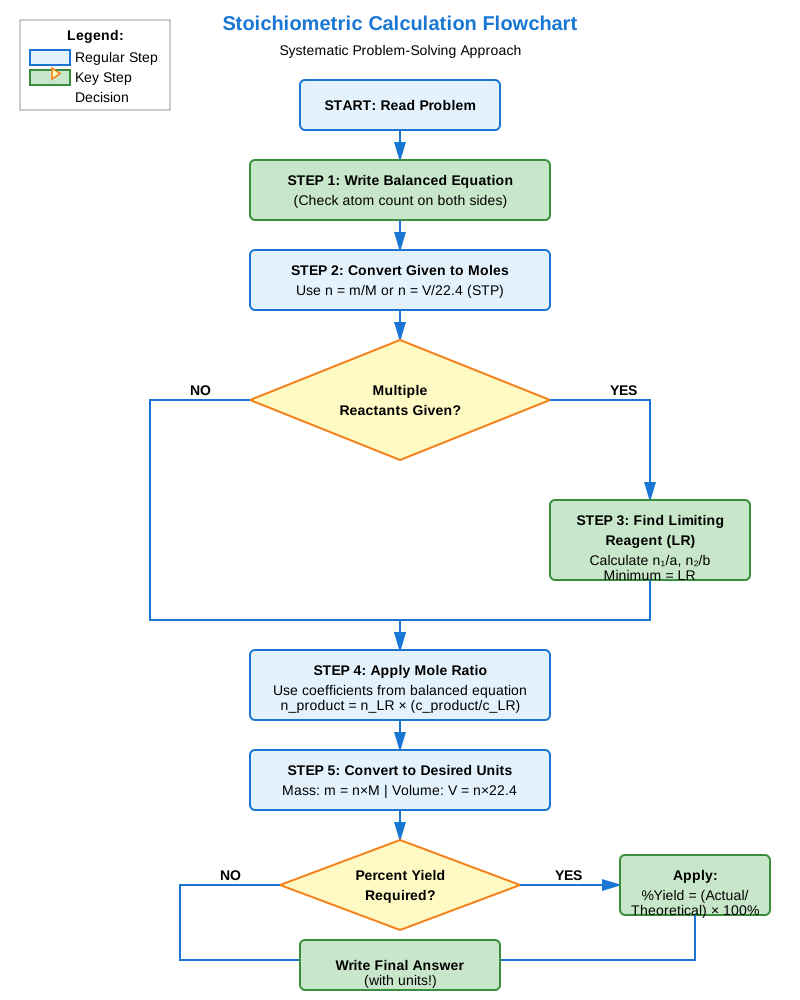
πŸ”¬ Deep Dive
Welcome, future chemists! Today, we're going to dive deep into a fundamental concept in chemistry that allows us to predict and quantify chemical reactions: Stoichiometric calculations, including the crucial idea of the Limiting Reagent. This topic is not just important for your board exams but forms the bedrock for quantitative problem-solving in JEE Main & Advanced. So, let's build a strong foundation together!

---

### 1. Introduction to Stoichiometry: The Quantitative Language of Chemistry

Have you ever wondered how chemists know exactly how much of a reactant to mix to get a desired amount of product, or how much product they *should* expect from a given set of reactants? The answer lies in stoichiometry.

The word "stoichiometry" comes from two Greek words: "stoicheion" (meaning element) and "metron" (meaning measure). In essence, stoichiometry is the branch of chemistry that deals with the quantitative relationships between reactants and products in chemical reactions. It's like the "recipe" for a chemical reaction, telling us the exact proportions of ingredients needed and the amount of product we'll get.

Why is it important?
Stoichiometry allows us to:
* Predict the amount of product that can be formed from a given amount of reactants.
* Determine the amount of reactants needed to produce a specific amount of product.
* Understand the efficiency of a chemical process.

The entire foundation of stoichiometry rests on the Law of Conservation of Mass, which states that matter cannot be created or destroyed in a chemical reaction. This means the total mass of reactants must equal the total mass of products. To apply this law quantitatively, we *must* use a balanced chemical equation.

---

### 2. Steps for Basic Stoichiometric Calculations (When Reactants are in Stoichiometric Proportions)

Before we introduce the concept of a limiting reagent, let's understand the basic steps involved in any stoichiometric calculation. Assume, for now, that reactants are available in the exact proportions dictated by the balanced equation, meaning they will all be consumed simultaneously.


  1. Write and Balance the Chemical Equation: This is the absolute first and most critical step. An unbalanced equation will lead to incorrect mole ratios and, consequently, incorrect answers. Ensure that the number of atoms of each element is the same on both sides of the equation.


  2. Convert Given Quantities to Moles: Chemical equations provide relationships in terms of *moles*. Therefore, any given quantity (mass, volume of gas at STP, number of particles, or concentration for solutions) must be converted into moles of the respective substance.


    • For mass (g): Moles = Mass / Molar Mass


    • For volume of gas at STP (L): Moles = Volume / 22.4 L/mol (at 0Β°C and 1 atm pressure)


    • For number of particles: Moles = Number of particles / Avogadro's Number (6.022 x 10²³)


  3. Use Mole Ratios from the Balanced Equation: This is the heart of stoichiometry. The coefficients in the balanced equation represent the mole ratio in which reactants combine and products are formed. For example, in the reaction `2Hβ‚‚ + Oβ‚‚ β†’ 2Hβ‚‚O`, the mole ratio of Hβ‚‚ to Oβ‚‚ is 2:1, and Hβ‚‚ to Hβ‚‚O is 2:2 (or 1:1). Use this ratio to find the moles of the desired substance.


  4. Convert Moles of Desired Substance to Required Units: Once you have the moles of the substance you need to find, convert it back into the units requested in the problem (mass, volume, particles, etc.) using the reverse of the conversions in Step 2.


#### Example 1: Basic Stoichiometric Calculation
Consider the combustion of methane (CHβ‚„):
`CHβ‚„(g) + 2Oβ‚‚(g) β†’ COβ‚‚(g) + 2Hβ‚‚O(l)`

Problem: What mass of carbon dioxide (COβ‚‚) is produced when 32 grams of methane (CHβ‚„) are completely combusted?
(Molar mass of CHβ‚„ = 16.04 g/mol; Molar mass of COβ‚‚ = 44.01 g/mol)

Solution:
1. Balanced Equation: The equation `CHβ‚„(g) + 2Oβ‚‚(g) β†’ COβ‚‚(g) + 2Hβ‚‚O(l)` is already balanced.
2. Convert given to moles:
Moles of CHβ‚„ = Mass of CHβ‚„ / Molar mass of CHβ‚„
Moles of CHβ‚„ = 32 g / 16.04 g/mol β‰ˆ 1.995 mol
3. Use mole ratio: From the balanced equation, 1 mole of CHβ‚„ produces 1 mole of COβ‚‚.
So, moles of COβ‚‚ produced = Moles of CHβ‚„ = 1.995 mol
4. Convert moles to required units (mass):
Mass of COβ‚‚ = Moles of COβ‚‚ Γ— Molar mass of COβ‚‚
Mass of COβ‚‚ = 1.995 mol Γ— 44.01 g/mol β‰ˆ 87.80 g

So, 87.80 grams of carbon dioxide are produced.

---

### 3. Understanding the Limiting Reagent (LR)

In most real-world chemical reactions, reactants are not mixed in precisely stoichiometric amounts. One reactant will often run out before the others. This introduces the concept of the Limiting Reagent.

#### Analogy: Making Sandwiches
Imagine you're making sandwiches. Each sandwich requires:
* 2 slices of bread
* 1 slice of cheese
* 2 slices of tomato

Suppose you have:
* 10 slices of bread
* 4 slices of cheese
* 12 slices of tomato

How many sandwiches can you make?
* Bread: With 10 slices, you can make 10/2 = 5 sandwiches.
* Cheese: With 4 slices, you can make 4/1 = 4 sandwiches.
* Tomato: With 12 slices, you can make 12/2 = 6 sandwiches.

You can only make 4 sandwiches because you'll run out of cheese first. The cheese is your limiting ingredient. Once the cheese is gone, you can't make any more sandwiches, even if you have bread and tomato left over.
* Limiting Reagent (LR): The reactant that is completely consumed first in a chemical reaction, thereby limiting the amount of product that can be formed.
* Excess Reagent (ER): The reactant(s) that are left over after the reaction is complete because the limiting reagent has been used up.

In our sandwich analogy, cheese is the LR. Bread and tomato are in excess. After 4 sandwiches:
* Bread used: 4 sandwiches * 2 slices/sandwich = 8 slices. Remaining: 10 - 8 = 2 slices.
* Cheese used: 4 sandwiches * 1 slice/sandwich = 4 slices. Remaining: 4 - 4 = 0 slices.
* Tomato used: 4 sandwiches * 2 slices/sandwich = 8 slices. Remaining: 12 - 8 = 4 slices.

Crucial Point: All stoichiometric calculations for product formation and the amount of excess reagent remaining must be based on the Limiting Reagent.

---

### 4. How to Identify the Limiting Reagent

There are several methods to identify the limiting reagent. Let's explore the most common ones:

#### Method 1: Comparing Mole Ratios (The "Divide by Coefficient" Method)
This is often the most efficient method for competitive exams like JEE.
1. Calculate the available moles of each reactant.
2. For each reactant, divide its available moles by its stoichiometric coefficient from the balanced equation.
3. The reactant that yields the *smallest* value after this division is the Limiting Reagent.

#### Method 2: Product-Based Comparison
1. Assume one reactant is completely consumed and calculate the theoretical amount of a specific product formed.
2. Repeat this for each of the other reactants, assuming each one is completely consumed.
3. The reactant that produces the *least* amount of product is the Limiting Reagent. This is because the reaction will stop when that reactant is used up, producing only that minimum amount of product.

#### Method 3: Required vs. Available
1. Choose one reactant (let's say Reactant A).
2. Calculate how much of the other reactant (Reactant B) would be *required* to completely react with the *given* amount of Reactant A, using the mole ratio from the balanced equation.
3. Compare this "required" amount of Reactant B with the "available" amount of Reactant B given in the problem.
* If "available B" < "required B", then Reactant B is the LR.
* If "available B" > "required B", then Reactant A is the LR.

---

### 5. Steps for Stoichiometric Calculations with Limiting Reagent

When a limiting reagent is involved, the general steps for stoichiometric calculations are modified slightly:


  1. Write and Balance the Chemical Equation: As always, this is the foundational step.


  2. Convert Given Quantities of ALL Reactants to Moles: You need to know the moles of every reactant involved to determine which one will run out first.


  3. Identify the Limiting Reagent (LR): Use one of the methods described above (Method 1 is generally recommended for speed).


  4. Use the Moles of the Limiting Reagent and Mole Ratios to Calculate Products: This is critical! Once the LR is identified, all subsequent calculations for products (and excess reagent consumed) *must* be based on the moles of the LR. The excess reagent cannot produce more product than what the LR allows.


  5. Convert Moles of Product(s) to Required Units: Convert the calculated moles of product back into the desired units (mass, volume, etc.).


  6. Calculate the Amount of Excess Reagent Remaining (Optional but Common):

    • First, calculate how many moles of the excess reagent were *consumed* by the LR, using the mole ratio between the LR and the ER.

    • Then, subtract the consumed moles from the initial moles of the excess reagent to find the moles remaining.

    • Convert the remaining moles back to the required units (usually mass).


#### Example 2: Stoichiometric Calculation with Limiting Reagent
Consider the reaction between nitrogen and hydrogen to form ammonia (Haber process):
`Nβ‚‚(g) + 3Hβ‚‚(g) β†’ 2NH₃(g)`

Problem: If 28 g of Nβ‚‚ reacts with 12 g of Hβ‚‚, what mass of NH₃ will be produced, and what mass of the excess reagent will remain?
(Molar mass of Nβ‚‚ = 28 g/mol; Molar mass of Hβ‚‚ = 2 g/mol; Molar mass of NH₃ = 17 g/mol)

Solution:
1. Balanced Equation: `Nβ‚‚(g) + 3Hβ‚‚(g) β†’ 2NH₃(g)` (already balanced).

2. Convert given quantities to moles:
* Moles of Nβ‚‚ = 28 g / 28 g/mol = 1.0 mol
* Moles of Hβ‚‚ = 12 g / 2 g/mol = 6.0 mol

3. Identify the Limiting Reagent (Using Method 1 - Divide by Coefficient):
* For Nβ‚‚: Available moles / Coefficient = 1.0 mol / 1 = 1.0
* For Hβ‚‚: Available moles / Coefficient = 6.0 mol / 3 = 2.0

Since 1.0 (for Nβ‚‚) is smaller than 2.0 (for Hβ‚‚), Nβ‚‚ is the Limiting Reagent. Hβ‚‚ is the Excess Reagent.

4. Calculate moles of NH₃ produced (based on LR, Nβ‚‚):
From the balanced equation, 1 mole of Nβ‚‚ produces 2 moles of NH₃.
Moles of NH₃ = Moles of Nβ‚‚ (LR) Γ— (2 moles NH₃ / 1 mole Nβ‚‚)
Moles of NH₃ = 1.0 mol Nβ‚‚ Γ— 2 = 2.0 mol NH₃

5. Convert moles of NH₃ to mass:
Mass of NH₃ = Moles of NH₃ Γ— Molar mass of NH₃
Mass of NH₃ = 2.0 mol Γ— 17 g/mol = 34 g NH₃

So, 34 grams of NH₃ will be produced.

6. Calculate the amount of Excess Reagent (Hβ‚‚) remaining:
* Moles of Hβ‚‚ consumed: From the balanced equation, 1 mole of Nβ‚‚ reacts with 3 moles of Hβ‚‚.
Moles of Hβ‚‚ consumed = Moles of Nβ‚‚ (LR) Γ— (3 moles Hβ‚‚ / 1 mole Nβ‚‚)
Moles of Hβ‚‚ consumed = 1.0 mol Nβ‚‚ Γ— 3 = 3.0 mol Hβ‚‚
* Moles of Hβ‚‚ remaining:
Initial moles of Hβ‚‚ = 6.0 mol
Moles of Hβ‚‚ remaining = Initial moles - Consumed moles = 6.0 mol - 3.0 mol = 3.0 mol Hβ‚‚
* Mass of Hβ‚‚ remaining:
Mass of Hβ‚‚ remaining = Moles of Hβ‚‚ remaining Γ— Molar mass of Hβ‚‚
Mass of Hβ‚‚ remaining = 3.0 mol Γ— 2 g/mol = 6 g Hβ‚‚

So, 6 grams of Hβ‚‚ will remain unreacted.

---

### 6. Reaction Yield (A Brief Introduction)

While not strictly part of identifying the limiting reagent, the concept of yield is very closely related to stoichiometric calculations.
* Theoretical Yield: The maximum amount of product that can be formed from the given amounts of reactants, calculated stoichiometrically using the limiting reagent. This is what we calculated in Example 2 (34 g NH₃).
* Actual Yield: The amount of product actually obtained from an experiment. This is almost always less than the theoretical yield due to various factors (incomplete reactions, side reactions, loss during isolation/purification).
* Percentage Yield: A measure of the efficiency of a reaction.
Percentage Yield = (Actual Yield / Theoretical Yield) Γ— 100%

---

### 7. CBSE vs. JEE Focus


Aspect CBSE / Board Exams JEE Main & Advanced
Complexity of Problems Generally straightforward. Focus on applying the steps correctly for basic calculations and LR identification. Can be highly complex. Involves multi-step reactions, percentage purity of reactants, percentage yield, solutions (molarity, dilution), gas laws (PV=nRT), mixtures of reactants, and sometimes involving redox reactions.
Data Provided Usually mass or volume at STP. Can involve molarity and volume for solutions, pressure/volume/temperature for gases, density, percentage by mass, etc.
Limiting Reagent Identification of LR and calculation of product or excess reactant. LR identification is often the first step in a longer, more involved calculation. Quick and accurate LR determination is key.
Emphasis Understanding the concept and step-by-step methodology. Efficiency in calculation, conceptual clarity across various contexts (solutions, gases), and problem-solving speed.


For JEE, mastering the "divide by coefficient" method for LR identification is crucial, as it saves time. Also, be prepared to integrate mole concept with other topics like solutions, gas laws, and redox reactions. Always double-check your balanced equation and unit conversions. Practice a variety of problems to build confidence!
🎯 Shortcuts

Mnemonics and Short-cuts: Stoichiometric Calculations & Limiting Reagent


Stoichiometry can seem daunting with its multi-step calculations. Using mnemonics and practical short-cuts can significantly improve your speed and accuracy in exams, especially for JEE Main.


1. Mnemonic for General Stoichiometric Calculation Steps


For any stoichiometric problem (whether it involves limiting reagent or not, these are the fundamental steps):


  • Balance the chemical equation.

  • Convert given quantities (mass, volume, particles) into moles.

  • Mole-to-mole ratio: Use the balanced equation to find the mole ratio between known and unknown substances.

  • Calculate the desired quantity (moles, then convert back to mass, volume, etc.).


Mnemonic: B.C.M.C. (Better Chemistry, More Confidence!)


Letter Step Explanation
B Balance Always the first step! Coefficients are crucial.
C Convert to Moles Use molar mass (g/mol), Molar Volume (22.4 L/mol at STP/NTP), or Avogadro's number.
M Mole Ratio From balanced equation: moles A / moles B. This is the heart of stoichiometry.
C Calculate/Convert Back Find moles of unknown, then convert to mass, volume, or number of particles as required.

JEE Tip: Mastering these steps makes even complex problems manageable. Speed comes with practice.


2. Mnemonic for Identifying Limiting Reagent (LR)


When quantities of *two or more reactants* are given, you must identify the Limiting Reagent. This is the reactant that will be completely consumed first and thus determines the maximum amount of product that can be formed.


  • For each reactant, divide its given moles by its stoichiometric coefficient from the balanced equation.

  • The reactant with the smallest quotient is the Limiting Reagent.


Mnemonic: M/S = Smallest LR


Term Represents Application
M Moles (given) The number of moles of each reactant you start with.
S Stoichiometric Coefficient The number in front of each reactant in the balanced equation.
Smallest LR Smallest Quotient identifies LR Calculate M/S for each reactant. The one with the minimum value is the LR.

CBSE vs JEE: This M/S method is crucial for JEE for speed. For CBSE, you might also use the "theoretical yield" method (calculate product from each reactant, the smaller yield determines LR), but M/S is faster.


3. Short-cut: Limiting Reagent Dictates Everything


Once you identify the Limiting Reagent, forget the initial amount of the excess reagent. All subsequent calculations (e.g., amount of product formed, amount of excess reagent consumed) must be based on the moles of the Limiting Reagent.


  • L.R. is the B.O.S.S. (Boss of Stoichiometric Solutions).

  • It determines the maximum yield of any product.

  • It determines how much of the excess reagent is consumed.


Keep these concise memory aids in mind, practice consistently, and you'll find these calculations much smoother!


πŸ’‘ Quick Tips

💬 Quick Tips for Stoichiometric Calculations & Limiting Reagent 💬


Mastering stoichiometric calculations, especially with limiting reagents, is fundamental for success in Chemistry. These quick tips will help you approach problems efficiently and accurately for both Board exams and JEE.


📜 General Stoichiometry Tips:


  • Balance the Chemical Equation FIRST: This is non-negotiable. An unbalanced equation will lead to incorrect mole ratios and thus, wrong answers. Always double-check your balancing.

  • Convert Everything to Moles: Whether quantities are given in grams, volume (for gases), or number of particles, convert all given reactants to moles. Moles are the common currency for chemical reactions.

    • For mass: Moles = Mass / Molar Mass

    • For gases at STP (0Β°C, 1 atm): Moles = Volume (L) / 22.4 L/mol (JEE Note: Be careful if conditions are not STP/NTP. Always use PV=nRT for general gas law problems).


  • Use Stoichiometric Ratios: The coefficients in the balanced equation represent the mole ratios of reactants consumed and products formed. Use these ratios to relate moles of one substance to another.

  • Unit Consistency: Always pay attention to units (g, kg, L, mL, mol, mmol, etc.) and ensure consistent usage throughout your calculation. Convert all quantities to base units (e.g., grams, liters, moles) before starting.


🤖 Limiting Reagent (LR) Specific Tips:


  • Identify the Limiting Reagent Early: If quantities of *two or more reactants* are given, it's a limiting reagent problem. You *must* identify the LR before proceeding with product calculations.

  • Quick LR Identification Method (JEE):

    1. Convert given mass/volume of *each reactant* to moles.

    2. Divide the moles of each reactant by its respective stoichiometric coefficient from the balanced equation.

    3. The reactant with the smallest resulting value is the limiting reagent.


    Example: For A + 2B → C, if you have 1 mol A and 1.5 mol B:


    • For A: 1 mol / 1 = 1

    • For B: 1.5 mol / 2 = 0.75

    • Since 0.75 is smaller, B is the limiting reagent.


  • Base All Product Calculations on LR: Once the limiting reagent is identified, all calculations for the amount of product formed and the amount of excess reagent consumed/remaining *must* be based *only* on the moles of the limiting reagent.

  • Calculate Excess Reagent Remaining:

    1. Calculate how much of the excess reagent is *consumed* by the limiting reagent using mole ratios.

    2. Subtract the consumed amount from the initial amount of the excess reagent to find the remaining amount.


⚠️ Common Pitfalls to Avoid:


  • Neglecting to Balance: The most common and fatal mistake, leading to incorrect mole ratios.

  • Using Mass Ratios Directly: Stoichiometric coefficients represent *mole ratios*, not mass ratios. Always convert to moles first.

  • Calculating Product from Excess Reagent: A product's yield is always dictated by the reactant that runs out first (the LR). Using the excess reagent will give an incorrectly higher yield.


By consistently applying these tips, you'll improve both your speed and accuracy in solving stoichiometry problems. Good luck!

🧠 Intuitive Understanding

Welcome to the intuitive understanding of Stoichiometric calculations, including the Limiting Reagent! Often, these concepts seem intimidating with moles and equations, but at their heart, they are quite logical and relatable.


The "Recipe" Analogy for Stoichiometry


Imagine you're baking. A recipe tells you exactly how much of each ingredient to use to get a certain amount of your final dish. Chemistry is no different!


  • Reactants: These are your ingredients (e.g., flour, sugar, eggs).

  • Products: This is your final dish (e.g., a cake, cookies).

  • Balanced Chemical Equation: This is your "recipe". The coefficients in front of each chemical represent the exact ratio (in moles) in which they react or are produced.


For example, if your recipe says:


2 cups Flour + 1 cup Sugar → 1 Cake

This means for every 2 cups of flour, you need 1 cup of sugar to make 1 cake. If you have 4 cups of flour, you know you'll need 2 cups of sugar to make 2 cakes, assuming you have enough of all other ingredients.


Understanding the Limiting Reagent: What Runs Out First?


Now, let's extend our recipe analogy to understand the Limiting Reagent. What happens if you don't have enough of *all* ingredients?


Example: Making Cheese Sandwiches


Let's say your recipe for one cheese sandwich is:


2 slices Bread (B) + 1 slice Cheese (C) → 1 Sandwich (S)


  1. Scenario 1 (Simple Stoichiometry):

    You have 10 slices of bread and 10 slices of cheese. How many sandwiches can you make?


    • For 10 slices of bread, you need 10/2 = 5 slices of cheese to make 5 sandwiches.

    • You have 10 slices of cheese, which is more than enough (5 slices are needed).

    • So, you can make 5 sandwiches. Bread is not limiting here because you have plenty of cheese.


  2. Scenario 2 (Limiting Reagent):

    You have 10 slices of bread (B) and only 3 slices of cheese (C). How many sandwiches can you make?


    • Consider Bread: If you use all 10 slices of bread, you'd need 10/2 = 5 slices of cheese.


    • Consider Cheese: If you use all 3 slices of cheese, you'd need 3 * 2 = 6 slices of bread.


    Now, compare what you *have* with what you *need*:


    • You *have* 10 slices of bread, but you only *need* 6 slices if you use all the cheese. Bread is in excess.

    • You *have* 3 slices of cheese, but you *need* 5 slices if you use all the bread. Cheese is insufficient.


    Since you only have 3 slices of cheese, you can only make 3 sandwiches (using 6 slices of bread). The cheese runs out first, stopping the sandwich-making process.


    In this scenario, Cheese is the Limiting Reagent. It limits the amount of product (sandwiches) that can be formed. Bread is the Excess Reagent, meaning some will be left over.


Connecting to Chemistry


Just like in our sandwich analogy:


  • In a chemical reaction, the Limiting Reagent is the reactant that is completely consumed first.

  • Once the limiting reagent is used up, the reaction stops, and no more product can be formed.

  • The amount of product formed is always determined by the Limiting Reagent.

  • Any other reactant present in a greater amount than required by the stoichiometry is an Excess Reagent.


JEE vs. CBSE: While CBSE often presents straightforward problems where the limiting reagent is obvious or easily calculated, JEE Main questions can be more nuanced. They might involve situations where the limiting reagent dictates the yield, or where you need to calculate the amount of excess reagent remaining. A strong intuitive grasp helps in quickly identifying the limiting species.


Always remember: The balanced chemical equation (your recipe) is key to understanding the mole ratios, which in turn helps you identify the limiting reagent and predict product amounts.

🌍 Real World Applications

Real World Applications of Stoichiometry & Limiting Reagent


Understanding stoichiometric calculations and the concept of a limiting reagent isn't just for theoretical problems; it's fundamental to various real-world processes and industries. These principles allow us to predict reaction outcomes, optimize resource utilization, and ensure product quality.


Key Application Areas:


  • Industrial Chemistry & Manufacturing:
    This is perhaps the most significant application. Chemical engineers rely on stoichiometry to:


    • Determine the exact amounts of raw materials needed for desired product yields.

    • Minimize waste and optimize production costs by identifying and controlling the limiting reactant.

    • Design and scale up industrial processes (e.g., fertilizer production, polymer synthesis, drug manufacturing).


  • Environmental Science & Pollution Control:
    Stoichiometric principles are used to:


    • Calculate the amount of reagent needed to neutralize pollutants (e.g., treating acidic wastewater with a base).

    • Assess the efficiency of combustion processes to minimize harmful emissions.

    • Understand biogeochemical cycles (e.g., carbon cycle, nitrogen cycle).


  • Food Science & Nutrition:
    In food processing and nutritional planning:


    • Recipes are essentially stoichiometric guides, ensuring ingredients are in the correct proportions.

    • Determining the limiting nutrient in a diet to ensure balanced nutrition.

    • Calculating the amount of preservatives or additives needed in food products.


  • Pharmaceuticals & Medicine:
    Crucial for drug development and administration:


    • Synthesizing drugs requires precise stoichiometric control to maximize yield of the active pharmaceutical ingredient (API) and minimize by-products.

    • Calculating precise dosages for medications based on patient weight and desired therapeutic effect.

    • Designing reaction pathways for new drug molecules efficiently.


Example: The Haber Process (Ammonia Production)


One of the most impactful applications is in the Haber process, which synthesizes ammonia (NH₃) from nitrogen (N₂) and hydrogen (H₂):


N₂(g) + 3H₂(g) → 2NH₃(g)


In industrial settings, engineers must decide whether to use nitrogen or hydrogen as the limiting reactant. Typically, hydrogen is the more expensive reactant. By making hydrogen the limiting reagent, they ensure that:


  • Almost all of the expensive hydrogen is consumed.

  • The process can be optimized to achieve maximum ammonia yield with minimal unreacted (and wasted) hydrogen.

  • This decision significantly impacts the economic viability and environmental footprint of ammonia production, a critical component for fertilizers and many other chemicals.


JEE vs. CBSE Relevance:


For both CBSE and JEE, understanding these real-world applications enhances conceptual clarity. While direct questions on specific industrial processes might be more prevalent in advanced chemistry, the underlying principles of stoichiometry and limiting reagent are tested rigorously. JEE aspirants often encounter problems that require applying these concepts to calculate yields in complex multi-step reactions, similar to those found in industrial synthesis.


Mastering stoichiometry means you're not just solving equations, you're understanding the quantitative backbone of the chemical world around us!


πŸ”„ Common Analogies

Common Analogies for Stoichiometric Calculations & Limiting Reagent


Understanding Stoichiometric Calculations, especially the concept of the Limiting Reagent, can often be simplified using relatable analogies. These analogies help build an intuitive grasp before diving into complex chemical equations and calculations.


1. The "Recipe" Analogy for Stoichiometry


Think of a balanced chemical equation as a recipe. Just like a recipe tells you the exact amounts of ingredients needed to make a certain quantity of food, a balanced chemical equation tells you the exact molar ratios of reactants needed to produce specific molar ratios of products.


  • Ingredients: Reactants (e.g., flour, sugar, eggs)

  • Directions/Ratios: Stoichiometric coefficients (e.g., 2 cups flour + 1 cup sugar)

  • Finished Dish: Products (e.g., 1 cake)


If you want to make more of the finished product, you need to proportionally increase all the ingredients according to the recipe's ratios.


2. The "Sandwich Making" Analogy for Limiting Reagent


This is arguably the most effective analogy for grasping the limiting reagent concept, crucial for both CBSE Board Exams and JEE Main.


Let's consider a simple sandwich recipe:


Recipe: 2 slices of bread + 1 slice of cheese + 1 slice of ham → 1 sandwich


Item Available Quantity Required per Sandwich
Bread slices 10 slices 2 slices
Cheese slices 4 slices 1 slice
Ham slices 3 slices 1 slice


Now, let's see how many sandwiches you can make based on each ingredient:


  • From Bread: 10 slices / 2 slices per sandwich = 5 sandwiches

  • From Cheese: 4 slices / 1 slice per sandwich = 4 sandwiches

  • From Ham: 3 slices / 1 slice per sandwich = 3 sandwiches


Even though you have enough bread for 5 sandwiches and cheese for 4 sandwiches, you can only make a maximum of 3 sandwiches because you run out of ham first!


  • Limiting Reagent: In this analogy, the Ham slices are the limiting reagent. It's the ingredient that gets consumed completely and limits the total number of products (sandwiches) you can make.


  • Excess Reagents: The Bread slices and Cheese slices are the excess reagents. You will have some left over after making 3 sandwiches.


  • Maximum Product: The 3 sandwiches represent the maximum amount of product that can be formed based on the limiting reagent.


Connecting to Chemistry:


Just like ham limited the number of sandwiches, a chemical reactant (limiting reagent) determines the maximum amount of product that can be formed in a chemical reaction. The other reactants will be present in excess. Mastering this concept is vital for quantitative analysis in chemistry.


πŸ“‹ Prerequisites


Prerequisites for Stoichiometric Calculations & Limiting Reagent


Mastering stoichiometric calculations, especially those involving limiting reagents, is fundamental for success in Chemistry, both for CBSE board exams and JEE Main. This section outlines the essential foundational concepts you must be thoroughly familiar with before delving into this topic. A strong grasp of these basics will ensure clarity and accuracy in your problem-solving.


Key Prerequisite Concepts:


  • Atomic, Molecular, and Formula Masses:

    • Understand the definition of atomic mass (weighted average of isotopes), molecular mass (sum of atomic masses in a molecule), and formula mass (sum of atomic masses in an ionic compound's formula unit).

    • Be proficient in calculating these masses from the atomic masses of individual elements. For example, the molecular mass of Hβ‚‚O = (2 × 1.008) + 15.999 = 18.015 amu or g/mol.

    • JEE Relevance: Quick and accurate calculation of molar masses is critical for time management.


  • The Mole Concept Fundamentals:

    • Definition: A mole is the amount of substance containing as many elementary entities (atoms, molecules, ions, electrons, etc.) as there are atoms in exactly 12 grams of the carbon-12 isotope.

    • Avogadro's Number (NA): 6.022 × 10²³ entities per mole.

    • Molar Mass: The mass of one mole of a substance (numerically equal to its atomic/molecular/formula mass in grams).

    • Relationships: Be able to confidently interconvert between:

      • Mass (g) ↔ Moles (n) using Molar Mass (M): n = mass / M

      • Moles (n) ↔ Number of Particles using Avogadro's Number: n = No. of particles / NA

      • Moles (n) ↔ Volume of Gas at STP (0Β°C, 1 atm): n = Volume (L) / 22.4 L


  • Balancing Chemical Equations:

    • This is a non-negotiable prerequisite. Every stoichiometric calculation starts with a correctly balanced chemical equation.

    • Understand that balancing ensures adherence to the Law of Conservation of Mass – matter is neither created nor destroyed in a chemical reaction.

    • Warning: An unbalanced equation will lead to incorrect mole ratios and, consequently, wrong answers.


  • Understanding Stoichiometric Coefficients:

    • Once an equation is balanced, the coefficients in front of each reactant and product represent the mole ratios in which substances react and are formed.

    • For example, in 2Hβ‚‚ + Oβ‚‚ → 2Hβ‚‚O, the coefficients (2:1:2) mean 2 moles of Hβ‚‚ react with 1 mole of Oβ‚‚ to produce 2 moles of Hβ‚‚O. These ratios are the backbone of all stoichiometric calculations.


Before moving to complex problems, ensure you can comfortably solve basic mole concept problems and balance common chemical equations. This groundwork is vital for building a solid understanding of stoichiometry and limiting reagents.


⚠️ Common Exam Traps

Common Exam Traps: Stoichiometric Calculations & Limiting Reagent


Stoichiometry and limiting reagent problems are fundamental in Chemistry and frequently appear in JEE Main and Board exams. While the concepts might seem straightforward, specific pitfalls can lead to incorrect answers. Be vigilant to avoid these common traps:


  • Trap 1: Failure to Balance the Chemical Equation

    Description: This is the most critical and often overlooked first step. All stoichiometric ratios are derived from a correctly balanced chemical equation. Proceeding with an unbalanced equation guarantees an incorrect answer.


    How to Avoid: Always, always, always write down and balance the chemical equation first. Double-check the coefficients before starting any calculations. For JEE, learn common reaction types to quickly balance equations.


  • Trap 2: Incorrectly Identifying the Limiting Reagent

    Description: Many students mistakenly identify the limiting reagent as the reactant with the smallest initial mass or moles. This is incorrect. The limiting reagent is determined by comparing the available moles of each reactant to their stoichiometric coefficients.


    How to Avoid:


    • Method 1 (Ratio Method): Divide the moles of each reactant by its respective stoichiometric coefficient. The reactant yielding the smallest value is the limiting reagent.

    • Method 2 (Product Method): Calculate the amount of product formed if each reactant were completely consumed. The reactant that produces the least amount of product is the limiting reagent.

    • JEE Tip: Practice both methods to find which one is faster and less prone to error for you. Speed is crucial.


  • Trap 3: Unit Inconsistency and Molar Mass Errors

    Description: Mixing units (e.g., using grams directly in mole ratios) or making errors in calculating molar masses of compounds can propagate significant errors throughout the entire problem.


    How to Avoid:


    • Convert all given quantities (mass, volume of solution, gas volume) to moles first using appropriate molar masses, concentrations, or gas laws (PV=nRT for gases).

    • Ensure molar masses are calculated accurately, using correct atomic masses.

    • Pay attention to the final required units (grams, liters, moles) and convert your answer accordingly.


  • Trap 4: Ignoring Purity and Percent Yield

    Description: Problems often state that a reactant is not 100% pure or ask for percent yield. Students sometimes use the total given mass for calculations or confuse theoretical yield with actual yield.


    How to Avoid:


    • If purity is given, calculate the actual mass of the pure reactant available for reaction before proceeding.

    • Understand the difference: Theoretical Yield (calculated from stoichiometry) vs. Actual Yield (experimentally obtained) vs. Percent Yield = (Actual Yield / Theoretical Yield) * 100.


  • Trap 5: Calculation Errors & Significant Figures

    Description: Simple arithmetic mistakes, especially with large numbers or scientific notation, and incorrect application of significant figure rules, can lead to loss of marks.


    How to Avoid: Use a calculator efficiently for JEE Main. For Board exams, show clear steps. Pay attention to the number of significant figures required in the final answer, usually guided by the least precise measurement given in the problem.


"Mastering stoichiometry comes from meticulous attention to detail. Practice consistently!"


⭐ Key Takeaways

πŸ”‘ Key Takeaways: Stoichiometric Calculations & Limiting Reagent


Mastering stoichiometric calculations and the concept of limiting reagent is fundamental to Quantitative Chemistry. These principles allow you to predict reactant consumption and product formation accurately.


Understanding Stoichiometry


  • Core Principle: Stoichiometry is the study of the quantitative relationships between reactants and products in a chemical reaction. It's based on the Law of Conservation of Mass.

  • Balanced Chemical Equation: This is the absolute prerequisite. Without a correctly balanced equation, all calculations will be erroneous. Coefficients represent mole ratios (and also molecule/atom ratios, or volume ratios for gases at constant T, P).

  • Mole-Mole Relationship: This is the primary bridge in stoichiometry. All calculations essentially convert to moles, use mole ratios, and then convert back to desired units (mass, volume, number of particles).


Steps for Stoichiometric Calculations


  1. Balance the Chemical Equation: Ensure the number of atoms of each element is the same on both sides.

  2. Convert Given Quantities to Moles: If given mass, use molar mass (n = m/M). If given volume of gas at STP, use 22.4 L/mol. For solutions, use molarity (n = Molarity Γ— Volume).

  3. Determine Mole Ratios: Use the coefficients from the balanced equation to find the moles of the unknown substance from the known substance.

  4. Convert Moles of Unknown to Desired Units: Convert back to mass, volume, or number of particles as required.


Limiting Reagent (LR) – The Deciding Factor


  • Definition: The limiting reagent is the reactant that is completely consumed first in a chemical reaction, thereby limiting the amount of product that can be formed.

  • Excess Reagent (ER): The reactant that is not completely consumed and remains after the reaction is called the excess reagent.

  • Why it's Crucial: In real-world scenarios, reactants are rarely present in perfect stoichiometric ratios. The amount of product formed always depends solely on the limiting reagent.


Identifying the Limiting Reagent (JEE Focus)


A common and efficient method for identifying the LR:


  • Calculate 'Mole Ratio Test':

    1. Calculate the moles of each reactant given.

    2. Divide the calculated moles of each reactant by its respective stoichiometric coefficient from the balanced equation.

    3. The reactant with the smallest resulting value is the limiting reagent.


    Example: For A + 2B β†’ C. If you have 2 moles of A and 3 moles of B.


    • For A: 2 mol / 1 (coefficient of A) = 2

    • For B: 3 mol / 2 (coefficient of B) = 1.5


    Since 1.5 < 2, B is the limiting reagent.


  • All calculations for product formation and excess reagent consumption must be based on the moles of the limiting reagent.


Exam Tips (CBSE & JEE)


  • CBSE: Focus on clear, step-by-step presentation of calculations, showing units at each stage. Understanding definitions is key.

  • JEE: Speed and accuracy are paramount. Efficient LR identification (like the mole ratio test) saves time. Be prepared for problems combining stoichiometry with other concepts (e.g., solution stoichiometry, gas laws).

  • Practice! The more problems you solve, the better you become at quickly identifying LR and performing calculations without errors.


"Every balanced equation is a roadmap; the limiting reagent tells you how far you can travel."


🧩 Problem Solving Approach

Problem-Solving Approach: Stoichiometric Calculations & Limiting Reagent


Mastering stoichiometric calculations and identifying limiting reagents is fundamental for success in Chemistry, especially for competitive exams like JEE Main and CBSE boards. A systematic approach ensures accuracy and efficiency. Follow these steps:


Phase 1: General Stoichiometric Calculations


  1. Balance the Chemical Equation: This is the most crucial first step. Ensure the number of atoms of each element is equal on both reactant and product sides. Without a balanced equation, all subsequent calculations will be incorrect.

  2. Convert Given Quantities to Moles: If you are given mass (g), volume (L for gases at STP), or number of particles, convert these to moles using appropriate molar mass, molar volume (22.4 L/mol at STP), or Avogadro's number (6.022 x 10²³ particles/mol).

  3. Use Mole Ratios (Stoichiometric Coefficients): From the balanced chemical equation, determine the mole ratio between the given substance and the substance you need to find. For example, if 2 moles of A react with 3 moles of B to form 4 moles of C, the ratio A:B:C is 2:3:4.

  4. Convert Moles of Desired Substance to Required Units: Once you have the moles of the desired substance, convert it back to mass, volume, or number of particles as required by the question.


Phase 2: Identifying and Solving Limiting Reagent Problems


Limiting Reagent (LR) problems arise when quantities of two or more reactants are given. The reactant that is completely consumed first limits the amount of product formed and is called the limiting reagent.


  1. Balance the Chemical Equation: (As above)

  2. Convert Given Quantities of ALL Reactants to Moles: This is key. Do this for every reactant whose quantity is provided.

  3. Determine the Limiting Reagent:

    • Method A (Ratio of Moles to Stoichiometric Coefficient): For each reactant, calculate the ratio of its initial moles to its stoichiometric coefficient from the balanced equation. The reactant with the smallest ratio is the limiting reagent.

      Example: For a reaction 2A + 3B → Products, if you have 10 moles of A and 12 moles of B:

      • Ratio for A = 10 moles / 2 = 5

      • Ratio for B = 12 moles / 3 = 4


      Since 4 < 5, B is the limiting reagent.

    • Method B (Product Formation): Calculate the moles of any one product that could be formed from each reactant, assuming the other reactants are in excess. The reactant that produces the least amount of product is the limiting reagent. This method is often more intuitive for beginners.


  4. Perform Calculations Based on the Limiting Reagent: Once the limiting reagent is identified, all further calculations (e.g., amount of product formed, amount of excess reactant consumed, amount of excess reactant remaining) must be done using the moles of the limiting reagent, as it dictates the maximum extent of the reaction.


JEE Main vs. CBSE Board Approach:


Aspect CBSE Board Exams JEE Main
Complexity Generally straightforward, direct application of concepts. May involve multiple steps, percentage purity/yield, gas laws, solution stoichiometry, or successive reactions.
Focus Understanding and showing all steps clearly. Speed, accuracy, and handling complex data efficiently.
Key Skill Systematic problem-solving. Conceptual clarity, quick mental calculations, error-free execution.


By consistently applying this structured approach, you can confidently tackle even the most challenging stoichiometric problems. Practice is key!

πŸ“ CBSE Focus Areas

CBSE Focus Areas: Stoichiometric Calculations Including Limiting Reagent


For CBSE Board Examinations, a strong grasp of Stoichiometric Calculations and Limiting Reagent is fundamental. These topics frequently appear as numerical problems, often carrying significant marks. The focus is on a systematic approach, correct application of formulas, and precise calculations.


Key Areas of Emphasis for CBSE:


  • Balanced Chemical Equations: This is the absolute prerequisite. CBSE questions often provide word equations or unbalanced equations. Ensure you can balance any given equation correctly, as all subsequent calculations depend on it.

  • Mole Concept Proficiency: A thorough understanding of the mole concept is essential. Be comfortable converting between:

    • Mass and Moles (using Molar Mass)

    • Number of particles and Moles (using Avogadro's Number)

    • Volume of Gas at STP and Moles (using 22.4 L/mol for ideal gases)


    These conversions form the backbone of all stoichiometric problems.


  • Stoichiometric Relationships:

    • Mole-Mole Relationships: Directly using coefficients from the balanced equation.

    • Mass-Mass Relationships: Most common type, involving converting given masses to moles, using mole ratios, and converting product moles back to mass.

    • Mole-Mass / Mass-Mole Relationships: Hybrid problems.


    CBSE generally presents straightforward numerical problems involving these calculations.


  • Limiting Reagent Identification: This is a crucial concept. When reactants are not in stoichiometric proportions, one reactant will be consumed completely first, thereby limiting the amount of product formed.

    • Method: The easiest way for CBSE is to calculate the moles of product formed from each reactant *separately*, assuming the other is in excess. The reactant that gives the *least* amount of product is the limiting reagent.

    • Importance: All product calculations (mass, moles, volume) MUST be based on the limiting reagent.


  • Excess Reagent Calculation: After identifying the limiting reagent, expect questions asking for the amount of the excess reagent left unreacted.

    • Steps: Calculate how much of the excess reagent reacts with the limiting reagent using stoichiometry. Subtract this from the initial amount of the excess reagent.


  • Units and Significant Figures: Always include appropriate units (g, mol, L, etc.) in your final answers. While strict significant figure rules might not be heavily penalized for minor deviations, provide answers with a reasonable number of significant figures (usually 2-3 decimal places for mass/volume, or matching the least precise input).


CBSE vs. JEE Perspective:


For CBSE, the questions are generally direct, focusing on your ability to apply the concepts systematically. Expect clear, single-step or two-step numerical problems. The complexity level is typically lower than JEE, which might combine multiple concepts or involve more intricate calculations (e.g., non-STP conditions, percentage purity, multiple reactions).


Exam Strategy for CBSE Numericals:


  1. Read Carefully: Understand what is given and what needs to be calculated.

  2. Balance the Equation: Always the first step.

  3. Convert to Moles: Convert given masses/volumes of reactants to moles.

  4. Identify Limiting Reagent (if applicable): Perform this crucial step if amounts of more than one reactant are given.

  5. Calculate Products/Excess: Use the stoichiometry of the balanced equation (and the limiting reagent) to find the required quantities.

  6. Convert Back to Required Units: If the answer needs to be in mass or volume, convert from moles.

  7. Present Neatly: Show all steps clearly, as partial marks are often awarded.


Practicing a variety of numerical problems with a focus on these steps will ensure you are well-prepared for the CBSE exams.

πŸŽ“ JEE Focus Areas

Stoichiometric Calculations Including Limiting Reagent: JEE Focus Areas


Stoichiometry forms the bedrock of quantitative chemistry and is a perpetually high-weightage topic in JEE Main. Beyond simple mole-to-mole conversions, JEE questions often test your ability to integrate concepts, especially concerning limiting reagents and various reaction conditions.


1. Mastering Limiting Reagent (LR) Identification


This is arguably the most critical aspect for JEE. Many students can do basic stoichiometry, but identifying and correctly applying the limiting reagent is where the challenge often lies. The product formed is *always* dictated by the limiting reactant.


  • Method for LR Identification:

    1. Balance the chemical equation.

    2. Convert given masses/volumes of reactants to moles.

    3. Divide the moles of each reactant by its respective stoichiometric coefficient from the balanced equation.

    4. The reactant with the smallest ratio is the limiting reagent.


  • Consequence: All product calculations must be based on the moles of the limiting reagent. The excess reagent's remaining amount might also be asked.


2. Integration with Solution Stoichiometry


JEE frequently combines stoichiometry with concentration terms. Expect problems where reactants are given as solutions with specified molarity, percentage by mass/volume, density, etc.


  • Key Conversions: You must be adept at converting between volume, density, mass, and moles using terms like Molarity (M), Molality (m), Normality (N), % w/w, % w/v.

  • Titration Concepts: While detailed titrations are less common in Main, the underlying stoichiometric principle of equivalence point (moles of acid = moles of base) is vital.


3. Gas Phase Stoichiometry


When gaseous reactants or products are involved, the Ideal Gas Equation (PV = nRT) becomes crucial. Remember standard conditions (STP: 273.15 K, 1 atm; NTP: 293.15 K, 1 atm - though STP is more common in JEE).


  • Avogadro's Law: For reactions at constant temperature and pressure, volume ratios are equal to mole ratios (and stoichiometric coefficients). This simplifies calculations for gaseous reactions.

  • Dalton's Law: Partial pressures in gas mixtures can be linked to mole fractions for reactant/product analysis.


4. Percentage Yield and Purity


These concepts introduce a practical aspect to calculations. Real-world reactions rarely achieve 100% yield, and reactants are often not 100% pure.


  • Percentage Yield = (Actual Yield / Theoretical Yield) Γ— 100. Theoretical yield is always calculated stoichiometrically from the limiting reagent.

  • Purity: If a reactant is X% pure, only X% of its given mass participates in the reaction. Adjust the initial moles accordingly.


5. Sequential & Parallel Reactions


JEE problems can involve a sequence of reactions or parallel reactions where a single reactant participates in multiple pathways. You need to connect the moles of intermediates across steps or distribute initial moles among parallel pathways based on stoichiometry.


  • Chain Reactions: Moles of product from the first reaction become the reactant for the second, and so on.


6. Empirical & Molecular Formula Determination


Often, combustion analysis data (mass of COβ‚‚, Hβ‚‚O, etc.) is given, requiring you to determine the empirical/molecular formula and then use it for stoichiometric calculations.


Strategic Tips for JEE:


  • Always Balance First: A single error in balancing will propagate through the entire calculation.

  • Units are Key: Pay close attention to units (g, kg, mL, L, M, kPa, atm, etc.) and convert them to consistent units (usually moles, L, atm/Pa, K).

  • Underline/Highlight Given Data: In complex problems, clearly identify what is given and what needs to be found.


CBSE vs. JEE Perspective:


While CBSE emphasizes the foundational calculations (mole-mole, mass-mass, simple LR), JEE challenges you with a combination of these concepts, often involving multiple steps, impure samples, and solutions with varying concentrations. The complexity of calculations and the integration of different topics (e.g., redox, gas laws, solutions) is significantly higher in JEE.


"Mastering stoichiometry is not just about calculations, but about understanding the quantitative relationships in every chemical reaction. Practice extensively to build confidence!"


🌐 Overview
Stoichiometry and Limiting Reagent: From balanced equations to real yields

Stoichiometry uses the mole ratios in a balanced chemical equation to relate amounts of reactants and products.

Limiting reagent (LR): The reactant that is consumed first, stopping the reaction. Other reactants become in excess.

Yields:
- Theoretical yield: maximum possible (from LR).
- Actual yield: obtained in practice.
- Percent yield = (Actual/Theoretical)Γ—100%.

Micro-example: N2 + 3H2 β†’ 2NH3. If n(N2)=1 mol, n(H2)=2 mol: H2 is limiting (needs 3 mol), so product = 2Γ—(2/3)=1.333... mol NH3.
πŸ“š Fundamentals
Fundamentals

- Balanced equation gives mole ratios β€” the backbone of stoichiometry.
- Limiting reagent: smallest (n/coefficient) among reactants.
- Excess reagent remaining = initial βˆ’ consumed (via ratio with LR).
- Yields: theoretical vs actual; percent yield ties practice to theory.
- Purity: mass of pure substance = (% purity/100) Γ— sample mass.
πŸ”¬ Deep Dive
Deep dive

- Titration stoichiometry: equivalents and normality (conceptual).
- Gas-evolution and precipitation reactions bookkeeping.
- Multi-reaction networks: identify the bottleneck step (LR per stage).
🎯 Shortcuts
Mnemonics

- B-MN-LR-Y β†’ Balance, to Moles, Normalize, Limiting, Result (yield).
- LR test: compare (n/coefficient) β€” "smallest wins".
πŸ’‘ Quick Tips
Quick tips

- Don't decide LR from masses directly β€” always go via moles.
- For solutions: use n = MΓ—V (in liters).
- For gases at known P,T: use PV=nRT to get moles.
- When both purity and yield appear: apply purity to reactant, yield to product.
🧠 Intuitive Understanding
Intuition

- Recipe thinking: If cake needs 3 cups flour : 2 eggs, and you have 2 eggs, eggs limit output even if flour is plenty.
- Normalize by coefficients: moles/coefficient tells how many "reaction packages" you can run with each reactant. Minimum decides LR.
🌍 Real World Applications
Applications

- Industrial synthesis planning: maximize output from scarce reactant.
- Pharmaceutical manufacturing: scale batches and forecast yields.
- Environmental engineering: reagent dosing for water treatment.
- Lab work: prepare exact quantities with minimal waste.
πŸ”„ Common Analogies
Analogies

- Sandwich assembly: 2 bread + 1 patty β†’ patties limit if fewer.
- Bus seats: passengers produced until seats (LR) run out.
- LEGO kits: number of full kits limited by rare pieces.
πŸ“‹ Prerequisites
Prerequisites

- Mole concept and molar mass (Topic 46).
- Balancing chemical equations.
- Conversions between mass, moles, volume (gases), and particles.
- Understanding percent purity and percent yield definitions.
⚠️ Common Exam Traps
Common exam traps

- Skipping the balance step β€” everything fails afterwards.
- Comparing masses instead of moles for LR.
- Forgetting to normalize by coefficients.
- Misapplying % yield to reactants instead of products.
- Unit mismatches (mL vs L; atm vs Pa; Β°C vs K).
⭐ Key Takeaways
Key takeaways

- Always convert to moles and normalize by coefficients.
- LR determines theoretical yield β€” everything else is excess.
- Keep careful unit tracking and significant figures.
- In multi-reactant problems, test each reactant as candidate LR quickly.
🧩 Problem Solving Approach
Problem-solving approach

1) Balance the equation.
2) Convert given amounts (g, L, MΓ—V) β†’ moles.
3) For each reactant, compute moles/coefficient; smallest β†’ LR.
4) Use LR to get product moles via ratio; convert to required unit.
5) For purity/yield: adjust input (purity) or output (% yield).
6) Compute leftover of excess reactants if asked.
πŸ“ CBSE Focus Areas
CBSE focus

- Straight stoichiometry: mass to mass, mass to volume (gases).
- LR identification and theoretical yield.
- Simple percent yield and percent purity questions.
- Stepwise unit work for full marks.
πŸŽ“ JEE Focus Areas
JEE focus

- Complex mixtures and multi-step reactions.
- Concurrency of solution/gas/solid data in one question.
- Back-calculating purity from yield and product data.
- Titration-type mole balance reasoning.
🌐 Overview
Stoichiometric calculations including limiting reagent is a quantitative chemistry technique ...
πŸ“š Fundamentals
Stoichiometry derives from the Greek words "stoicheion" (element) and "metron" (measure). ...
🎯 Shortcuts
MOLE BRIDGE Mnemonic: "Must Obtain Lab Evidence Before Reaching Intelligent Decisions Genuinely Everywhere" ...
πŸ’‘ Quick Tips
Balance first; use mole ratios; watch %yield.
🌍 Real World Applications
Industrial Chemistry: Chemical plants use stoichiometry to optimize reactant ratios, minimize waste, and maximize profit. ...
πŸ”„ Common Analogies
MISCONCEPTION 1: "Stoichiometric coefficients represent mass ratios." FALSE. ...
πŸ“‹ Prerequisites
ESSENTIAL PREREQUISITES: (1) Atomic structure and atomic mass ...
⭐ Key Takeaways
KEY FORMULAS: n = m/M | V(STP) = n Γ— 22.4 L | % Yield = (Actual/Theoretical) Γ— 100% ...
🧩 Problem Solving Approach
SYSTEMATIC 7-STEP METHOD: STEP 1 - Read and Identify: Extract given data ...
πŸŽ“ JEE Focus Areas
5-7 minutes for JEE Main

CBSE

For CBSE Class 11 Chemistry Chapter 1 (Some Basic Concepts in Chemistry), stoichiometric calculations and limiting reagent are essential. STEPS FOR STOICHIOMETRY PROBLEMS: Step 1 - Write balanced equation. Step 2 - Identify given and required quantities. Step 3 - Convert given to moles using: moles = mass/molar mass or moles = volume/22.4 L (STP for gases) or moles = number of particles/(6.022Γ—10Β²Β³). Step 4 - Use mole ratio from coefficients. Step 5 - Convert moles of product/reactant to required unit. LIMITING REAGENT METHOD: Given masses of multiple reactants, identify which runs out first. Method 1 (Mole Ratio): Calculate (moles available)/(stoichiometric coefficient) for each reactant. Smallest value β†’ limiting reagent. Method 2 (Product Formation): Calculate product formed from each reactant separately assuming others are in excess. Smallest product amount indicates limiting reagent. IMPORTANT POINTS: (1) Always balance equation first - coefficients give mole ratios, not mass ratios. (2) Limiting reagent determines product amount; excess reagents have leftover. (3) Theoretical yield uses limiting reagent only. (4) In industrial processes, expensive reactants are limiting reagent; cheap ones are in excess to ensure complete consumption of expensive reactant. TYPICAL BOARD QUESTIONS: (1) Given masses of reactants, find limiting reagent and product mass (3-5 marks). (2) Calculate excess reagent remaining (2-3 marks). (3) Percent yield problems (2 marks). (4) Multi-step synthesis with overall yield (4-5 marks). TIPS: Draw a clear roadmap - given unit β†’ moles β†’ mole ratio β†’ moles of product β†’ final unit. Keep track of significant figures. Show all steps for full credit even if answer is wrong.

Wikipedia

Stoichiometric calculations follow a systematic approach: (1) BALANCE THE EQUATION: Ensure atoms of each element are equal on both sides. Coefficients give mole ratios. Example: 2Hβ‚‚ + Oβ‚‚ β†’ 2Hβ‚‚O means 2 moles Hβ‚‚ react with 1 mole Oβ‚‚ to produce 2 moles Hβ‚‚O. Mole ratios: Hβ‚‚:Oβ‚‚:Hβ‚‚O = 2:1:2. (2) CONVERT GIVEN QUANTITIES TO MOLES: Use molar mass (g/mol), Avogadro's number (for particles), or molar volume (for gases at STP: 22.4 L/mol). (3) USE MOLE RATIOS: From balanced equation, convert moles of given substance to moles of desired substance. (4) CONVERT BACK TO REQUIRED UNITS: Mass, volume, or number of particles. LIMITING REAGENT IDENTIFICATION: Calculate moles of each reactant, divide by stoichiometric coefficient from balanced equation. The reactant giving smallest value is limiting. Example: Nβ‚‚ + 3Hβ‚‚ β†’ 2NH₃. If we have 2 mol Nβ‚‚ and 4 mol Hβ‚‚: For Nβ‚‚: 2/1 = 2. For Hβ‚‚: 4/3 = 1.33. Hβ‚‚ gives smaller value β†’ Hβ‚‚ is limiting reagent. Only (1.33) Γ— 2 = 2.67 mol NH₃ can form (not all Nβ‚‚ will react). EXCESS REAGENT CALCULATION: After reaction, excess reagent amount remaining = initial moles - moles consumed (calculated from limiting reagent using mole ratio). In above example: Hβ‚‚ consumed = 4 mol (all). Nβ‚‚ consumed = (4 mol Hβ‚‚) Γ— (1 mol Nβ‚‚/3 mol Hβ‚‚) = 1.33 mol. Nβ‚‚ remaining = 2 - 1.33 = 0.67 mol. PERCENT YIELD: Accounts for real-world inefficiencies. If theoretical yield = 10 g but actual yield = 8.5 g, percent yield = (8.5/10) Γ— 100% = 85%. Common reasons for <100%: incomplete reactions, side reactions, product loss during purification, measurement errors.

πŸ“CBSE 12th Board Problems (1)

Problem 1
Mark
Calculate the mass of sodium chloride (NaCl) produced when 4.6 g of sodium reacts completely with excess chlorine gas. (Given: Na = 23, Cl = 35.5)
Show Solution
Given: Mass of Na = 4.6 g ...
Final Answer: 11.7 g of NaCl is produced.

🎯IIT-JEE Main Problems (2)

Problem 1
Mark
In the reaction: 2Al + Feβ‚‚O₃ β†’ Alβ‚‚O₃ + 2Fe (Thermite reaction). If 5.4 g of Al reacts with 16.0 g of Feβ‚‚O₃, calculate: (a) Which reactant is in excess and by how much? (b) Mass of iron produced (c) If actual yield is 9.8 g, what is the percent yield? (Al = 27, Fe = 56, O = 16)
Show Solution
Given: Mass of Al = 5.4 g ...
Final Answer: Percent yield = 87.5%
Problem 2
Mark
Consider the sequential reaction: A β†’ B β†’ C. Starting with 100 g of A, ...
Show Solution
Given: Initial mass of A = 100 g ...
Final Answer: Sequential reactions, Cumulative yield, Multi-step synthesis, Yield propagation in consecutive reactions

πŸŽ₯Educational Videos (1)

Stoichiometry and Limiting Reagent - Complete Tutorial
Channel: Khan Academy Duration: 15:24 Rating:

Comprehensive introduction to stoichiometric calculations focusing on limiting reagent concept. Khan Academy's Sal explains step-by-step approach to identifying limiting reagents, calculating theoretical yields, and understanding mole ratios from balanced equations. Excellent for building foundational understanding with clear visualizations and real-world examples.

πŸ–ΌοΈVisual Resources (1)

πŸ“Important Formulas (1)

Moles from Mass
n = \frac{m}{M}
Text: n = frac{m}{M}
Fundamental formula to convert mass of a substance to number of moles. This is the starting point for all stoichiometric calculations. Essential for converting given mass in a problem to moles before applying mole ratios from balanced equations.
Variables: Used in every stoichiometry problem to convert mass to moles. First step in mass-mass, mass-volume, and mass-mole conversions. Critical for identifying limiting reagents when masses of multiple reactants are given.

πŸ“šReferences & Further Reading (1)

Book
NCERT Chemistry Class 11 - Chapter 1: Some Basic Concepts of Chemistry
By: NCERT
https://ncert.nic.in/textbook.php?kech1=1-8
Official NCERT textbook covering stoichiometry, limiting reagent, and mole concept. Sections 1.6 (Stoichiometry) and 1.7 (Reactions in Solutions) are particularly relevant. Includes solved examples and exercises specifically designed for CBSE board pattern. Mandatory reading for Class 11 students.
Note: Official NCERT textbook covering stoichiometry, limiting reagent, and mole concept. Sections 1.6 (Stoichiometry) and 1.7 (Reactions in Solutions) are particularly relevant. Includes solved examples and exercises specifically designed for CBSE board pattern. Mandatory reading for Class 11 students.

⚠️Common Mistakes to Avoid (1)

Important Conceptual

❌ Not Balancing the Equation First

Students jump directly into calculations without verifying that the chemical equation is balanced. They use incorrect coefficients, leading to wrong mole ratios and completely incorrect answers.
πŸ’­ Why This Happens:
Unbalanced equations have incorrect stoichiometric ratios. The law of conservation of mass requires equal numbers of each atom type on both sides. Using unbalanced equations violates fundamental chemistry principles and gives meaningless results. Example: Using Hβ‚‚ + Oβ‚‚ β†’ Hβ‚‚O (unbalanced) instead of 2Hβ‚‚ + Oβ‚‚ β†’ 2Hβ‚‚O (balanced) leads to wrong Hβ‚‚:Oβ‚‚:Hβ‚‚O ratio.
βœ… Correct Approach:
ALWAYS balance the equation as the FIRST step. Verify atom count on both sides matches. Only then proceed with molar mass calculations and mole conversions. Make this a non-negotiable habit. Write equation β†’ Balance it β†’ Check balance β†’ Then calculate.
πŸ“ Examples:
❌ Wrong:
Using C₃Hβ‚ˆ + Oβ‚‚ β†’ COβ‚‚ + Hβ‚‚O directly.
βœ… Correct:
First balance to C₃Hβ‚ˆ + 5Oβ‚‚ β†’ 3COβ‚‚ + 4Hβ‚‚O, then use coefficients 1:5:3:4 for mole ratios. If student uses unbalanced equation, calculated Oβ‚‚ requirement would be off by factor of 5!

πŸ“„Summary

Summary Summary

Stoichiometric calculations are quantitative relationships between reactants and products in chemical reactions based on balanced chemical equations. The term "stoichiometry" comes from Greek: stoicheion (element) and metron (measure). Every balanced equation provides mole ratios between reactants and products, allowing us to calculate how much product forms from given reactants or how much reactant is needed to produce a desired amount of product. The LIMITING REAGENT (or limiting reactant) is the reactant that is completely consumed first in a reaction, determining the maximum amount of product that can be formed. Other reactants present in excess are called EXCESS REAGENTS. Identifying the limiting reagent is crucial for: (1) predicting theoretical yield (maximum product possible), (2) calculating amounts of excess reagents left over, (3) industrial process optimization to minimize waste and cost. THEORETICAL YIELD is the maximum amount of product calculated from stoichiometry assuming 100% conversion. ACTUAL YIELD is what is obtained experimentally (always less due to incomplete reactions, side reactions, losses). PERCENT YIELD = (Actual Yield/Theoretical Yield) Γ— 100%. This topic is fundamental for quantitative chemistry in labs, industry, and environmental calculations. CBSE focus: Balanced equations, mole-mole conversions, limiting reagent identification, theoretical yield calculations. JEE focus: Multi-step stoichiometry, limiting reagent in complex scenarios, percent yield problems, real-world applications.

πŸŽ“Educational Resource

Educational Resource Educational Resource

Understanding limiting reagent through analogy: Imagine making sandwiches. Recipe: 2 slices of bread + 1 slice of cheese β†’ 1 sandwich. You have 10 slices of bread and 3 slices of cheese. Bread can make 10/2 = 5 sandwiches. Cheese can make 3/1 = 3 sandwiches. Cheese is limiting - you can only make 3 sandwiches maximum. Bread is in excess - after making 3 sandwiches, (10 - 6) = 4 slices of bread remain unused. This is exactly how chemical limiting reagent works! STOICHIOMETRIC CALCULATIONS FRAMEWORK: [Step 1] BALANCE EQUATION - Use inspection or algebraic method. Verify: count atoms of each element on both sides. [Step 2] IDENTIFY GIVEN & FIND - What is provided? (mass, volume, moles, particles). What to find? Mark clearly. [Step 3] CONVERT TO MOLES - The universal currency for stoichiometry. Mass β†’ moles: n = m/M. Volume (gas at STP) β†’ moles: n = V/22.4. Particles β†’ moles: n = N/(6.022Γ—10Β²Β³). [Step 4] APPLY MOLE RATIOS - From balanced equation coefficients. Example: aA + bB β†’ cC + dD. Mole ratio: A:B:C:D = a:b:c:d. [Step 5] CONVERT TO DESIRED UNIT - Reverse of step 3. LIMITING REAGENT SYSTEMATIC APPROACH: (1) Calculate moles of each reactant. (2) For each reactant, calculate: moles/coefficient from equation. (3) Compare these values - smallest indicates limiting reagent. (4) Use limiting reagent moles and stoichiometry to find product. (5) Calculate excess reagent consumed using limiting reagent, then subtract from initial. PERCENT YIELD INTERPRETATION: 100% = perfect (theoretical, rarely achieved). 80-95% = very good (common for simple reactions). 50-80% = acceptable (multi-step or complex reactions). <50% = poor (side reactions, losses, needs optimization). Zero = no reaction occurred. >100% = error! (product contaminated or measurement error).

Stoichiometric calculations including limiting reagent

Subject: Chemistry
Complexity: Mid
Syllabus: JEE_Main

Content Completeness: 100.0%

100.0%
πŸ“š Explanations: 4
πŸ“ CBSE Problems: 1
🎯 JEE Problems: 2
πŸŽ₯ Videos: 1
πŸ–ΌοΈ Images: 1
πŸ“ Formulas: 1
πŸ“š References: 1
⚠️ Mistakes: 1
πŸ€– AI Explanation: Yes