๐Ÿ“–Topic Explanations

๐ŸŒ Overview
Hello students! Welcome to Sets and their representation!

In the vast landscape of mathematics, understanding how to organize and categorize information is a superpower. This topic lays the groundwork for that crucial skill, empowering you to approach complex problems with clarity and precision.

Have you ever thought about how we group things in our daily lives? Like all the students in your class, or all the even numbers, or perhaps all the continents on Earth? Mathematics provides a powerful tool for precisely defining and working with such collections. This tool is called a Set.

At its core, a set is simply a well-defined collection of distinct objects. The emphasis here is on "well-defined" โ€“ meaning there's no ambiguity about whether an object belongs to the set or not. And "distinct," meaning each object within the set is unique. Imagine grouping your favourite books โ€“ that's a set! Or consider all the natural numbers less than 10 โ€“ that's another set. Simple, right? But this seemingly simple concept forms the fundamental building block for much of advanced mathematics.

Why is this topic so important for your IIT JEE and Board exams? Firstly, Sets serve as the language for understanding crucial topics like Relations, Functions, Probability, and even Boolean Algebra. A strong grasp here will make those subsequent chapters significantly easier to conquer. It's not just about solving set-specific problems; it's about developing a foundational mathematical logic that permeates through your entire syllabus. Secondly, questions on sets are often straightforward and can be quick scoring opportunities in competitive exams, provided your basics are crystal clear.

In this section, we'll embark on a journey to understand:

  • What precisely constitutes a set and what makes a collection "well-defined."

  • Different ways to represent sets, primarily the Roster or Tabular form (listing elements) and the powerful Set-builder form (describing properties).

  • How to distinguish between different types of sets, such as empty sets, finite sets, and infinite sets.

  • The concept of subsets and supersets, and how to identify them.


This overview will equip you with the foundational vocabulary and initial understanding necessary to delve deeper. Get ready to explore a world where precision meets pattern, and where simple collections can unlock profound mathematical insights.

Let's begin this exciting journey and build a rock-solid foundation for your mathematical success!
๐Ÿ“š Fundamentals
Hello everyone! Welcome to our very first session in the exciting world of Sets, Relations, and Functions. We're starting with the absolute basics today, building a rock-solid foundation for everything that comes next. Think of this as learning the alphabet before you write a novel โ€“ it's that fundamental!

Our topic for today is Sets and their Representation.

---

### 1. What Exactly is a Set? (The Big Idea!)

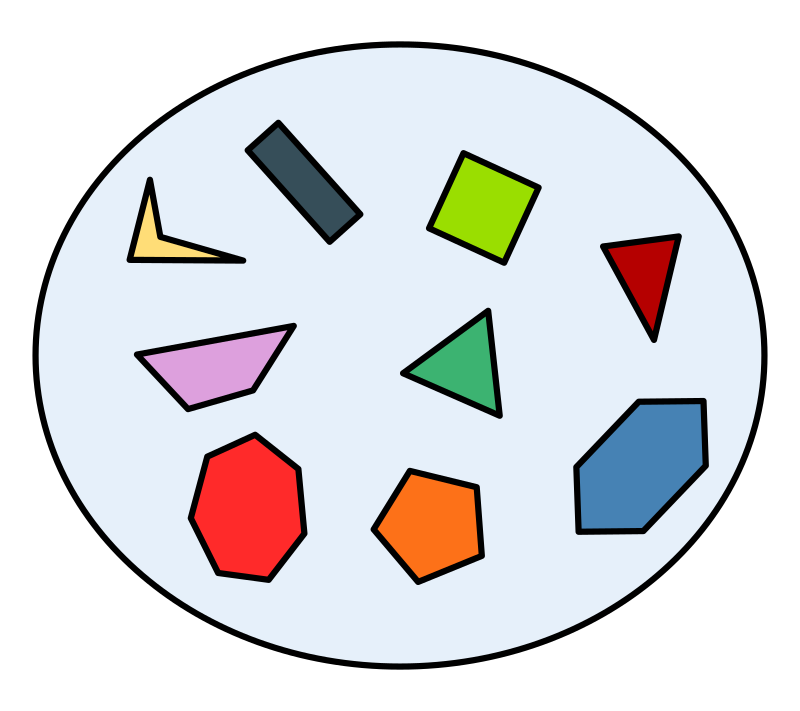
Imagine you're asked to collect all your favorite books. Or maybe all the red pens in your pencil box. What you're doing, in both cases, is gathering a collection of items based on some common characteristic. In mathematics, we have a special name for such a collection: a Set.

Formally, a set is a well-defined collection of distinct objects.

Let's break down this definition because every word here is super important!

#### a) "Collection of Objects"
This part is straightforward. A set is basically a group of things. These 'things' are called elements or members of the set. The objects can be anything โ€“ numbers, letters, people, cities, fruits, mathematical functions, or even other sets!

#### b) "Well-Defined" - The Crucial Part!
This is the heart of the definition. What does "well-defined" mean?
It means that there should be no ambiguity about whether a particular object belongs to the set or not. Everyone should agree on what goes into the set and what stays out.

Let's look at some examples to clarify:


Well-Defined Collection (It's a Set!) Not Well-Defined Collection (It's NOT a Set!)


  • The collection of all vowels in the English alphabet.
    (Clearly, 'a', 'e', 'i', 'o', 'u' belong. 'b' does not. No confusion.)

  • The collection of all natural numbers less than 10.
    (Numbers 1, 2, 3, 4, 5, 6, 7, 8, 9 belong. 10 does not. Again, no confusion.)

  • The collection of rivers in India.
    (A list of rivers can be compiled; a river either is in India or it isn't.)


  • The collection of "good" students in your class.
    (What does "good" mean? Good in studies? Good in sports? Good in behavior? This is subjective and depends on who is judging. Ambiguous!)

  • The collection of "beautiful" flowers.
    (Beauty is in the eye of the beholder! What one person finds beautiful, another might not. Not well-defined.)

  • The collection of "talented" artists.
    (Similar to "good students", talent is subjective and difficult to quantify universally.)


Key Takeaway: For a collection to be a set, there must be an objective criterion for inclusion or exclusion.

#### c) "Distinct Objects"
This simply means that each object in a set must be unique. We don't list the same element more than once. Even if an object appears multiple times in a description, we only count it once when forming a set.

For example, if you collect the letters from the word "MATHEMATICS", the set of unique letters would be {M, A, T, H, E, I, C, S}. We don't write {M, A, T, H, E, M, A, T, I, C, S} because 'M', 'A', 'T' are repeated.

Analogy: Think of a set like a specific type of container, say a special display box. Each item you put in that box has to be unique and clearly defined. You wouldn't put two identical toy cars if the rule for the box is "unique toys." And you wouldn't put an apple if the box is for "vegetables."

---

### 2. Notation and Basic Terminology

* Sets are usually denoted by capital letters, like A, B, C, X, Y, Z.
* The elements or members of a set are usually denoted by lowercase letters, like a, b, c, x, y, z.
* If 'x' is an element of set A, we write $x in A$. This is read as "x belongs to A" or "x is an element of A".
* If 'y' is not an element of set A, we write $y
otin A$
. This is read as "y does not belong to A" or "y is not an element of A".

Example:
Let V be the set of vowels in the English alphabet.
So, $V = {a, e, i, o, u}$.
Here, $a in V$, $e in V$, etc.
But, $b
otin V$, $z
otin V$.

---

### 3. Methods of Representing a Set

There are two primary ways to represent or describe a set:

#### a) Roster Form (or Tabular Form)

In this method, we simply list all the elements of the set, separating them by commas, and enclosing them within curly braces `{}`.

Important points about Roster Form:
1. Order of elements does not matter. For example, ${1, 2, 3}$ is the same set as ${3, 1, 2}$ or ${2, 3, 1}$.
2. Elements are not repeated. Even if an element is mentioned multiple times, it is listed only once.

Examples:
* Set of vowels: $V = {a, e, i, o, u}$
* Set of natural numbers less than 6: $N = {1, 2, 3, 4, 5}$
* Set of even numbers between 1 and 10 (inclusive): $E = {2, 4, 6, 8, 10}$
* Set of letters in the word "MISSISSIPPI": $L = {M, I, S, P}$ (Notice the repeated letters are listed only once)

What if the set has many elements, or is infinite?
We use an ellipsis (`...`) to indicate that the pattern continues.
* Set of natural numbers: $N = {1, 2, 3, 4, ...}$
* Set of multiples of 5 less than 50: $M = {5, 10, 15, ..., 45}$ (Here, the pattern is clear, and we know it ends at 45).

#### b) Set-Builder Form (or Rule Method)

This method is used when it's difficult or impossible to list all the elements (e.g., for very large or infinite sets) or when we want to define a set based on a common property that all its elements share.

In this form, we describe the elements of the set by stating a characteristic property that all elements of the set satisfy, and no other element outside the set satisfies.

The general form looks like this:
${x : P(x)}$ or ${x | P(x)}$

Let's break down this notation:
* `x`: Represents a generic element of the set.
* `: ` or `|`: Stands for "such that".
* `P(x)`: Is the property or condition that `x` must satisfy to be an element of the set.

Examples:

1. Set of vowels in the English alphabet:
* Roster form: $V = {a, e, i, o, u}$
* Set-builder form: $V = {x : x ext{ is a vowel in the English alphabet}}$
* (Read as: "V is the set of all x such that x is a vowel in the English alphabet.")

2. Set of all natural numbers:
* Roster form: $N = {1, 2, 3, ...}$
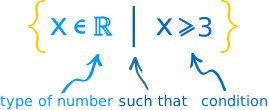
* Set-builder form: $N = {x : x ext{ is a natural number}}$ or $N = {x mid x in mathbb{N}}$ (Here, $mathbb{N}$ denotes the set of natural numbers, which is a common mathematical symbol).

3. Set of even integers:
* Roster form: $E = {..., -4, -2, 0, 2, 4, ...}$
* Set-builder form: $E = {x : x ext{ is an integer and } x ext{ is divisible by 2}}$
* A more mathematical way: $E = {x mid x = 2n, ext{ where } n in mathbb{Z}}$ (Here, $mathbb{Z}$ denotes the set of integers).

4. Set of squares of natural numbers less than 5:
* Let's find the elements first: Natural numbers less than 5 are {1, 2, 3, 4}. Their squares are {1, 4, 9, 16}.
* Roster form: $S = {1, 4, 9, 16}$
* Set-builder form: $S = {x^2 : x in mathbb{N} ext{ and } x < 5}$
* (Read as: "S is the set of all $x^2$ such that x is a natural number and x is less than 5.")
* Alternatively: $S = {y : y = x^2 ext{ for some } x in mathbb{N} ext{ and } x < 5}$

Why is Set-Builder Form so powerful?
It allows us to define sets very precisely, especially when elements cannot be easily listed. For instance, consider the set of all real numbers between 0 and 1. You cannot list them in roster form because there are infinitely many real numbers, even in that small interval.
$A = {x mid x in mathbb{R} ext{ and } 0 < x < 1}$ โ€“ This is a clear and concise definition using set-builder form.

---

### 4. Basic Types of Sets (A Quick Glimpse)

While we'll cover types of sets in detail later, it's good to be familiar with a few basic ones as they often come up in representation.

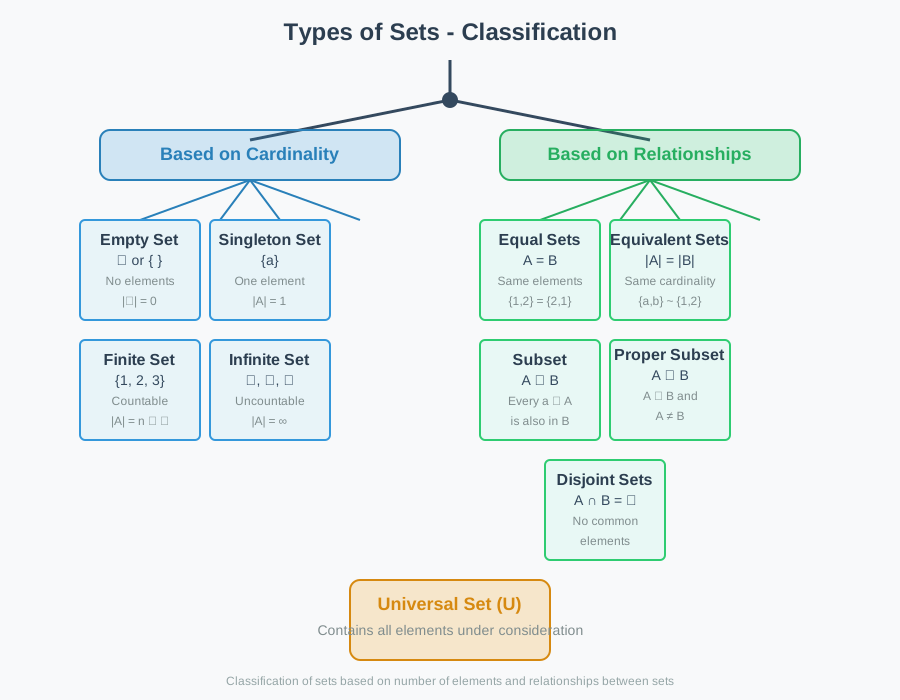
#### a) The Empty Set (or Null Set)
A set that contains no elements at all. It is denoted by $emptyset$ or {}.

Example:
* The set of all natural numbers less than 1. (There are none!) So, $A = emptyset$.
* The set of students in your class who are 10 feet tall. (Hopefully none!) So, $B = emptyset$.

#### b) Finite Set
A set where the elements can be counted, meaning it has a definite number of elements. The process of counting the elements would eventually come to an end.

Example:
* The set of days in a week: ${Monday, Tuesday, ..., Sunday}$ (7 elements)
* The set of solutions to the equation $x^2 - 4 = 0$: ${-2, 2}$ (2 elements)

#### c) Infinite Set
A set that contains an unlimited number of elements; the elements cannot be counted completely.

Example:
* The set of all natural numbers: ${1, 2, 3, ...}$
* The set of all integers: ${..., -2, -1, 0, 1, 2, ...}$
* The set of all points on a line.

---

### 5. CBSE vs. JEE Focus

For CBSE and Board exams, understanding the definition of a set, being able to identify well-defined collections, and confidently converting between Roster and Set-Builder forms are key. Questions will be relatively straightforward in terms of the properties used in Set-Builder form.

For JEE Mains & Advanced, sets form the absolute bedrock for various topics like Relations, Functions, Probability, and Logic. While the definition remains the same, the complexity of the properties described in Set-Builder form can significantly increase. You'll encounter sets defined by intricate conditions involving inequalities, modulus, greatest integer function, fractional part function, trigonometric functions, etc.
Therefore, a deep and intuitive understanding of Set-Builder form is crucial. You must be able to visualize and interpret what elements satisfy complex conditions. This is where your problem-solving skills will be tested later on.

---

### Practice Time! (Let's solidify our understanding)

Example 1: Convert from Roster Form to Set-Builder Form

Let $A = {1, 8, 27, 64, 125}$

Step-by-step thinking:
1. Look at the numbers: 1, 8, 27, 64, 125.
2. Can you see a pattern?
* $1 = 1^3$
* $8 = 2^3$
* $27 = 3^3$
* $64 = 4^3$
* $125 = 5^3$
3. So, the elements are cubes of natural numbers.
4. What's the range? From 1 to 5.
5. Thus, $A = {x^3 : x in mathbb{N} ext{ and } 1 le x le 5}$
Or, $A = {x : x = n^3 ext{ for some natural number } n, ext{ where } 1 le n le 5}$

Example 2: Convert from Set-Builder Form to Roster Form

Let $B = {x : x ext{ is an integer and } -3 < x le 2}$

Step-by-step thinking:
1. Identify the type of numbers: Integers ($mathbb{Z}$). These are whole numbers, including zero and negative whole numbers ($..., -2, -1, 0, 1, 2, ...$).
2. Look at the conditions:
* $x > -3$ (This means x cannot be -3. So, -2, -1, 0, 1, 2...)
* $x le 2$ (This means x can be 2. So, ..., 0, 1, 2)
3. Combine these conditions: The integers that are strictly greater than -3 but less than or equal to 2 are -2, -1, 0, 1, 2.
4. Thus, $B = {-2, -1, 0, 1, 2}$

Example 3: Checking "Well-defined"

Is the collection of "the 10 most intelligent students in your school" a set?

Step-by-step thinking:
1. What does "intelligent" mean? Is there a universal, objective measure of intelligence that everyone would agree upon?
2. Some might judge by exam scores, others by problem-solving skills, others by creativity, or by an IQ test.
3. Since the criteria for 'intelligence' can vary and is subjective, we cannot definitively say who the "most intelligent" students are without ambiguity.
4. Therefore, this collection is NOT a set.

---

I hope this detailed explanation of sets and their representation helps you build a strong foundation. Remember, practice is key! Try to define your own collections and determine if they are sets, and then practice converting between Roster and Set-Builder forms. Let's move forward with this clarity!
๐Ÿ”ฌ Deep Dive
Hello everyone! Welcome to this deep dive into the fascinating world of Sets. As future engineers and scientists, a strong understanding of mathematical foundations is absolutely crucial, and Sets form one of the most fundamental building blocks of modern mathematics. From advanced calculus to computer science, sets provide a language to describe collections of objects precisely.

In this section, we'll start from the very basics, assuming you've never encountered sets before, and progressively build up to the level required for JEE Mains & Advanced. Weโ€™ll focus on what a set is, its key characteristics, and the various ways we can represent them mathematically.

---

### 1. What is a Set? - The Foundation

Let's begin with the most basic question: What exactly is a set?

In simple terms, a set is a well-defined collection of distinct objects.

Let's break down this definition with an analogy. Imagine you have a collection of your favorite books. This collection is a set. What makes it a set?
1. Collection: It's a gathering of items.
2. Objects: The items are the individual books.
3. Well-defined: You can clearly tell whether a particular book belongs to your collection or not. For instance, if you say "my collection of 'good' books," that's not well-defined because what's "good" is subjective. But if you say "my collection of books written by Chetan Bhagat," then it's clear. A book either is written by him or it isn't. There's no ambiguity.
4. Distinct: Each book is unique. Even if you have two copies of the same book, mathematically, we consider them as one distinct element in the set for most purposes, unless specified otherwise (like a multiset, which is beyond our current scope).


Key Idea: The term "well-defined" is the cornerstone of the set definition. It means that for any given object, we must be able to unambiguously decide whether that object belongs to the set or not. There should be no subjective judgment involved.


Examples of Well-Defined Collections (Sets):
* The collection of all even natural numbers less than 10. (Elements: 2, 4, 6, 8)
* The collection of all vowels in the English alphabet. (Elements: a, e, i, o, u)
* The collection of all months of a year beginning with the letter 'J'. (Elements: January, June, July)
* The collection of solutions to the equation $x^2 - 4 = 0$. (Elements: -2, 2)

Examples of Not Well-Defined Collections (Not Sets):
* The collection of "smart" students in your class. (What defines "smart"?)
* The collection of "beautiful" flowers. (Beauty is subjective.)
* The collection of "talented" singers. (Talent is subjective.)

The individual objects within a set are called elements or members of the set. We usually denote sets by capital letters (A, B, C, X, Y, Z, etc.) and elements by lowercase letters (a, b, c, x, y, z, etc.).

If 'a' is an element of set 'A', we write this symbolically as $a in A$. This symbol '$in$' means "is an element of" or "belongs to".
If 'b' is not an element of set 'A', we write $b
otin A$. This symbol '$
otin$' means "is not an element of" or "does not belong to".

---

### 2. Key Characteristics of a Set

To reinforce our understanding, let's summarize the essential properties of a set:

1. Well-defined: As discussed, there must be no ambiguity regarding the membership of an object in the set.
2. Distinct Elements: The objects in a set must be distinct. Repetition of elements within a set is generally not allowed. For example, the set of letters in the word "SCHOOL" is {S, C, H, O, L}, not {S, C, H, O, O, L}. Even if an element is written multiple times, it is still considered only once.
3. Order is Immaterial: The order in which the elements are listed does not change the set. For instance, the set {1, 2, 3} is exactly the same as {3, 2, 1} or {2, 1, 3}. This is a crucial distinction from ordered lists or sequences.

---

### 3. Standard Notations for Some Special Sets

Mathematics frequently deals with certain types of numbers, and we have standard symbols for these sets:

* $mathbb{N}$ or N: The set of Natural Numbers = {1, 2, 3, ...} (Some definitions include 0, but for JEE, generally N starts from 1 unless specified).
* $mathbb{W}$ or W: The set of Whole Numbers = {0, 1, 2, 3, ...}
* $mathbb{Z}$ or I: The set of Integers = {..., -3, -2, -1, 0, 1, 2, 3, ...}
* $mathbb{Q}$ or Q: The set of Rational Numbers = {$p/q mid p, q in mathbb{Z}, q
e 0$}
* $mathbb{R}$ or R: The set of Real Numbers (includes all rational and irrational numbers)
* $mathbb{C}$ or C: The set of Complex Numbers

You might also encounter notations like $mathbb{Z}^+$ (positive integers), $mathbb{R}^+$ (positive real numbers), etc.

---

### 4. Representation of Sets

There are primarily two standard methods to represent a set:

1. Roster or Tabular Form
2. Set-builder Form or Rule Method

Let's explore each method in detail.

#### 4.1 Roster or Tabular Form

In this form, all the elements of the set are listed, separated by commas, and enclosed within curly braces `{}`.

Characteristics of Roster Form:
* Elements are listed explicitly.
* Commas separate the elements.
* Curly braces `{}` enclose the entire list.
* No element is generally repeated.
* The order of elements does not matter.

Examples:

* Example 1: The set of all vowels in the English alphabet.
$A = {a, e, i, o, u}$

* Example 2: The set of even natural numbers less than 10.
$B = {2, 4, 6, 8}$

* Example 3: The set of positive integers which are divisors of 12.
The divisors of 12 are 1, 2, 3, 4, 6, 12.
$C = {1, 2, 3, 4, 6, 12}$

* Example 4: The set of natural numbers such that $x^2 = 4$.
The solutions to $x^2 = 4$ are $x = 2$ and $x = -2$. Since we are looking for natural numbers, only $x=2$ qualifies.
$D = {2}$

For Infinite Sets:
If a set has an infinite number of elements, we list a few elements to establish a pattern and then use three dots (ellipses) `...` to indicate that the pattern continues indefinitely.

* Example 5: The set of natural numbers.
$N = {1, 2, 3, 4, ...}$

* Example 6: The set of integers.
$Z = {..., -3, -2, -1, 0, 1, 2, 3, ...}$


CBSE Focus: Roster form is fundamental and frequently tested in basic set theory problems. Ensure you are comfortable listing elements for simple conditions.


#### 4.2 Set-builder Form or Rule Method

In this form, we do not list the elements. Instead, we describe a characteristic property or a rule that all elements in the set must satisfy, and no other element outside the set satisfies this property.

The general structure of the Set-builder form is:
$A = {x mid ext{P}(x) }$ or $A = {x : ext{P}(x) }$

Here:
* `x` represents an arbitrary element of the set.
* `|` (vertical bar) or `:` (colon) stands for "such that".
* `P(x)` is the characteristic property that the element `x` must satisfy to be a member of the set.

Examples:

* Example 1: The set of all vowels in the English alphabet.
In Roster form: $A = {a, e, i, o, u}$
In Set-builder form: $A = {x mid x ext{ is a vowel in the English alphabet}}$

* Example 2: The set of even natural numbers less than 10.
In Roster form: $B = {2, 4, 6, 8}$
In Set-builder form: $B = {x mid x ext{ is an even natural number and } x < 10}$
Alternatively: $B = {x in mathbb{N} mid x ext{ is even and } x < 10}$ (This specifies the domain more clearly)

* Example 3: The set of positive integers which are divisors of 12.
In Roster form: $C = {1, 2, 3, 4, 6, 12}$
In Set-builder form: $C = {x mid x in mathbb{Z}^+ ext{ and } x ext{ divides } 12}$

* Example 4: The set of all real numbers whose square is 25.
$E = {x mid x in mathbb{R} ext{ and } x^2 = 25}$
In Roster form: $E = {-5, 5}$

* Example 5: The set of all rational numbers between 0 and 1 (exclusive).
$F = {x mid x in mathbb{Q} ext{ and } 0 < x < 1}$
Notice: This set cannot be written in Roster form because there are infinitely many rational numbers between 0 and 1, and they cannot be listed in any discernible pattern. This highlights the power of set-builder form for certain infinite sets.

Working with Set-builder Form (JEE Perspective):

JEE questions often present sets in set-builder form and require you to analyze their properties, perform operations, or convert them to roster form. Mastering the interpretation of the characteristic property $P(x)$ is vital.

Consider the set $G = {x mid x = 2n, n in mathbb{N} ext{ and } n le 5}$.
Let's break this down:
1. $x = 2n$: This tells us the form of the elements in the set. They are multiples of 2.
2. $n in mathbb{N}$: This tells us that 'n' must be a natural number (1, 2, 3, ...).
3. $n le 5$: This limits the values of 'n' to {1, 2, 3, 4, 5}.

Now, substitute these values of 'n' into $x = 2n$:
* If $n=1$, $x = 2(1) = 2$
* If $n=2$, $x = 2(2) = 4$
* If $n=3$, $x = 2(3) = 6$
* If $n=4$, $x = 2(4) = 8$
* If $n=5$, $x = 2(5) = 10$
So, in Roster form, $G = {2, 4, 6, 8, 10}$.


JEE Focus: For JEE, proficiency in translating between Roster and Set-builder forms is critical. You'll encounter complex conditions involving inequalities, functions, specific types of numbers (primes, composites, perfect squares, etc.), and combinations of these. Always pay attention to the domain of 'x' (e.g., $x in mathbb{N}, x in mathbb{Z}, x in mathbb{R}$).


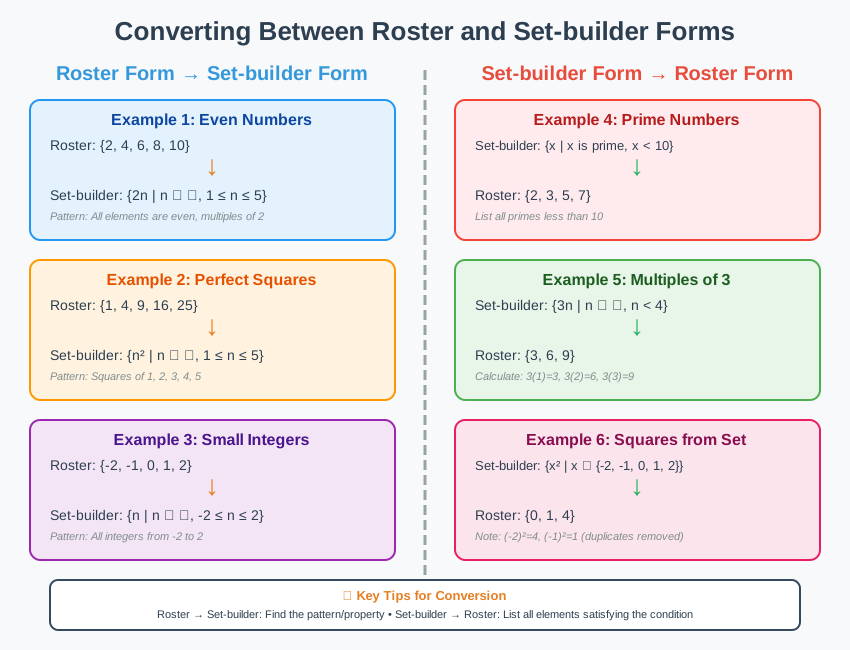
### Conversion Examples (Roster to Set-builder and Vice Versa)

Let's practice a few conversions:

| S. No. | Roster Form Representation | Set-Builder Form Representation | Explanation of Conversion |
| :----- | :------------------------- | :------------------------------------------------------------------------------------------------- | :---------------------------------------------------------------------------------------------------------------------------------------------------------------------------------------------------------------------------------------------------------------------------------------------------------------------------------------------------------------------------------------------------------------------------------------------------- |
| 1 | $A = {1, 3, 5, 7, 9}$ | $A = {x mid x ext{ is an odd natural number and } x < 10}$ | Identify the pattern: These are odd numbers. Determine the range: They are natural numbers and less than 10. |
| 2 | $B = {0, 1, 4, 9, 16}$ | $B = {x^2 mid x in mathbb{W} ext{ and } x le 4}$
OR
$B = {y mid y = x^2, x in mathbb{Z} ext{ and } -4 le x le 4}$ (Careful here, distinct elements are $0^2, 1^2, 2^2, 3^2, 4^2$. Also $(-1)^2=1$, so for unique elements, $x ge 0$ suffices, or $y$ itself is the square of an integer) | Recognize the elements as perfect squares: $0^2, 1^2, 2^2, 3^2, 4^2$. Specify the base 'x' as a whole number up to 4. The second form is also valid, but the simplest definition is preferred. The key is that $x^2$ is the element, not $x$. |
| 3 | $C = { -2, -1, 0, 1, 2 }$ | $C = {x mid x in mathbb{Z} ext{ and } -2 le x le 2}$ | Identify the type of numbers: Integers. Determine the range: From -2 to 2 inclusive. |
| 4 | $D = { frac{1}{2}, frac{2}{3}, frac{3}{4}, frac{4}{5} }$ | $D = { frac{n}{n+1} mid n in mathbb{N} ext{ and } n le 4 }$ | Observe the pattern: Numerator 'n' and denominator 'n+1'. The 'n' values are 1, 2, 3, 4. So, 'n' is a natural number from 1 to 4. |
| 5 | $E = {x mid x in mathbb{R} ext{ and } 2 < x < 5}$ | This set cannot be written in Roster form as it contains an infinite number of real numbers between 2 and 5, which cannot be listed. | This example highlights a key limitation of Roster form. When there is a continuum of numbers (like real numbers in an interval), only set-builder form (or interval notation) can represent it. |

---

### Conclusion

Understanding sets and their representations is a foundational skill in mathematics. The ability to clearly define a set, identify its elements, and express it accurately using both Roster and Set-builder forms is paramount. For JEE aspirants, the Set-builder form, especially with complex conditions and domain specifications, will be your primary tool for interpreting problems and formulating solutions. Always practice converting between forms and pay meticulous attention to the "well-defined" nature of a collection.

This solid understanding will be your stepping stone as we delve deeper into types of sets, subsets, set operations, and eventually, relations and functions. Keep practicing!
๐ŸŽฏ Shortcuts

Memorizing definitions and distinguishing between different concepts can be challenging, especially under exam pressure. Mnemonics and short-cuts provide quick recall tools for core definitions and distinctions in the topic of Sets and their Representation. For JEE Main, these help in efficiently tackling questions, particularly those testing basic understanding.


I. Definition of a Set


A set is a well-defined collection of distinct objects.


  • Mnemonic: W.D.C.

    • Well-Defined: Clear criteria for inclusion/exclusion.

    • Distinct: No repeated elements.

    • Collection: A group of objects.


    This quick acronym reminds you of the three essential characteristics that define a set.


II. Methods of Set Representation


There are two primary ways to represent sets:


  • Roster or Tabular Form: Elements are listed within curly braces, separated by commas.

    • Mnemonic: "Roster Lists, Roll Call Ranks."

      Think of a "roll call" where you list out each student's name individually. Similarly, Roster form lists out each rank (element).

      Example: `A = {1, 2, 3, 4}`


  • Set-Builder Form: Elements are described by a common property or rule.

    • Mnemonic: "Set-Builder Builds a Statement."

      This form builds a descriptive statement or rule that all elements must satisfy. The vertical bar `|` or colon `:` reads as "such that".

      Example: `A = {x | x is a natural number and x < 5}`


III. Key Set Types & Distinctions


Understanding the nuances between different types of sets is crucial.


  • Empty Set (Null Set): A set containing no elements. Denoted by `โˆ…` or `{}`.

    • Mnemonic: "Empty Circle, Empty Braces."

      The symbol `โˆ…` looks like an empty circle. The curly braces `{}` are literally empty. Both visually reinforce the idea of "nothing inside."


  • Finite vs. Infinite Sets:

    • Finite Set: Elements can be counted.

    • Infinite Set: Elements cannot be counted (process never ends).

    • Mnemonic: "Finite Finished, Infinite Indefinite."

      A Finite set has a definite end point, its elements can be finished counting. An Infinite set goes on indefinitely. Often denoted by `...` (ellipsis).


  • Equal vs. Equivalent Sets:

    • Equal Sets: Have exactly the same elements. `A = B` means `A โІ B` and `B โІ A`.

    • Equivalent Sets: Have the same number of elements (same cardinality). `n(A) = n(B)`.

    • Mnemonic: "EQual has EQual elements. EQuivalent has EQual count (Cardinality)."

      The 'L' in 'Equal' can remind you of 'elements'. The 'V' in 'Equivalent' looks like a Roman numeral for 5, hinting at 'count' or 'value'.


IV. Symbols Quick Recall


Familiarity with set notation is fundamental for both CBSE and JEE Main.


  • `โˆˆ` (Element of):

    • Mnemonic: "E-lement of." The symbol looks like a curved 'E'.


  • `โІ` (Subset/Is a subset of or Equal to):

    • Mnemonic: "Sub-Equal." The 'U' shape indicates 'subset', and the line underneath indicates 'or equal to'. Think of it as "smaller than or equal to".


  • `โŠ‚` (Proper Subset/Is a proper subset of):

    • Mnemonic: "Strictly Sub." The absence of the line means it cannot be equal. It must be strictly smaller.


Mastering these basic definitions and representations with the help of mnemonics will build a strong foundation for more complex topics in Set Theory, ensuring accuracy and speed in your exams.

๐Ÿ’ก Quick Tips
Here are some quick, exam-oriented tips for mastering "Sets and their Representation":

Mastering the basics of sets is crucial as it forms the foundation for Relations and Functions. Pay close attention to the subtleties of representation and element identification.


  • Understanding Set Elements:

    • Order of elements does not matter: The set `{1, 2, 3}` is identical to `{3, 1, 2}`.

    • Repetition of elements is ignored: The set `{1, 1, 2, 3}` is simply `{1, 2, 3}`. Always list distinct elements only.

    • An element can itself be a set. For example, in `A = {1, {2}, 3}`, the elements are `1`, `{2}`, and `3`. The cardinality `n(A)` is 3.


  • Roster Form vs. Set-Builder Form:

    • Roster Form (Tabular Form): Directly lists all elements within curly braces, separated by commas. Easy to understand for finite sets. Example: `A = {a, e, i, o, u}`.

    • Set-Builder Form: Describes elements by a common property. Example: `B = {x | x is a prime number less than 10}`. This is widely used in JEE.

      • JEE Trap Alert: Always carefully interpret the 'type' of element (`x โˆˆ N`, `x โˆˆ Z`, `x โˆˆ R`, etc.) and the 'condition' it must satisfy. A slight change in domain can drastically alter the set.


  • Cardinality of a Set:

    • The cardinality of a finite set A, denoted by `n(A)` or `|A|`, is the number of distinct elements in it.

    • If `A = {a, {b}, c}`, then `n(A) = 3`. Note that `{b}` is counted as one element.


  • The Empty Set (Null Set):

    • Represented by `โˆ…` or `{}`. It contains no elements, so `n(โˆ…) = 0`.

    • Key Property: The empty set is a subset of every set (`โˆ… โІ A` for any set A).

    • Common Mistake: Do not confuse `โˆ…` with `{0}` or `{โˆ…}`.

      • `โˆ…`: A set with 0 elements.

      • `{0}`: A set with one element (the number 0). `n({0}) = 1`.

      • `{โˆ…}`: A set with one element (which is the empty set itself). `n({โˆ…}) = 1`.


  • Subsets and Proper Subsets:

    • If every element of set A is also an element of set B, then A is a subset of B (`A โІ B`).

    • If `A โІ B` and `A โ‰  B`, then A is a proper subset of B (`A โŠ‚ B`).

    • A set with `n` elements has `2^n` subsets.

    • A set with `n` elements has `2^n - 1` proper subsets. (The set itself is excluded).


  • Power Set:

    • The power set of a set A, denoted by `P(A)`, is the set of all possible subsets of A.

    • If `n(A) = k`, then `n(P(A)) = 2^k`.

    • JEE Focus: Be extremely careful with the distinction between 'element of' (`โˆˆ`) and 'subset of' (`โІ`) when dealing with power sets.

      • Example: If `A = {1, 2}`, then `P(A) = {โˆ…, {1}, {2}, {1, 2}}`.

      • Here, `1 โˆˆ A` (true), `{1} โˆˆ P(A)` (true), `{1} โІ A` (true), `โˆ… โˆˆ P(A)` (true), `โˆ… โІ A` (true).


  • Equality of Sets:

    • Two sets A and B are equal (`A = B`) if and only if they have exactly the same elements.

    • This means `A โІ B` and `B โІ A` must both be true. This property is often used in proofs.


  • JEE Main Specific Tip:

    • Problems frequently test your ability to correctly interpret complex set-builder notations, especially those involving inequalities or specific number systems (integers, rationals, reals).

    • Always attempt to convert set-builder forms into a clearer roster form (if finite) or visualize the elements (e.g., using number line intervals for real numbers) before performing operations or determining properties.

    • Practice problems that involve finding the cardinality of power sets of sets derived from tricky conditions.


๐Ÿง  Intuitive Understanding

Intuitive Understanding: Sets and Their Representation


At its core, a Set is a fundamental concept in mathematics that mirrors our everyday act of grouping things together. Think of it as a well-defined collection of distinct objects. The intuition behind sets is simple: whenever you gather items based on a common characteristic, you are essentially forming a set.


What Makes a Collection a "Set"?


The "well-defined" part is crucial. It means there should be absolutely no ambiguity about whether an object belongs to the collection or not. Consider these examples:


  • Is a Set: "The collection of all even numbers less than 10." (2, 4, 6, 8 - clearly defined)

  • Not a Set: "The collection of all beautiful flowers." (What is 'beautiful' to one person might not be to another; it's subjective.)


For JEE and CBSE, recognizing if a given description forms a valid set is an important initial step. The criteria must be objective and universal.


Key Intuitive Properties of Sets:


  • Distinct Objects: Each object in a set must be unique. If you list an item multiple times, it's still considered only once in the set.

    Intuition: If you have two identical pens, you still only have one *type* of pen. The collection {pen, pen, eraser} is effectively {pen, eraser}.

    Mathematically: {1, 1, 2, 3} is the same as {1, 2, 3}.

  • Order Doesn't Matter: The arrangement of elements within a set does not change the set itself.

    Intuition: Your collection of books is the same whether they are alphabetized or arranged by color.

    Mathematically: {a, b, c} is the same as {c, a, b}.


Intuitive Understanding of Set Representation:


How do we write down or describe a set? There are two primary ways, each with its intuitive appeal:


1. Roster Form (or Tabular Form)


  • Intuition: This is like making a shopping list. You simply list all the items (elements) of the set, separated by commas, and enclosed within curly braces `{}`.

  • When to use: Best for sets with a small number of elements, or when elements are not easily described by a single property.

  • Example: The set of vowels in the English alphabet is V = {a, e, i, o, u}.


2. Set-Builder Form (or Rule Method)


  • Intuition: This is like setting up a rule or a filter. Instead of listing every element, you describe the common property that all elements of the set share.

  • When to use: Ideal for large or infinite sets, or when elements follow a specific pattern. It's more abstract but incredibly powerful.

  • Example: The set of all even natural numbers can't be listed. So we describe it as E = {x | x is an even natural number} or E = {x | x = 2n, where n โˆˆ N}. The vertical bar '|' reads "such that".


Comparison: Roster vs. Set-Builder


Set Description Roster Form Set-Builder Form
First three natural numbers {1, 2, 3} {x | x โˆˆ N and x < 4}
Integers between -2 and 2 (exclusive) {-1, 0, 1} {x | x โˆˆ Z and -2 < x < 2}


Understanding these basic intuitions โ€“ what a set is, its core properties, and how to represent it โ€“ forms the bedrock for all advanced concepts in Set Theory. For JEE, accurately identifying, forming, and interpreting sets from various descriptions is a recurring skill tested in problems.


๐ŸŒ Real World Applications

Real World Applications of Sets and Their Representation


While the study of sets might seem abstract, its fundamental principles underpin countless real-world scenarios and technological advancements. Understanding sets not only builds a strong mathematical foundation but also helps in comprehending how information is organized, classified, and processed in various fields.

Here are some practical applications where sets and their representations are extensively used:


  • Computer Science and Data Management:

    • Databases: Relational databases store data in tables, where each table can be considered a set of records. Queries (e.g., SQL queries) use set operations like union, intersection, and difference to retrieve, combine, or filter data.

    • Programming: Many programming languages have built-in set data structures to efficiently store unique elements and perform set operations, useful for tasks like finding common elements or removing duplicates.

    • Network Routing: Identifying optimal paths in a network can involve finding the intersection of available routes or the union of network nodes.


  • Logic and Artificial Intelligence:

    • Problem Solving: AI algorithms often use sets to represent possible states, valid moves, or a collection of features for a particular problem.

    • Expert Systems: Knowledge is often represented as sets of rules or facts, enabling the system to make logical deductions.


  • Statistics and Probability:

    • Data Analysis: When analyzing survey data, researchers often group respondents into sets based on their characteristics (e.g., age group, gender, preferences) and then use set operations to find overlaps or differences.

    • Event Representation: In probability, events are often defined as sets of outcomes. For example, rolling an even number on a die is the set {2, 4, 6}.


  • Biology and Medicine:

    • Classification: Biologists classify organisms into sets based on shared characteristics (e.g., species, genus, family).

    • Genetics: Analyzing genetic data often involves identifying sets of genes associated with a particular disease or trait.


  • Engineering:

    • System Design: When designing complex systems (e.g., electrical circuits, software modules), engineers often define components and their relationships as sets to ensure proper functionality and minimize redundancies.

    • Control Systems: Defining the operational states or failure modes of a system can be done using sets.


Illustrative Example: Database Filtering


Consider a simple database of students and their enrolled courses.


Student ID Student Name Enrolled Course
101AlicePhysics
102BobChemistry
103CharlieMath
101AliceMath
104DavidPhysics


Using set theory:


  • Let S be the set of all students: S = {Alice, Bob, Charlie, David}

  • Let P be the set of students enrolled in Physics: P = {Alice, David}

  • Let M be the set of students enrolled in Math: M = {Alice, Charlie}


We can easily answer questions like:


  • Students taking both Physics AND Math (Intersection): P โˆฉ M = {Alice}

  • Students taking Physics OR Math (Union): P โˆช M = {Alice, David, Charlie}

  • Students taking Physics but NOT Math (Difference): P - M = {David}


JEE Main and CBSE Relevance


For both JEE Main and CBSE, direct questions asking for "real-world applications of sets" are rare. However, understanding these applications provides a deeper conceptual understanding and helps in developing logical reasoning skills. The ability to model problems using set theory, even if abstract, is crucial for solving complex mathematical and computational challenges encountered in higher studies and competitive exams.


A solid grasp of set theory equips you to think about data organization and relationships, which is an invaluable skill beyond just solving equations. Keep exploring, and you'll find mathematics everywhere!

๐Ÿ”„ Common Analogies

Common Analogies for Sets and Their Representation


Analogies are powerful tools that help us understand new, abstract mathematical concepts by relating them to familiar real-world scenarios. For Sets, which form the foundational bedrock of modern mathematics, using relatable analogies can significantly enhance comprehension, especially for JEE and board exams where a strong conceptual grip is crucial.


1. The "Collection" Analogy: A Well-Defined Bag or Container


Imagine a set as a bag, box, or basket. This is perhaps the most fundamental analogy for a set.


  • The Set Itself: The bag/box/basket. It holds things.


  • Elements of the Set: The items inside the bag. For example, if your set is of "Stationery Items," the bag might contain a pen, a pencil, and an eraser.


  • Well-Defined: This means we can clearly tell whether an item belongs in the bag or not. For instance, a pen clearly belongs to the "Stationery Items" bag, but a sandwich does not. This property is crucial for both CBSE and JEE exams. Ambiguous collections (e.g., "a collection of good books") cannot be sets.


  • Distinct Elements: If you put two identical red pens into the bag, mathematically, the "set of pens" still only contains 'red pen' as a single distinct element. Sets do not list duplicate elements.


  • Order Doesn't Matter: If you rearrange the pen, pencil, and eraser inside the bag, the contents of the bag remain exactly the same. Similarly, the order in which elements are listed in a set does not change the set (e.g., {1, 2, 3} is the same as {3, 1, 2}).


2. The "Group" Analogy: A Team or Committee


Think of a set as a sports team (e.g., a cricket or football team) or a committee.


  • The Set Itself: The team or committee.


  • Elements of the Set: The individual players on the team or members of the committee.


  • Well-Defined: There are clear rules for who can be on the team (e.g., age limit, skill level, nationality) or who can be a committee member. This makes the collection of players/members unambiguous.


  • Distinct Elements: Each player on a team is a unique individual. You can't have "Virat Kohli" listed twice as a player on the same team (even if he has two jerseys, he's still one person).


  • Order Doesn't Matter: Whether the team lines up for a photo in one order or another, it's still the same team with the same players.


Connecting to Representation:


  • Roster/Tabular Form (List): This is like listing all the items in your bag (e.g., {pen, pencil, eraser}) or all the players on your team's roster (e.g., {Player A, Player B, Player C}).


  • Set-Builder Form (Rule): This is like describing the characteristic that defines what goes into the bag or who gets on the team. "The set of all x such that x is a stationery item" or "The set of all x such that x is a player selected for the national cricket team." This is particularly important for JEE, where complex set-builder notations are common.


Understanding sets through these simple analogies will make complex set operations and relations much more intuitive as you progress in your JEE and board exam preparation.


๐Ÿ“‹ Prerequisites

Prerequisites for Sets and their Representation


Before delving into the concept of Sets and their various representations, it is crucial to have a solid understanding of certain fundamental mathematical concepts. These foundational skills will significantly aid in grasping the definitions, notation, and applications of sets effectively.


  • 1. Basic Number Systems:

    A clear understanding of different categories of numbers is paramount, as these numbers frequently constitute the elements within sets. You should be thoroughly familiar with:


    • Natural Numbers (N): The counting numbers {1, 2, 3, ...}. (Note: Some definitions include 0).

    • Whole Numbers (W): Natural numbers including zero {0, 1, 2, 3, ...}.

    • Integers (Z or I): All whole numbers and their negative counterparts {..., -2, -1, 0, 1, 2, ...}.

    • Rational Numbers (Q): Numbers that can be expressed as a fraction p/q, where p, q โˆˆ Z and q โ‰  0.

    • Irrational Numbers: Real numbers that cannot be expressed as a simple fraction (e.g., โˆš2, ฯ€).

    • Real Numbers (R): The set encompassing all rational and irrational numbers.


    JEE Relevance: Questions in JEE often assume familiarity with these standard number sets and their respective symbols. Incorrect identification of the domain (e.g., integer vs. real) can lead to errors.


  • 2. Fundamental Algebraic Notation and Variables:

    Proficiency in interpreting and using basic algebraic elements is essential, especially for the Set-Builder Form of representation:


    • Understanding that variables (e.g., x, y, n) can represent generic elements.

    • Interpreting basic algebraic expressions, equations, and inequalities (e.g., x + 5 = 10, 2n > 4).

    • Grasping the concept of a 'condition' or 'property' that an element might satisfy.


  • 3. Basic Logical Reasoning & Connectives:

    While formal mathematical logic is a separate topic, an informal understanding of common logical connectives is implicitly used when defining sets based on specific criteria:


    • 'and' (โˆง): Indicates that multiple conditions must simultaneously be true.

    • 'or' (โˆจ): Indicates that at least one of the given conditions must be true.

    • 'such that' (| or :): A phrase used to introduce a condition or property that elements of a set must satisfy.


  • 4. Inequalities and Interval Notation:

    Many sets are defined by conditions involving inequalities. A strong command over these concepts is crucial:


    • Solving simple linear inequalities (e.g., 3x - 1 < 8).

    • Understanding the meaning of inequality symbols (<, >, โ‰ค, โ‰ฅ).

    • Representing solution sets of inequalities using interval notation (e.g., (a, b) for 'a < x < b', [a, โˆž) for 'x โ‰ฅ a').


    Example: To understand the set {x โˆˆ R | -3 < x โ‰ค 7}, one must recognize it represents all real numbers greater than -3 and less than or equal to 7, which can be written as the interval (-3, 7].


    CBSE vs JEE: Both curricula require strong inequality skills. JEE often integrates inequalities into more complex set definitions and functions.


Revisiting these fundamental concepts will provide a robust foundation, making the upcoming topics on Sets significantly clearer and easier to master.

โš ๏ธ Common Exam Traps

Common Exam Traps: Sets and their Representation


Understanding sets and their representations seems straightforward, but exams often feature subtle questions designed to trip up students. Be aware of these common pitfalls to avoid losing crucial marks.


  • Trap 1: Confusing Elements with Subsets (and the Empty Set)


    This is arguably the most common trap. Students frequently mix up an element x with the set containing that element {x}, especially when the empty set โˆ… is involved.


    • Key Distinction: a โˆˆ A means 'a is an element of A'. B โІ A means 'B is a subset of A'.

    • Empty Set (โˆ… or {}):

      • The empty set โˆ… is an element of itself if and only if it is explicitly listed as one. For example, in A = {โˆ…, {โˆ…}}, โˆ… โˆˆ A.

      • The empty set โˆ… is a subset of every set, including itself. So, for any set A, โˆ… โІ A is always true.


    • JEE Insight: JEE questions often involve sets with nested sets or the empty set, requiring a clear understanding of when something is an element versus a subset.


    Example: Let A = {1, {2}, 3}.


    • 1 โˆˆ A (True)

    • {1} โІ A (True)

    • {2} โˆˆ A (True, because {2} is an element of A)

    • 2 โˆˆ A (False, 2 is not an element of A)

    • {{2}} โІ A (True, because {2} is an element of A, so the set containing this element is a subset)


  • Trap 2: Incorrect Cardinality of Sets, especially with Nested Sets


    The cardinality of a set A, denoted n(A), is the number of distinct elements in A. Mistakes occur when elements are themselves sets.


    • Count Distinct Elements: Each distinct item (whether it's a number, a variable, or another set) counts as one element.

    • Example:

      • If A = {1, 2, 3}, then n(A) = 3.

      • If B = {1, {2, 3}, 4}, then n(B) = 3 (The elements are 1, {2, 3}, and 4).

      • If C = {โˆ…, {โˆ…}}, then n(C) = 2 (The elements are โˆ… and {โˆ…}).


  • Trap 3: Misinterpreting Set-builder Notation


    Set-builder notation {x | P(x)} specifies elements by a property. Errors often arise from misreading the variable, the domain from which x is taken, or the condition P(x) itself.


    • Domain Matters: Always note the universal set or the type of numbers x belongs to (e.g., x โˆˆ N, x โˆˆ Z, x โˆˆ R).

    • Condition Clarity: Ensure you understand the inequality or property precisely.

    • Example:

      • A = {x | xยฒ - 4 = 0, x โˆˆ N}. Here, x = 2 is the only natural number solution. So, A = {2}. (Not {-2, 2}, because -2 โˆ‰ N).

      • B = {x | x is an even prime number}. The only even prime number is 2. So, B = {2}.


    • CBSE vs. JEE: CBSE typically has simpler conditions. JEE often includes more complex inequalities, functions, or number theory conditions, requiring careful evaluation of the domain and property simultaneously.


Pro Tip: For tricky questions involving elements and subsets, mentally (or physically) draw a box around each distinct element of the main set. This helps clarify what constitutes an element. Practice converting between roster form and set-builder notation carefully.


โญ Key Takeaways

This section summarizes the most crucial points regarding Sets and their representation, essential for both Board exams and JEE Main. Focus on these fundamental concepts to build a strong base.


  • What is a Set?

    • A set is a well-defined collection of distinct objects. The term 'well-defined' means that it must be absolutely clear whether a particular object belongs to the set or not.

    • The objects in a set are called its elements or members.

    • Sets are usually denoted by capital letters (e.g., A, B, C) and their elements by lowercase letters (e.g., a, b, c).


  • Key Properties of Elements in a Set:

    • Order of elements does not matter: For example, ({1, 2, 3}) is the same set as ({3, 1, 2}).

    • Elements are not repeated: If an element appears multiple times, it is still considered only once. For example, ({1, 1, 2, 3}) is simply ({1, 2, 3}). This is crucial for understanding cardinality later.


  • Membership Notation:

    • The symbol '∈' (epsilon) means "is an element of" or "belongs to". E.g., (1 in {1, 2, 3}).

    • The symbol '∉' means "is not an element of" or "does not belong to". E.g., (4
      otin {1, 2, 3}).


  • Methods of Representation:

    There are two primary ways to represent a set:


    1. Roster or Tabular Form:

      • All elements of the set are listed within curly braces ({ }), separated by commas.

      • Example (CBSE & JEE): The set of even natural numbers less than 10 is (A = {2, 4, 6, 8}).

      • Use ellipses (...) for large or infinite sets where a pattern is clear. E.g., The set of natural numbers (N = {1, 2, 3, ...}).


    2. Set-Builder Form (Property Method):

      • Elements are described by a common property they all possess, which is not possessed by any other element outside the set.

      • General form: ({x : P(x)}) or ({x | P(x)}), read as "the set of all x such that x has property P".

      • Example (CBSE): (A = {x : x ext{ is an even natural number and } x < 10}).

      • Example (JEE Focus): This form is frequently used in JEE problems, often involving inequalities or specific functions. E.g., (B = {x in mathbb{R} : x^2 - 5x + 6 = 0}). Here, you need to solve the quadratic equation to find the elements, i.e., (B = {2, 3}).


  • Fundamental Set Types (Briefly):

    • Empty Set / Null Set ((emptyset) or {}): A set containing no elements. E.g., ({x : x ext{ is a natural number and } x < 1}).

    • Singleton Set: A set containing exactly one element. E.g., ({5}).

    • Finite Set: A set whose elements can be counted, ending at a certain number. E.g., The set of days in a week.

    • Infinite Set: A set whose elements cannot be counted, it has an unending number of elements. E.g., The set of all integers (mathbb{Z}).


  • JEE Specific Tip: Always be comfortable converting between Roster and Set-Builder forms. JEE problems often present sets in complex set-builder notation, requiring you to first identify the elements to proceed with further operations (like union, intersection, etc.). Practice interpreting conditions like domain, range, inequalities, and functions within set-builder notation.


Mastering these foundational aspects of sets is crucial as they form the bedrock for understanding relations, functions, and various other advanced topics in mathematics.

๐Ÿงฉ Problem Solving Approach

Problem Solving Approach: Sets and their Representation


A systematic approach is crucial for efficiently tackling problems related to sets and their representation. Understanding the precise definitions and notation forms the foundation for accurate solutions, especially in competitive exams like JEE Main.


Key Steps for a Robust Approach:


  1. Deconstruct the Question:

    • Read the problem statement carefully. Identify exactly what is being asked. Are you required to:

      • Represent a set in Roster Form?

      • Represent a set in Set-Builder Form?

      • Identify elements of a given set?

      • Determine if a set is empty, finite, or infinite?

      • Check if two sets are equal?


  2. Identify Given Conditions:

    • List all conditions, properties, or rules that define the elements of the set(s) in question.

    • Note the universal set or the domain from which elements are to be chosen (e.g., natural numbers, integers, real numbers). This is a common source of error if overlooked.


  3. Choose the Optimal Representation Strategy:

    • If a set is given in Set-Builder Form, systematically test values from the specified domain against the given properties to derive its elements for the Roster Form.

    • If elements are described verbally or listed, generalize their common property to express the set in Set-Builder Form.

    • For certain problems, a simple mental sketch or number line visualization can help understand the range of elements.


  4. Apply Definitions and Constraints:

    • Use the formal definitions of set types (e.g., empty set: no elements satisfy the condition; finite set: countable number of elements; infinite set: uncountable number of elements).

    • Ensure all elements strictly adhere to every condition specified in the set-builder notation.


  5. Systematic Execution & Notation:

    • For Roster Form: List all unique elements, separated by commas, enclosed in curly braces {}. Ensure no element is repeated.

    • For Set-Builder Form: Use the format {x | P(x)}, where 'x' is a variable representing elements and P(x) is the property or condition(s) x must satisfy. Clearly state the domain of x.


  6. Verify and Conclude:

    • Double-check if your final set satisfies all original conditions.

    • Ensure the answer is presented in the format requested by the question.


CBSE vs. JEE Main Focus:


Aspect CBSE Board Exams JEE Main
Question Type Direct conversions between Roster and Set-Builder forms, identifying types of sets (empty, finite, infinite), simple comparisons. Emphasis on correct notation. More conceptual questions. Often involves solving equations/inequalities to find elements, careful interpretation of complex Set-Builder conditions (e.g., involving different domains like Z, R, N), and sometimes implicit properties.
Complexity Relatively straightforward. Requires strong analytical skills and precision in understanding mathematical conditions. Minor errors in domain or condition interpretation can lead to incorrect answers.


Example:


Problem: Consider the set $A = {x | x in mathbb{R} ext{ and } x^2 - 5x + 6 = 0}$. Determine if A is a finite or infinite set and represent it in Roster Form.


  1. Deconstruct: Find elements of set A, state if finite/infinite, represent in Roster form.

  2. Given: $x in mathbb{R}$ (real numbers), condition is $x^2 - 5x + 6 = 0$.

  3. Strategy: Solve the quadratic equation to find the values of x.

  4. Apply Definitions: A finite set has a countable number of elements.

  5. Execute:

    $x^2 - 5x + 6 = 0$

    $(x - 2)(x - 3) = 0$

    So, $x = 2$ or $x = 3$.


    Both 2 and 3 are real numbers, satisfying the condition $x in mathbb{R}$.


    Therefore, $A = {2, 3}$.


  6. Verify & Conclude: The set A has exactly two elements, which is a countable number. Thus, A is a finite set, and its Roster Form is $A = {2, 3}$.


Practice extensively to master the art of translating between different forms and accurately interpreting set definitions under various conditions.


๐Ÿ“ CBSE Focus Areas

CBSE Focus Areas: Sets and Their Representation


For CBSE board exams, the topic of 'Sets and their representation' is foundational. While it might seem straightforward, a thorough understanding of definitions and basic operations is crucial for scoring well and building a strong base for subsequent topics in Relations and Functions.


Key Concepts & Areas of Emphasis for CBSE:


  • Definition of a Set: Understand that a set is a well-defined collection of distinct objects. CBSE often tests this fundamental understanding, asking whether a given collection constitutes a set.

    • Example: "The collection of all beautiful girls in your class" is NOT a set because 'beautiful' is not well-defined. "The collection of all students in your class taller than 170 cm" IS a set.


  • Methods of Representation: This is a highly critical area for CBSE.

    • Roster (Tabular) Form: Listing all elements, separated by commas, within curly braces. Elements are not repeated.

      • Exam Tip: Be careful with order and repetition (though order doesn't matter, avoid repeating elements).


    • Set-Builder Form: Describing the elements by a characteristic property that all elements of the set satisfy. This usually takes the form `{x : P(x)}`.

      • Exam Tip: Practice converting between Roster and Set-Builder forms extensively. This is a very common question type.


  • Types of Sets: Be able to identify and define the following:

    • Empty Set (Null Set): A set containing no elements, denoted by ∅ or {}.

    • Finite Set: A set containing a definite number of elements.

    • Infinite Set: A set containing an indefinite number of elements.

    • Equal Sets: Two sets A and B are equal if they have exactly the same elements.


  • Subsets and Superset:

    • Understanding the notation A ⊆ B (A is a subset of B) and A ⊃ B (A is a superset of B).

    • The empty set ∅ is a subset of every set. Every set is a subset of itself.


  • Proper Subsets: If A ⊆ B and A ≠ B, then A is a proper subset of B.


  • Power Set: The collection of all subsets of a set A. It is denoted by P(A).

    • If a set A has 'n' elements, then its power set P(A) has 2n elements. This formula is frequently tested.


  • Universal Set: The basic set from which all other sets in a particular context are drawn. Denoted by U.


Typical CBSE Question Patterns:


  1. Converting a set from Roster form to Set-Builder form, and vice-versa.

  2. Identifying the type of set (finite, infinite, empty, equal).

  3. Writing all subsets or proper subsets of a given set.

  4. Finding the number of elements in a power set.

  5. Determining if a collection is a well-defined set or not.


CBSE vs. JEE Main Perspective:


For CBSE, the focus is on a clear understanding of definitions, notations, and straightforward application of these concepts. Questions are generally direct. For JEE Main, while these basics are essential, questions delve into more complex problem-solving, often combining sets with other topics like functions, relations, or inequalities.


Example Question (CBSE-style):


Q: Convert the set A = {x : x is an integer, x2 ≤ 9} into Roster form.


Solution: We need to find all integers whose square is less than or equal to 9.


  • For x = 0, x2 = 0 ≤ 9

  • For x = ±1, x2 = 1 ≤ 9

  • For x = ±2, x2 = 4 ≤ 9

  • For x = ±3, x2 = 9 ≤ 9

  • For x = ±4, x2 = 16 > 9 (so these are not included)


Therefore, in Roster form, A = {-3, -2, -1, 0, 1, 2, 3}.


Mastering these basics will provide a strong foundation for your board exams and future mathematical pursuits!


๐ŸŽ“ JEE Focus Areas

JEE Focus Areas: Sets and Their Representation


Sets form the foundational bedrock for many advanced topics in Mathematics, particularly in Relations, Functions, Probability, and Logic. While seemingly simple, a thorough understanding of set representation and definitions is crucial for accurately solving complex JEE problems.


Key Focus Areas for JEE Main:


  • Mastering Set Notation (Roster vs. Set-Builder Form):

    • CBSE Perspective: Primarily focuses on basic conversion between roster (listing elements) and set-builder (describing properties) forms.

    • JEE Perspective: Problems often present sets in complex set-builder forms. You must be adept at interpreting conditions involving inequalities, modulus, greatest integer function, fractional part function, trigonometric functions, or properties from number theory (e.g., divisibility, prime numbers) to determine the exact elements of the set. Accuracy in parsing these conditions is paramount.


  • Understanding Types of Sets:

    • Null Set (Empty Set, ∅ or {}): A set with no elements. Be careful not to confuse {∅} or {0} with the null set; these are singleton sets containing the null set itself or the element '0' respectively.

    • Finite vs. Infinite Sets: Distinguish based on whether elements can be counted or not.

    • Singleton Set: A set containing exactly one element.


  • Cardinality of a Set:

    • The number of distinct elements in a finite set, denoted as n(A) or |A|. This simple concept becomes challenging when the set definition is complex, requiring careful enumeration of elements.


  • Subsets and Proper Subsets:

    • Definition: A set A is a subset of B (A ⊆ B) if every element of A is also an element of B. A is a proper subset of B (A ⊂ B) if A ⊆ B and A ≠ B.

    • Number of Subsets: For a finite set A with n(A) = m, the total number of subsets is 2m. The number of proper subsets is 2m - 1. This is a frequently tested concept, often disguised within problems involving complex set definitions.


  • Power Set:

    • The set of all subsets of a given set A, denoted as P(A).

    • If n(A) = m, then n(P(A)) = 2m. Understanding the definition and cardinality of a power set is directly linked to the concept of subsets.


  • Equality of Sets:

    • Two sets A and B are equal if they have exactly the same elements. Order of elements does not matter, and repetition of elements within a set is ignored (e.g., {1, 2, 3} = {3, 1, 2} = {1, 1, 2, 3}). This is a common pitfall where students might miscount distinct elements.


JEE Tip: Always ensure you correctly identify the distinct elements of a set defined by complex conditions before performing any operations or calculating cardinality. This foundational accuracy is key to scoring well in set theory questions.


Master these basics, and you'll build a strong platform for the entire Functions unit!


๐ŸŒ Overview
Sets and Their Representation: The language of collections

A set is a well-defined collection of distinct objects (elements). We represent sets using:
- Roster/Tabular form: list elements inside braces, e.g., A = {2,4,6}.
- Set-builder form: describe property, e.g., A = {x โˆˆ N | x is even, x โ‰ค 10}.
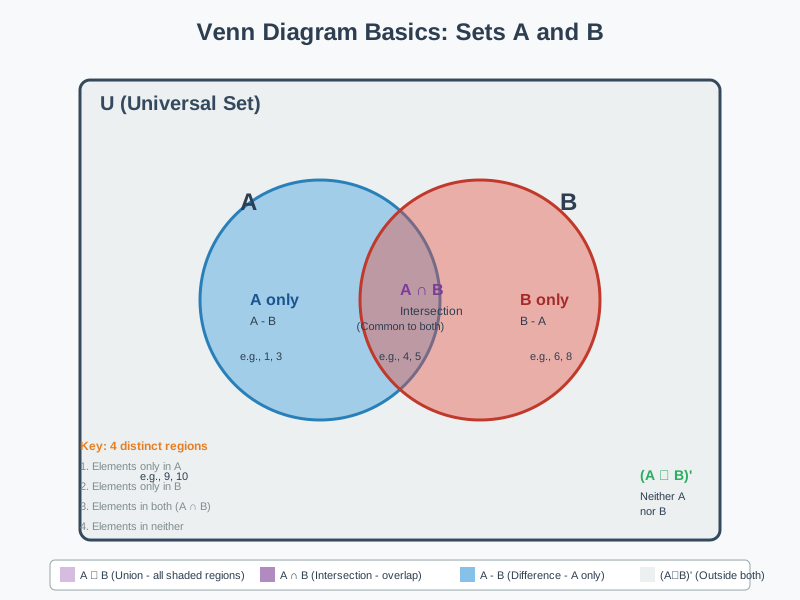
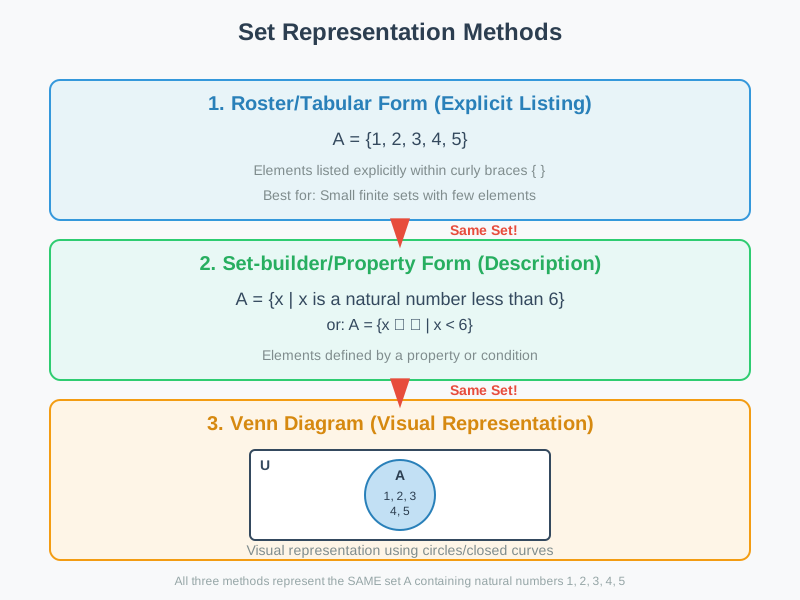
- Venn diagrams: circles inside a rectangle (universal set) to visualize membership.

Key notions: membership (x โˆˆ A), subset (A โІ B), proper subset (A โŠ‚ B), empty set (โˆ…), universal set (U), finite/infinite sets, equal sets, cardinality n(A).
๐Ÿ“š Fundamentals
Fundamentals

- Distinctness: no repeats in a set; order doesn't matter.
- Well-defined property: each element either qualifies or not.
- Subset test: A โІ B iff (โˆ€x)(x โˆˆ A โ‡’ x โˆˆ B).
- Cardinality n(A): number of elements when finite; |A| notation is common.
๐Ÿ”ฌ Deep Dive
Deep dive

- Infinite sets: N, Z, Q, R; intervals and their set-builder forms.
- Power set P(A) and its size: |P(A)| = 2^{|A|}.
- Ordered pairs vs sets (why (a,b) โ‰  {a,b}).
๐ŸŽฏ Shortcuts
Mnemonics

- Rโ†’L, Sโ†’R: Roster โ†’ "List"; Set-builder โ†’ "Rule".
- SUBset: "Stuff Under Bigger" (A inside B).
๐Ÿ’ก Quick Tips
Quick tips

- In roster form, don't repeat elements; {1,1,2} = {1,2}.
- For infinite sets, prefer set-builder notation.
- Declare U early to avoid ambiguity in complements (later topic).
- Use clean braces and separators for readability.
๐Ÿง  Intuitive Understanding
Intuition

- A set is simply a box containing items that satisfy a rule.
- Roster = explicitly name items; set-builder = describe the rule.
- Venn diagrams help you "see" relationship: inside = belongs, outside = does not.
- "Well-defined" means there's no ambiguity ("tall students" is vague; "height โ‰ฅ 170 cm" is well-defined).
๐ŸŒ Real World Applications
Applications

- Databases: sets of records matching criteria.
- Search filters: results are sets defined by conditions.
- Probability: sample space and events are sets.
- Programming: sets for membership tests, uniqueness, and fast lookups.
๐Ÿ”„ Common Analogies
Analogies

- Library shelves: books of a genre form a set.
- Playlists: songs satisfying a theme.
- Shopping carts: items currently selected.
- Tags: each tag defines a set of tagged items.
๐Ÿ“‹ Prerequisites
Prerequisites

- Basic logic: statements, truth, quantifiers ("for all", "there exists").
- Number systems: N, Z, Q, R; intervals notation.
- Notation: โˆˆ, โІ, โŠ‚, โˆ…, U, n(A).
โš ๏ธ Common Exam Traps
Common exam traps

- Repeating elements in roster form.
- Vague set-builder properties (not well-defined).
- Confusing โІ with โŠ‚; mixing up โˆˆ with โІ.
- Forgetting to specify the universal set when needed.
โญ Key Takeaways
Key takeaways

- Master notation: { }, โˆˆ, โІ, โŠ‚, โˆ…, U, n(A).
- Roster form works for small finite sets; set-builder scales to infinite sets.
- Venn diagrams are tools to reason visually about membership and relations.
- Precision matters โ€” avoid vague properties.
๐Ÿงฉ Problem Solving Approach
Problem-solving approach

1) Clarify the universal set U.
2) Decide representation: roster for listing, set-builder for rules.
3) Check membership with the property definition.
4) Use Venn sketches to test subset/equality claims.
5) Count elements carefully; avoid duplicates in roster form.
๐Ÿ“ CBSE Focus Areas
CBSE focus

- Definitions and representing sets in roster and set-builder forms.
- Identify subset/proper subset/equal sets; empty and universal set.
- Simple Venn-based identification questions.
- Counting n(A) from descriptions.
๐ŸŽ“ JEE Focus Areas
JEE focus

- Clean notation and precise definitions; avoid ambiguity.
- Translating word problems to set language for later inclusion-exclusion.
- Foundations for probability and functions.
๐ŸŒ Overview
"Sets and their representation" introduces the language of modern mathematics. A set is a well-defined collection of distinct objects (elements). We describe sets using roster (listing) or set-builder (property) notation, visualize with Venn diagrams, and perform operations like union, intersection, difference, and complement. Mastering notation, membership ((in,
otin)), subsets ((subseteq)), and cardinality (|A|) builds the foundation for relations, functions, probability, and algebraic structures.
๐Ÿ“š Fundamentals
- Notation: Capital letters for sets (A, B, U), lowercase for elements (a, b, x). Membership: (x in A) means x is in A; (x
otin A) otherwise. Empty set: (varnothing). Universal set: U.
- Roster form: A = {1, 2, 3}. Set-builder: A = { x in mathbb{N} mid 1 le x le 3 }.
- Equal sets: A = B if they contain the same elements (order and repetition don't matter).
- Subset: (A subseteq B) if every element of A is in B; proper subset: (A subset B).
- Power set: (mathcal{P}(A)) is the set of all subsets of A; if |A| = n, then (|mathcal{P}(A)| = 2^n).
- Basic operations with Venn diagrams:
Union: (A cup B = {x : x in A ext{ or } x in B})
Intersection: (A cap B = {x : x in A ext{ and } x in B})
Difference: (A setminus B = {x : x in A, x
otin B})
Complement: (A^c = U setminus A)
- Laws (samples): Commutative ((A cup B = B cup A)), associative, distributive, De Morgan: ((A cup B)^c = A^c cap B^c), ((A cap B)^c = A^c cup B^c).
๐Ÿ”ฌ Deep Dive
- Translating between roster and set-builder: e.g., E = {2,4,6,...} = { x in mathbb{N} mid x = 2k, k in mathbb{N} }.
- Intervals as sets on (mathbb{R}): (a,b), [a,b], (a,b], [a,b). Cardinality is infinite; endpoints are included/excluded per bracket.
- Inclusionโ€“exclusion for finite sets: (|A cup B| = |A| + |B| - |A cap B|); for three sets, add singles, subtract pairwise intersections, add triple intersection.
- Set identities proof idea: element-chasing or Venn-region equivalence. Example: To prove (A cap (B cup C) = (A cap B) cup (A cap C)), show any x in LHS iff x in RHS.
- Partitions: A collection of non-empty disjoint subsets whose union is the whole set. Leads to equivalence relations and quotient sets.
๐ŸŽฏ Shortcuts
- De Morgan: "break the bar, swap the operator" ((cup leftrightarrow cap)).
- Subset test: A (subseteq) B iff (A cap B = A).
๐Ÿ’ก Quick Tips
- Specify U early to avoid ambiguous complements.
- Remove duplicates in roster lists; order doesn't matter.
- Prefer set-builder for infinite sets; roster for small finite sets.
- When stuck, switch forms (roster โ†” builder) or draw a diagram.
๐Ÿง  Intuitive Understanding
Sets are containers of objects defined by a clear rule. Roster form is a shopping list; set-builder is the shopping rule. Venn diagrams are maps of overlapping memberships. Operations are like combining or filtering items based on belonging.
๐ŸŒ Real World Applications
- Databases: SQL joins mirror unions/intersections/differences of record sets.
- Search queries: OR/AND/NOT are set operations on result lists.
- Probability: events as subsets of a sample space; inclusionโ€“exclusion for counts.
- Programming: collections (arrays/sets/maps), membership checks, deduplication.
๐Ÿ”„ Common Analogies
- Library shelves: union of two shelves = all books present on either; intersection = books common to both categories.
- Stickers collection: complement = stickers you don't have yet relative to the full series.
๐Ÿ“‹ Prerequisites
- Number systems ((mathbb{N}, mathbb{Z}, mathbb{Q}, mathbb{R})).
- Logic basics: AND/OR/NOT, implication.
- Coordinate line/plane familiarity for intervals and Venn sketches.
โš ๏ธ Common Exam Traps
- Treating order/repetition as relevant in sets (they are not).
- Forgetting to define the universal set before taking complements.
- Misreading set-builder conditions; mixing (cup) and (cap).
- Double-counting without inclusionโ€“exclusion.
โญ Key Takeaways
- Distinct, unordered elements; repetition irrelevant in sets.
- Two representations: roster and set-builder; choose for clarity.
- Core operations: (cup, cap, setminus, {}^c) and their laws.
- Power set size is (2^n) for finite sets of size n.
- Inclusionโ€“exclusion prevents double-counting.
๐Ÿงฉ Problem Solving Approach
1) Clarify the universal set and domain of discourse.
2) Translate statements into precise set notation.
3) Draw a Venn diagram for unions/intersections/differences.
4) Use identities to simplify; for counts use inclusionโ€“exclusion.
5) Convert final answer to the requested form (set/number/interval).
๐Ÿ“ CBSE Focus Areas
- Definitions: set, element, subset, empty, universal, equal sets.
- Representations and Venn diagrams; simple identities and examples.
- Inclusionโ€“exclusion for two/three finite sets; word problems.
๐ŸŽ“ JEE Focus Areas
- Proofs by element method; tricky set-builder translations.
- Counting with constraints via inclusionโ€“exclusion.
- Power set/combinatorial links; interval manipulations on (mathbb{R}).

CBSE NCERT Class 11 Mathematics Chapter 1

NCERT Class 11 Mathematics Chapter 1 (Sets) introduces sets as fundamental mathematical concepts. A set is defined as a well-defined collection of distinct objects. "Well-defined" means it should be absolutely clear whether a given object belongs to the set or not. For CBSE board exams, students must master three representation methods:

1. ROSTER FORM (Tabular Form): List all elements between braces. Example: Set of vowels = {a, e, i, o, u}. Order does not matter: {1,2,3} = {3,2,1}. Repetition is ignored: {1,1,2,2,3} = {1,2,3}.

2. SET-BUILDER FORM (Property Method): Describe common property. Example: A = {x : x is a natural number less than 10} or A = {x | x โˆˆ โ„•, x < 10}. The vertical bar "|" or colon ":" is read as "such that".

3. VENN DIAGRAMS: Visual representation where sets are shown as closed curves (usually circles) within a rectangle representing the universal set.

Key CBSE exam topics: Identify well-defined vs not well-defined collections; Convert between roster and set-builder forms; Determine cardinality |A| (number of elements); Classify sets as finite/infinite, empty/non-empty, singleton/pair; Recognize equal vs equivalent sets; Use proper notation (โˆˆ, โˆ‰, โІ, โŠ‚). Common board questions include: "Express the set {1, 4, 9, 16, 25} in set-builder form" (Answer: {xยฒ | x โˆˆ โ„•, 1 โ‰ค x โ‰ค 5}) or "Is {x : x is a beautiful flower} a set?" (No, not well-defined). Practice NCERT Exercise 1.1 to 1.6 thoroughly.

Wikipedia Wikipedia - Set Theory Article

In mathematics, a set is a collection of distinct objects, considered as an object in its own right. Sets are fundamental objects in mathematics, developed by German mathematician Georg Cantor (1845-1918) in his work on infinite series and real numbers. The objects in a set are called elements or members. The notation x โˆˆ A (read "x is an element of A" or "x belongs to A") indicates set membership. Two sets are equal if they contain exactly the same elements, regardless of order or repetition. Set representation includes: Roster notation {a, b, c, ...} lists elements explicitly; Set-builder notation {x | P(x)} describes elements by a predicate P; Semantic definition describes the set in natural language. Important set types: Empty set (โˆ… or {}) contains no elements; Singleton set contains exactly one element; Finite set has countable elements; Infinite set continues without bound; Universal set (U) contains all objects under consideration. Naive set theory, while intuitive, led to paradoxes (Russell's paradox). Modern mathematics uses axiomatic set theory (Zermelo-Fraenkel with Axiom of Choice) to provide rigorous foundations. Sets are used extensively in topology, algebra, analysis, probability theory, and computer science.

๐Ÿ“CBSE 12th Board Problems (6)

Problem 1
Easy Mark
Write the following sets in roster form: (a) A = {x : x is a natural number less than 6} (b) B = {x : x is a prime number which is a divisor of 60}
Show Solution
Part (a): A = {x : x is a natural number less than 6} Step 1: Identify the condition Natural numbers: 1, 2, 3, 4, 5, 6, 7, ... Condition: x < 6 Step 2: List elements satisfying the condition Natural numbers less than 6: 1, 2, 3, 4, 5 Step 3: Write in roster form A = {1, 2, 3, 4, 5} Answer (a): A = {1, 2, 3, 4, 5} Part (b): B = {x : x is a prime number which is a divisor of 60} Step 1: Find divisors of 60 60 = 2ยฒ ร— 3 ร— 5 Divisors of 60: 1, 2, 3, 4, 5, 6, 10, 12, 15, 20, 30, 60 Step 2: Identify which divisors are prime Prime numbers: Numbers with exactly two factors (1 and itself) From divisors: 2 (prime), 3 (prime), 5 (prime) Note: 1 is not prime, 4, 6, 10, etc. are composite Step 3: Write in roster form B = {2, 3, 5} Answer (b): B = {2, 3, 5} Key Point: Always list elements in ascending order for clarity (though order technically doesn't matter in sets). Set-builder to roster conversion
Final Answer: See solution
Problem 2
Easy Mark
Write the following sets in set-builder form: (a) A = {3, 6, 9, 12, 15, 18} (b) B = {1, 4, 9, 16, 25, 36, 49}
Show Solution
Part (a): A = {3, 6, 9, 12, 15, 18} Step 1: Identify the pattern 3, 6, 9, 12, 15, 18 are all multiples of 3 Or: 3ร—1, 3ร—2, 3ร—3, 3ร—4, 3ร—5, 3ร—6 Step 2: Determine the range Smallest: 3 = 3ร—1, Largest: 18 = 3ร—6 These are multiples of 3 from 3 to 18 Step 3: Write in set-builder form Method 1: A = {x : x = 3n, n โˆˆ โ„•, 1 โ‰ค n โ‰ค 6} Method 2: A = {x : x is a multiple of 3, x โ‰ค 18} Method 3: A = {3n : n โˆˆ โ„•, n โ‰ค 6} Answer (a): A = {x : x = 3n, n โˆˆ โ„•, 1 โ‰ค n โ‰ค 6} (Most precise) Part (b): B = {1, 4, 9, 16, 25, 36, 49} Step 1: Identify the pattern 1 = 1ยฒ, 4 = 2ยฒ, 9 = 3ยฒ, 16 = 4ยฒ, 25 = 5ยฒ, 36 = 6ยฒ, 49 = 7ยฒ These are perfect squares Step 2: Determine the range Smallest: 1ยฒ = 1, Largest: 7ยฒ = 49 Perfect squares from 1ยฒ to 7ยฒ Step 3: Write in set-builder form Method 1: B = {x : x = nยฒ, n โˆˆ โ„•, 1 โ‰ค n โ‰ค 7} Method 2: B = {xยฒ : x โˆˆ โ„•, 1 โ‰ค x โ‰ค 7} Method 3: B = {nยฒ : n โˆˆ โ„•, n โ‰ค 7} Answer (b): B = {xยฒ : x โˆˆ โ„•, 1 โ‰ค x โ‰ค 7} Board Exam Tip: Any of the methods above are acceptable. Choose the clearest, most concise form.
Final Answer: See solution
Problem 3
Medium Mark
Examine whether the following statements define a set or not: (a) The collection of all beautiful paintings in a museum (b) The collection of all even natural numbers (c) The collection of all talented students in your class
Show Solution
To determine if a collection is a set, it must be WELL-DEFINED: we must be able to clearly determine if any object belongs to the collection or not. Part (a): Collection of all beautiful paintings in a museum Analysis: - "Beautiful" is subjective - Different people have different opinions about beauty - One person may consider a painting beautiful, another may not - No objective criterion to decide membership Conclusion: NOT A SET (not well-defined) Part (b): Collection of all even natural numbers Analysis: - "Even" has a precise mathematical definition: divisible by 2 - Natural numbers: 1, 2, 3, 4, 5, ... - Even natural numbers: 2, 4, 6, 8, 10, ... (clear list) - For any natural number, we can definitively determine if it's even Example verification: - Is 7 in this collection? No (7 รท 2 = 3.5)
Final Answer: See solution
Problem 4
Medium Mark
Find the cardinal number (number of elements) of the following sets: (a) A = {x : x is a letter in the word "MATHEMATICS"} (b) B = {x : xยฒ - 5x + 6 = 0, x โˆˆ โ„•}
Show Solution
Part (a): A = {x : x is a letter in the word "MATHEMATICS"} Step 1: Write the word and identify distinct letters Word: M-A-T-H-E-M-A-T-I-C-S Step 2: List each letter (counting once, since sets don't have repetition) M - appears at positions 1
Final Answer: See solution
Problem 5
Medium Mark
Classify the following sets as finite or infinite: (a) A = {x : x โˆˆ โ„•, x < 100} (b) B = {x : x โˆˆ โ„, 0 < x < 1} (c) C = Set of all prime numbers (d) D = {x : x = 2โฟ, n โˆˆ โ„•}
Show Solution
A finite set has countable elements (can be listed completely). An infinite set continues without end. Part (a): A = {x : x โˆˆ โ„•, x < 100} Analysis: - Natural numbers less than 100: 1, 2, 3, ..., 99 - Clearly defined starting point (1) - Clearly defined ending point (99) - Total elements: 99 (countable) A = {1, 2, 3, 4, ..., 99} Classification: FINITE SET Cardinality: |A| = 99 Part (b): B = {x : x โˆˆ โ„, 0 < x < 1} Analysis: - Real numbers between 0 and 1 - Examples: 0.1, 0.01, 0.001, 0.5, 0.99, 0.333..., ฯ€/4, 1/โˆš2 - Between any two real numbers, infinitely many real numbers exist - Cannot count or list all elements - No "next" real number after any given number Classification: INFINITE SET Note: This is an uncountably infinite set Part (c): C = Set of all prime numbers Analysis: - Prime numbers: 2, 3, 5, 7, 11, 13, 17, 19, 23, 29, ... - Euclid's theorem (300 BCE): There are infinitely many prime numbers - Proof: Assume finite list pโ‚
Final Answer: See solution
Problem 6
Medium Mark
Which of the following pairs of sets are equal? (a) A = {1, 2, 3} and B = {3, 1, 2} (b) C = {x : xยฒ = 9} and D = {-3, 3} (c) E = {2, 4, 6, 8} and F = {x : x is an even number less than 10}
Show Solution
Two sets are EQUAL if they contain exactly the same elements (same members). Order and repetition don't matter. Part (a): A = {1}}
Final Answer: See solution

๐ŸŽฏIIT-JEE Main Problems (6)

Problem 1
Hard Mark
Let A = {x : x โˆˆ โ„, |x - 2| โ‰ค 3} and B = {x : x โˆˆ โ„, xยฒ - 6x + 5 โ‰ค 0}. Express A and B in interval notation and find A โˆฉ B.
Show Solution
Part 1: Express A in interval notation Given: A = {x : x โˆˆ โ„, |x - 2| โ‰ค 3} Step 1: Solve the absolute value inequality |x - 2| โ‰ค 3 This means: -3 โ‰ค x - 2 โ‰ค 3 Step 2: Solve for x Add 2 to all parts: -3 + 2 โ‰ค x โ‰ค 3 + 2 -1 โ‰ค x โ‰ค 5 Step 3: Express in interval notation A = [-1, 5] Part 2: Express B in interval notation Given: B = {x : x โˆˆ โ„, xยฒ - 6x + 5 โ‰ค 0} Step 1: Factor the quadratic xยฒ - 6x + 5 = 0 (x - 1)(x - 5) = 0 Roots: x = 1, x = 5 Step 2: Analyze the inequality We need: (x - 1)(x - 5) โ‰ค 0 Test regions: - x < 1: Both factors negative โ†’ product positive โœ— - 1 โ‰ค x โ‰ค 5: (x-1)โ‰ฅ0, (x-5)โ‰ค0 โ†’ product negative โœ“ - x > 5: Both factors positive โ†’ product positive โœ— Step 3: Solution B = [1, 5] Part 3: Find A โˆฉ B Step 1: Identify the sets A = [-1, 5] (all x from -1 to 5, inclusive) B = [1, 5] (all x from 1 to 5, inclusive) Step 2: Find intersection (common elements) A โˆฉ B = {x : x โˆˆ A AND x โˆˆ B} = {x : -1 โ‰ค x โ‰ค 5 AND 1 โ‰ค x โ‰ค 5} = {x : 1 โ‰ค x โ‰ค 5} Step 3: Express in interval notation A โˆฉ B = [1, 5] Visual representation on number line: A: [=============================] -1 0 5 B: [===========] 1 5 AโˆฉB: [===========] 1 5 Answer: A = [-1, 5] B = [1, 5] A โˆฉ B = [1, 5] Note: A โˆฉ B = B (since B is completely contained within A, i.e., B โІ A)
Final Answer: See solution
Problem 2
Hard Mark
If A = {1, 2, 3, 4, 5}, find the number of subsets of A that contain: (a) exactly 3 elements, (b) at least 4 elements, (c) the element 1 but not 5.
Show Solution
Given: A = {1, 2, 3, 4, 5}, so |A| = 5 Part (a): Subsets with exactly 3 elements Step 1: Understand the problem We need to choose 3 elements from 5 elements This is a combination problem: โตCโ‚ƒ Step 2: Calculate โตCโ‚ƒ = 5!/(3!(5-3)!) = 5!/(3!ร—2!) = (5ร—4ร—3!)/(3!ร—2ร—1) = (5ร—4)/(2ร—1) = 20/2 = 10 Answer (a): 10 subsets with exactly 3 elements Examples: {1,2,3}, {1,2,4}, {1,2,5}, {1,3,4}, {1,3,5}, {1,4,5}, {2,3,4}, {2,3,5}, {2,4,5}, {3,4,5} Part (b): Subsets with at least 4 elements Step 1: "At least 4" means "4 or more" So we need subsets with 4 elements OR 5 elements Step 2: Count subsets with exactly 4 elements โตCโ‚„ = 5!/(4!ร—1!) = 5!/4! = 5 These are: {1,2,3,4}, {1,2,3,5}, {1,2,4,5}, {1,3,4,5}, {2,3,4,5} Step 3: Count subsets with exactly 5 elements โตCโ‚… = 5!/(5!ร—0!) = 1 This is: {1,2,3,4,5} (the set A itself) Step 4: Total Total = โตCโ‚„ + โตCโ‚… = 5 + 1 = 6 Answer (b): 6 subsets with at least 4 elements Part (c): Subsets containing 1 but not 5 Step 1: Analyze the constraint - Must include: 1 - Must exclude: 5 - Can choose any combination from: {2, 3, 4} Step 2: Determine the problem Since 1 is fixed (must be included) and 5 is excluded, we need to form subsets from the remaining elements: {2, 3, 4} These subsets must all contain 1. Step 3: Count possibilities Remaining elements: {2, 3, 4} (3 elements) Each element can either be included or not included Choices: 2ยณ = 8 subsets can be formed from {2, 3, 4} Step 4: List all possibilities When we add 1 to each subset of {2, 3, 4}: 1. {} โ†’ {1} 2. {2} โ†’ {1, 2} 3. {3} โ†’ {1, 3} 4. {4} โ†’ {1, 4} 5. {2, 3} โ†’ {1, 2, 3} 6. {2, 4} โ†’ {1, 2, 4} 7. {3, 4} โ†’ {1, 3, 4} 8. {2, 3, 4} โ†’ {1, 2, 3, 4} Answer (c): 8 subsets containing 1 but not 5 Alternative formula: 2^(n-2) where n=5 (total elements) = 2^(5-2) = 2ยณ = 8 Verification: All 8 subsets contain 1 โœ“, None contain 5 โœ“ SUMMARY: (a) Exactly 3 elements: 10 subsets (b) At least 4 elements: 6 subsets (c) Contains 1 but not 5: 8 subsets Key Formula: Number of subsets of n-element set = 2โฟ Number of k-element subsets = โฟCโ‚–
Final Answer: See solution
Problem 3
Hard Mark
Let U = {1, 2, 3, 4, 5, 6, 7, 8, 9, 10} be the universal set. If A = {x โˆˆ U : x is divisible by 2} and B = {x โˆˆ U : x is divisible by 3}, find: (a) Aโ€ฒ (complement of A), (b) Bโ€ฒ, (c) (A โˆช B)โ€ฒ, (d) Aโ€ฒ โˆฉ Bโ€ฒ. Verify De Morgan's law.
Show Solution
Given: U = {1, 2, 3, 4, 5, 6, 7, 8, 9, 10} A = {x โˆˆ U : x is divisible by 2} B = {x โˆˆ U : x is divisible by 3} Step 1: Find sets A and B Set A (divisible by 2): 2, 4, 6, 8, 10 are divisible by 2 A = {2, 4, 6, 8, 10} Set B (divisible by 3): 3, 6, 9 are divisible by 3 B = {3, 6, 9} Part (a): Find Aโ€ฒ (complement of A) Step 2: Aโ€ฒ = U - A (elements in U but not in A) Aโ€ฒ = {1, 2, 3, 4, 5, 6, 7, 8, 9, 10} - {2, 4, 6, 8, 10} Aโ€ฒ = {1, 3, 5, 7, 9} Answer (a): Aโ€ฒ = {1, 3, 5, 7, 9} (odd numbers in U) Part (b): Find Bโ€ฒ (complement of B) Step 3: Bโ€ฒ = U - B Bโ€ฒ = {1, 2, 3, 4, 5, 6, 7, 8, 9, 10} - {3, 6, 9} Bโ€ฒ = {1, 2, 4, 5, 7, 8, 10} Answer (b): Bโ€ฒ = {1, 2, 4, 5, 7, 8, 10} Part (c): Find (A โˆช B)โ€ฒ Step 4: First find A โˆช B A โˆช B = {2, 4, 6, 8, 10} โˆช {3, 6, 9} = {2, 3, 4, 6, 8, 9, 10} Step 5: Find complement (A โˆช B)โ€ฒ = U - (A โˆช B) = {1, 2, 3, 4, 5, 6, 7, 8, 9, 10} - {2, 3, 4, 6, 8, 9, 10} = {1, 5, 7} Answer (c): (A โˆช B)โ€ฒ = {1, 5, 7} Part (d): Find Aโ€ฒ โˆฉ Bโ€ฒ Step 6: Intersection of complements Aโ€ฒ โˆฉ Bโ€ฒ = {1, 3, 5, 7, 9} โˆฉ {1, 2, 4, 5, 7, 8, 10} Common elements: 1, 5, 7 Aโ€ฒ โˆฉ Bโ€ฒ = {1, 5, 7} Answer (d): Aโ€ฒ โˆฉ Bโ€ฒ = {1, 5, 7} VERIFICATION OF DE MORGAN'S LAW De Morgan's Law states: (A โˆช B)โ€ฒ = Aโ€ฒ โˆฉ Bโ€ฒ Step 7: Compare results From part (c): (A โˆช B)โ€ฒ = {1, 5, 7} From part (d): Aโ€ฒ โˆฉ Bโ€ฒ = {1, 5, 7} Since (A โˆช B)โ€ฒ = Aโ€ฒ โˆฉ Bโ€ฒ = {1, 5, 7} โœ“ De Morgan's Law is VERIFIED INTERPRETATION: - Elements 1, 5, 7 are neither divisible by 2 nor by 3 - These are the elements that are NOT in (A โˆช B) - These are also the elements common to both Aโ€ฒ and Bโ€ฒ ANSWERS SUMMARY: (a) Aโ€ฒ = {1, 3, 5, 7, 9} (b) Bโ€ฒ = {1, 2, 4, 5, 7, 8, 10} (c) (A โˆช B)โ€ฒ = {1, 5, 7} (d) Aโ€ฒ โˆฉ Bโ€ฒ = {1, 5, 7} De Morgan's Law verified: (A โˆช B)โ€ฒ = Aโ€ฒ โˆฉ Bโ€ฒ โœ“
Final Answer: See solution
Problem 4
Hard Mark
Let A and B be two finite sets such that n(A) = 20, n(B) = 28, and n(A โˆช B) = 36. Find: (a) n(A โˆฉ B), (b) n(A - B), (c) n(B - A). If n(Aโ€ฒ) = 52, find n(U).
Show Solution
Given: n(A) = 20 (number of elements in A) n(B) = 28 (number of elements in B) n(A โˆช B) = 36 (elements in union) n(Aโ€ฒ) = 52 (elements not in A) Part (a): Find n(A โˆฉ B) Step 1: Use the fundamental formula for union n(A โˆช B) = n(A) + n(B) - n(A โˆฉ B) Step 2: Substitute values 36 = 20 + 28 - n(A โˆฉ B) 36 = 48 - n(A โˆฉ B) Step 3: Solve for n(A โˆฉ B) n(A โˆฉ B) = 48 - 36 n(A โˆฉ B) = 12 Answer (a): n(A โˆฉ B) = 12 elements Interpretation: 12 elements are common to both A and B Part (b): Find n(A - B) Step 1: Understand A - B A - B = elements in A but not in B Step 2: Use formula n(A - B) = n(A) - n(A โˆฉ B) Step 3: Calculate n(A - B) = 20 - 12 n(A - B) = 8 Answer (b): n(A - B) = 8 elements Interpretation: 8 elements are in A only (not in B) Part (c): Find n(B - A) Step 1: Understand B - A B - A = elements in B but not in A Step 2: Use formula n(B - A) = n(B) - n(A โˆฉ B) Step 3: Calculate n(B - A) = 28 - 12 n(B - A) = 16 Answer (c): n(B - A) = 16 elements Interpretation: 16 elements are in B only (not in A) Part (d): Find n(U) given n(Aโ€ฒ) = 52 Step 1: Understand relationship Aโ€ฒ = U - A (complement of A) So: n(Aโ€ฒ) = n(U) - n(A) Step 2: Substitute known values 52 = n(U) - 20 Step 3: Solve for n(U) n(U) = 52 + 20 n(U) = 72 Answer (d): n(U) = 72 elements VERIFICATION using Venn diagram logic: Universal set breakdown: - Elements only in A: n(A - B) = 8 - Elements only in B: n(B - A) = 16 - Elements in both: n(A โˆฉ B) = 12 - Elements in A โˆช B: 8 + 12 + 16 = 36 โœ“ - Elements in neither A nor B: n(U) - n(A โˆช B) = 72 - 36 = 36 Total: n(U) = 8 + 12 + 16 + 36 = 72 โœ“ SUMMARY OF ANSWERS: (a) n(A โˆฉ B) = 12 (b) n(A - B) = 8 (c) n(B - A) = 16 (d) n(U) = 72 KEY FORMULAS USED: 1. n(A โˆช B) = n(A) + n(B) - n(A โˆฉ B) 2. n(A - B) = n(A) - n(A โˆฉ B) 3. n(Aโ€ฒ) = n(U) - n(A)
Final Answer: See solution
Problem 5
Hard Mark
In a survey of 100 students: 60 play cricket, 50 play football, 40 play tennis, 30 play cricket and football, 20 play football and tennis, 15 play cricket and tennis, and 10 play all three games. Find: (a) How many play at least one game? (b) How many play exactly two games? (c) How many play only cricket?
Show Solution
Given information: Total students surveyed: 100 n(C) = 60 (play cricket) n(F) = 50 (play football) n(T) = 40 (play tennis) n(C โˆฉ F) = 30 (play cricket and football) n(F โˆฉ T) = 20 (play football and tennis) n(C โˆฉ T) = 15 (play cricket and tennis) n(C โˆฉ F โˆฉ T) = 10 (play all three) Part (a): How many play at least one game? Step 1: Use inclusion-exclusion principle for three sets n(C โˆช F โˆช T) = n(C) + n(F) + n(T) - n(C โˆฉ F) - n(F โˆฉ T) - n(C โˆฉ T) + n(C โˆฉ F โˆฉ T) Step 2: Substitute values n(C โˆช F โˆช T) = 60 + 50 + 40 - 30 - 20 - 15 + 10 Step 3: Calculate n(C โˆช F โˆช T) = 150 - 65 + 10 = 95 Answer (a): 95 students play at least one game Part (b): How many play exactly two games? Step 1: Find students playing exactly cricket and football (but not tennis) n(C โˆฉ F only) = n(C โˆฉ F) - n(C โˆฉ F โˆฉ T) = 30 - 10 = 20 Step 2: Find students playing exactly football and tennis (but not cricket) n(F โˆฉ T only) = n(F โˆฉ T) - n(C โˆฉ F โˆฉ T) = 20 - 10 = 10 Step 3: Find students playing exactly cricket and tennis (but not football) n(C โˆฉ T only) = n(C โˆฉ T) - n(C โˆฉ F โˆฉ T) = 15 - 10 = 5 Step 4: Total playing exactly two games Total = 20 + 10 + 5 = 35 Answer (b): 35 students play exactly two games Part (c): How many play only cricket? Step 1: Break down cricket players n(C) = (only C) + (C and F only) + (C and T only) + (all three) 60 = (only C) + 20 + 5 + 10 Step 2: Solve for "only C" 60 = (only C) + 35 (only C) = 60 - 35 = 25 Answer (c): 25 students play only cricket VERIFICATION using Venn diagram breakdown: Only Cricket: 25 Only Football: n(F) - (CF only + FT only + all) = 50 - 20 - 10 - 10 = 10 Only Tennis: n(T) - (CT only + FT only + all) = 40 - 5 - 10 - 10 = 15 Cricket & Football only: 20 Football & Tennis only: 10 Cricket & Tennis only: 5 All three: 10 Total playing at least one: 25 + 10 + 15 + 20 + 10 + 5 + 10 = 95 โœ“ Students playing no games: 100 - 95 = 5 COMPLETE BREAKDOWN: โ€ข Only C: 25 โ€ข Only F: 10 โ€ข Only T: 15 โ€ข C โˆฉ F only: 20 โ€ข F โˆฉ T only: 10 โ€ข C โˆฉ T only: 5 โ€ข All three (C โˆฉ F โˆฉ T): 10 โ€ข None: 5 โ€ข Total: 100 โœ“ FINAL ANSWERS: (a) 95 students play at least one game (b) 35 students play exactly two games (c) 25 students play only cricket
Final Answer: See solution
Problem 6
Hard Mark
If A = {x : xยฒ - 5x + 6 = 0} and B = {x : xยฒ - 3x + 2 = 0}, find: (a) A โˆช B in roster form, (b) A โˆฉ B, (c) A ร— B (Cartesian product), (d) n(A ร— B).
Show Solution
Part 1: Find set A Given: A = {x : xยฒ - 5x + 6 = 0} Step 1: Solve the quadratic equation xยฒ - 5x + 6 = 0 Factorization: xยฒ - 2x - 3x + 6 = 0 x(x - 2) - 3(x - 2) = 0 (x - 2)(x - 3) = 0 Solutions: x = 2 or x = 3 A = {2, 3} Part 2: Find set B Given: B = {x : xยฒ - 3x + 2 = 0} Step 1: Solve the quadratic equation xยฒ - 3x + 2 = 0 Factorization: xยฒ - x - 2x + 2 = 0 x(x - 1) - 2(x - 1) = 0 (x - 1)(x - 2) = 0 Solutions: x = 1 or x = 2 B = {1, 2} Part (a): Find A โˆช B Step 1: Union includes all elements from both sets A โˆช B = {2, 3} โˆช {1, 2} Step 2: List all distinct elements (no repetition) A โˆช B = {1, 2, 3} Answer (a): A โˆช B = {1, 2, 3} Part (b): Find A โˆฉ B Step 1: Intersection includes only common elements A โˆฉ B = {2, 3} โˆฉ {1, 2} Step 2: Identify common elements Common element: 2 A โˆฉ B = {2} Answer (b): A โˆฉ B = {2} Part (c): Find A ร— B (Cartesian product) Step 1: Understand Cartesian product A ร— B = {(a, b) : a โˆˆ A and b โˆˆ B} All ordered pairs where first element from A, second from B Step 2: List all ordered pairs systematically From A = {2, 3} and B = {1, 2} When a = 2: (2, 1), (2, 2) When a = 3: (3, 1), (3, 2) Step 3: Write complete Cartesian product A ร— B = {(2, 1), (2, 2), (3, 1), (3, 2)} Answer (c): A ร— B = {(2, 1), (2, 2), (3, 1), (3, 2)} Part (d): Find n(A ร— B) Step 1: Count elements in Cartesian product Method 1 - Direct count: A ร— B has 4 ordered pairs Method 2 - Using formula: n(A ร— B) = n(A) ร— n(B) = 2 ร— 2 = 4 Answer (d): n(A ร— B) = 4 ADDITIONAL EXPLORATION: Find B ร— A (note: A ร— B โ‰  B ร— A in general): B ร— A = {(1, 2), (1, 3), (2, 2), (2, 3)} Verification: A ร— B โ‰  B ร— A (different ordered pairs) But: n(A ร— B) = n(B ร— A) = 4 (same cardinality) COMPLETE ANSWERS: (a) A โˆช B = {1, 2, 3} (b) A โˆฉ B = {2} (c) A ร— B = {(2, 1), (2, 2), (3, 1), (3, 2)} (d) n(A ร— B) = 4 KEY CONCEPTS: โ€ข Union combines all elements (no duplicates) โ€ข Intersection includes only common elements โ€ข Cartesian product creates ordered pairs โ€ข n(A ร— B) = n(A) ร— n(B) โ€ข Cartesian product is NOT commutative: A ร— B โ‰  B ร— A
Final Answer: See solution

No videos available yet.

๐Ÿ–ผ๏ธVisual Resources (8)

No formulas available yet.

๐Ÿ“šReferences & Further Reading (9)

Book
NCERT Mathematics Class XI - Chapter 1: Sets
By: NCERT
https://ncert.nic.in/textbook.php?kemh1=1-8
Comprehensive introduction to sets and their representation. Covers: What is a set, Roster form, Set-builder form, Types of sets (empty, finite, infinite, equal, subset), Venn diagrams, Operations on sets. Contains solved examples and exercise problems aligned with CBSE curriculum. Emphasizes well-defined collections and practical applications.
Note: PRIMARY REFERENCE for CBSE board exam preparation. All concepts in this topic directly map to NCERT Chapter 1. Exercises provide foundation for board exam questions. Must-read for Class 11 students. Essential starting point before attempting JEE-level problems.
Book
Naive Set Theory
By: Paul R. Halmos
https://www.springer.com/gp/book/9780387900926
Classic introduction to axiomatic set theory. Discusses: Axiom of extension, Specification, Unordered pairs, Power sets, Russell's paradox, NULL, Relations. Written in accessible style despite rigorous treatment. Presents sets as foundation of all mathematics. Influential text that shaped modern set theory pedagogy.
Note: ADVANCED REFERENCE for students interested in mathematical foundations. Provides deeper understanding beyond JEE syllabus. Explains WHY set theory works, Ordered pairs
Book
Elements of Set Theory
By: Herbert B. Enderton
https://www.elsevier.com/books/elements-of-set-theory/enderton/978-0-08-057042-6
Comprehensive treatment of set theory fundamentals. Topics include: Set notation, Russell paradox resolution, Axiom of choice, Cardinal numbers, Ordinal numbers. Provides historical context for set theory development. Includes exercises ranging from elementary to challenging. Bridges gap between naive and axiomatic set theory.
Note: SUPPLEMENTARY REFERENCE for deep conceptual understanding. Useful for JEE Advanced theoretical questions. Explains complications with set definitions (Russell's paradox). Provides mathematical maturity needed for proof-based problems. Optional but valuable for top-tier aspirants.
Book
Objective Mathematics by R.D. Sharma - Chapter: Sets
By: R.D. Sharma
https://www.dhanpatrai.com/
Comprehensive problem sets for JEE preparation. Contains: 100+ solved examples, 300+ practice problems, Difficulty progression (easy to advanced), Previous year JEE questions, CBSE board questions, Detailed solutions with multiple approaches, Conceptual notes and tips. Covers all set theory concepts tested in JEE.
Note: ESSENTIAL JEE PREPARATION BOOK used by millions of aspirants. Problems organized by difficulty level. Solved examples show standard techniques. Practice problems build speed and accuracy. Must-have resource for serious JEE preparation. Complements coaching material perfectly.
Book
Problems in Mathematics by V. Govorov et al. - Chapter: Set Theory
By: V. Govorov, P. Dybov, N. Miroshin, S. Smirnova
https://archive.org/details/ProblemsinMathematicsGovorov
Russian problem book with challenging set theory questions. Features: Olympiad-level problems, Multiple solution approaches, Emphasis on proof techniques, Problems requiring creative thinking, Historical problems from Soviet mathematics. Builds problem-solving maturity. Difficulty exceeds typical JEE Advanced.
Note: ADVANCED PROBLEM SOURCE for top JEE aspirants aiming for ranks below 100. Problems require deep understanding and creativity. Good for developing mathematical thinking beyond formula application. Optional but valuable for building confidence with difficult problems. Prepare for unexpected JEE Advanced questions.
Website
Khan Academy - Introduction to Sets
By: Khan Academy
https://www.khanacademy.org/math/statistics-probability/probability-library/basic-set-ops/v/intersection-and-union-of-sets
Free video lectures covering: Set notation basics, Roster and set-builder forms, Universal sets, Subsets and proper subsets, Venn diagrams, Set operations (union, intersection, complement, difference), Cardinality calculations. Interactive exercises with immediate feedback. Progresses from basics to applications. Includes worked examples.
Note: EXCELLENT ONLINE RESOURCE for visual learners. Videos explain concepts with animations and color-coding. Good for first-time learning or quick revision. Complements NCERT textbook with different teaching style. Free and accessible anytime. Recommended for clearing conceptual doubts.
Website
Brilliant.org - Set Theory
By: Brilliant
https://brilliant.org/wiki/set-theory/
Interactive lessons on set theory fundamentals. Covers: Set notation, Representation methods, Cardinality, Power sets, Cartesian products, Set identities, De Morgan's laws, NULL, not just formula application. Premium content available. Complements traditional textbook learning.
Note: Inclusion-exclusion principle. Features problem-solving challenges with hints and solutions. Community discussions for doubts. Progress tracking and skill assessment. INTERACTIVE LEARNING PLATFORM ideal for problem-solving practice. Challenges test understanding at deeper level than rote memorization. Good for JEE preparation as problems require thinking
Website
Math StackExchange - Set Theory Questions
By: Community
https://math.stackexchange.com/questions/tagged/set-theory
Community-driven Q&A platform with thousands of set theory questions and answers. Features: Expert answers with detailed explanations, Multiple solution approaches, Discussions of subtle points, Common confusion clarifications, Questions from basic to research-level. Searchable database of solved problems. Active community for asking new questions.
Note: PROBLEM-SOLVING RESOURCE for specific doubts. Search function helps find similar questions already answered. Community provides multiple perspectives on problems. Good for understanding WHY something works, not just WHAT the answer is. Useful when stuck on a specific concept or problem. Free and accessible.
Research_Paper
Georg Cantor and the Origins of Transfinite Set Theory
By: Joseph W. Dauben
https://www.scientificamerican.com/article/georg-cantor-and-origins-of-transfinite-set-theory/
Historical account of Georg Cantor's development of set theory (1870s-1890s). Discusses: Cantor's diagonal argument, Different sizes of infinity, Opposition from contemporary mathematicians, Philosophical implications, Influence on modern mathematics. Contextualizes why we study sets today.
Note: HISTORICAL CONTEXT for understanding importance of set theory. Not directly useful for JEE problems but provides motivation. Interesting read for students curious about "why study this?". Shows how abstract mathematics connects to fundamental questions. Optional enrichment material for curious minds.

โš ๏ธCommon Mistakes to Avoid (1)

Critical Conceptual

โŒ Writing duplicate elements in roster form: {1, 2, 2, 3} or thinking sets can ...

Writing duplicate elements in roster form: {1, 2, 2, 3} or thinking sets can contain repeated elements
๐Ÿ’ญ Why This Happens:
Students come from arithmetic where repetition is meaningful (2+2 vs 2). They fail to grasp that sets are collections of DISTINCT objects only. Confusion arises from multiset concept (not in syllabus) or writing what they see in problem statement verbatim without recognizing duplicates should collapse.
โœ… Correct Approach:
By definition, a set contains only distinct elements. Any repetition is automatically eliminated. When writing roster form, list each element exactly once, regardless of how many times it appears in the source. Check final roster form: each element appears exactly once. If element repeats, remove duplicates.
๐Ÿ“ Examples:
โŒ Wrong:
Wrong: "Express as a set: the digits in 1223" โ†’ {1, 2, 2, 3}. Wrong: {a, a, b, c} is a valid set with 4 elements. Wrong: {x, xยฒ} when x=1 gives {1, 1} which is valid.
โœ… Correct:
Correct: "Express as a set: the digits in 1223" โ†’ {1, 2, 3} (3 elements only). Correct: {a, a, b, c} = {a, b, c} (3 elements). Correct: {x, xยฒ} when x=1 gives {1, 1} = {1} (1 element, since 1=1ยฒ).
๐Ÿ’ก Prevention Tips:
Remember: Sets have NO order and NO repetition (two fundamental properties). When converting any list/sequence to set, first identify unique elements. Practice: {2,4,6,4,2} = {2,4,6}. After writing roster form, scan for duplicates and remove. In set-builder form, duplicates naturally handled by condition.
CBSE_12th JEE_Main JEE_Advanced

๐Ÿ“„Summary

Summary IIT-JEE Mathematics Foundation

A set is a well-defined collection of distinct objects, called elements or members. The concept of sets, introduced by Georg Cantor in the late 19th century, forms the foundation of modern mathematics. Sets can be represented in three primary ways: (1) Roster or Tabular Form - listing all elements within curly braces, e.g., A = {1, 2, 3, 4, 5}, (2) Set-builder Form - describing properties that elements must satisfy, e.g., B = {x | x is a natural number less than 6}, and (3) Venn Diagrams - visual representation using closed curves. Key concepts include: membership (โˆˆ, โˆ‰), cardinality (number of elements), types of sets (finite, infinite, empty, singleton, equal, equivalent), and subset relationships. Sets are denoted by capital letters (A, B, C) while elements use lowercase letters (a, b, c). The notation x โˆˆ A means "x belongs to set A" while x โˆ‰ A means "x does not belong to A". Understanding set representation is crucial as it underpins all mathematical structures including relations, functions, groups, and vector spaces.

๐ŸŽ“Educational Resource

Educational Resource Educational Best Practices - Mathematics Pedagogy

Understanding sets through real-world analogies makes the abstract concept concrete:

ANALOGY 1 - COLLECTION BOXES: Imagine a box labeled "Primary Colors". Inside are three balls: red, blue, yellow. This is a set! The box = set notation (braces), balls = elements, label = set-builder description. You can check any color and determine if it belongs to the box (membership test).

ANALOGY 2 - CLUB MEMBERSHIP: A sports club has members. The set of members can be listed (roster: {Alice, Bob, Carol}) or described (set-builder: {x | x paid membership fee and signed form}). A person either is or isn't a member (clear membership).

LEARNING FRAMEWORK:
Step 1: Understand "well-defined" - create clear boundary between what's in and what's out
Step 2: Master notation - practice writing {}, โˆˆ, โˆ‰, |A| until automatic
Step 3: Representation conversion - develop skill to switch between roster and set-builder
Step 4: Classification - identify set types quickly (finite vs infinite crucial for JEE)
Step 5: Visual thinking - draw Venn diagrams for every problem

MEMORY TECHNIQUES:
โ€ข Roster = "Roll call" (calling out names one by one)
โ€ข Set-builder = "Rule book" (describing who qualifies)
โ€ข โˆˆ looks like "element" starting with E
โ€ข Empty set โˆ… looks like zero (0 elements)
โ€ข Cardinality |A| uses vertical bars like counting tally marks

COMMON STUDENT ERRORS TO AVOID:
โŒ Writing {a, a, b} instead of {a, b} (no repetition!)
โŒ Thinking {1, 2, 3} โ‰  {3, 2, 1} (order doesn't matter!)
โŒ Confusing element with subset: 1 โˆˆ {1,2,3} but {1} โІ {1,2,3}
โŒ Using {} and โˆ… interchangeably with context confusion

For visual learners: Color-code different types of sets in notes. For kinesthetic learners: Use physical objects to create sets. For auditory learners: Say definitions aloud 10 times. This foundational topic appears in 5-10% of JEE Main questions, so invest time in mastery!

Sets and their representation

Subject: Mathematics
Sub-unit: 1.1 - Sets
Complexity: Easy
Syllabus: JEE_Main

Content Completeness: 77.8%

77.8%
๐Ÿ“š Explanations: 4
๐Ÿ“ CBSE Problems: 6
๐ŸŽฏ JEE Problems: 6
๐ŸŽฅ Videos: 0
๐Ÿ–ผ๏ธ Images: 8
๐Ÿ“ Formulas: 0
๐Ÿ“š References: 9
โš ๏ธ Mistakes: 1
๐Ÿค– AI Explanation: Yes